
Wood chip mulch looks like a simple material. Put wood into a chipper, collect the chips and use them on the ground. But when customers send wood chips to our factory for a screening test, we normally see more than one material in the sample. There are good chips, small dust, bark, long strips and sometimes stones or other waste.
The final grade begins upstream with how wood chips are produced and screened. If the material will be used in a garden or landscape project, this guide can also help you choose between wood chips and mulch for landscaping.
If the wood chips are only used on a rough path, this may not be a big problem. If you sell mulch, pack it into bags or supply a landscaping project, the product needs to look clean and even. The particle size also needs to stay stable from one batch to the next.
In this article, we will first explain what wood chip mulch is and where it can be used. Then we will show why screening is an important step for commercial mulch production, and what information Sanyuantang needs before we select a wood chip screener for you.
What Is Wood Chip Mulch?
Mulch is a general name for any material placed on top of soil. Wood chips are one type of organic mulch. They are normally produced from branches, logs, slabs, forestry residue or clean wood waste that has passed through a chipper.
The resulting material may contain:
- regular wood chips;
- bark and small twigs;
- leaves or needles;
- fine wood particles and sawdust;
- long, thin pieces that did not chip cleanly;
- stones or metal if the feed material was contaminated.
For a garden owner, this mixture may be acceptable around trees or on a rough path. For a mulch supplier, landscaping contractor or bagging operation, the same inconsistency can become a quality problem. Too many fines make the product dusty and cause it to break down quickly. Oversized pieces are difficult to spread and reduce the visual consistency of the finished surface.
This is why it is useful to distinguish between unscreened arborist chips and screened wood chip mulch.
Common Types of Wood Chip Mulch
Fresh arborist wood chips
These chips are made directly from recently cut branches and trees. They normally contain a mixture of wood, bark, twigs and green material. They are often inexpensive and useful for paths, mature trees and large landscape areas.
Fresh chips can be warm and moist when delivered in a large pile. Do not pile them against trunks, wooden structures or plant crowns. If the source is unknown, ask whether diseased, treated or chemically contaminated wood was included.
Aged wood chips
Aged chips have been stored long enough for part of the fresh material to begin decomposing. They usually have a darker color and a less raw appearance. Aging can make the material easier to use, but it does not automatically remove stones, long pieces or other contaminants.
Bark-rich mulch
Bark-rich products are usually darker and more decorative. Depending on how they are processed, they may be sold as bark mulch, bark nuggets or shredded bark. They should not be treated as exactly the same product as whole-tree chips because their structure, decomposition and appearance are different.
Screened commercial wood chip mulch
Screened mulch is graded to obtain a more controlled particle size. Fine particles, oversized pieces and some contaminants are separated before the material is sold or sent to the next production step.
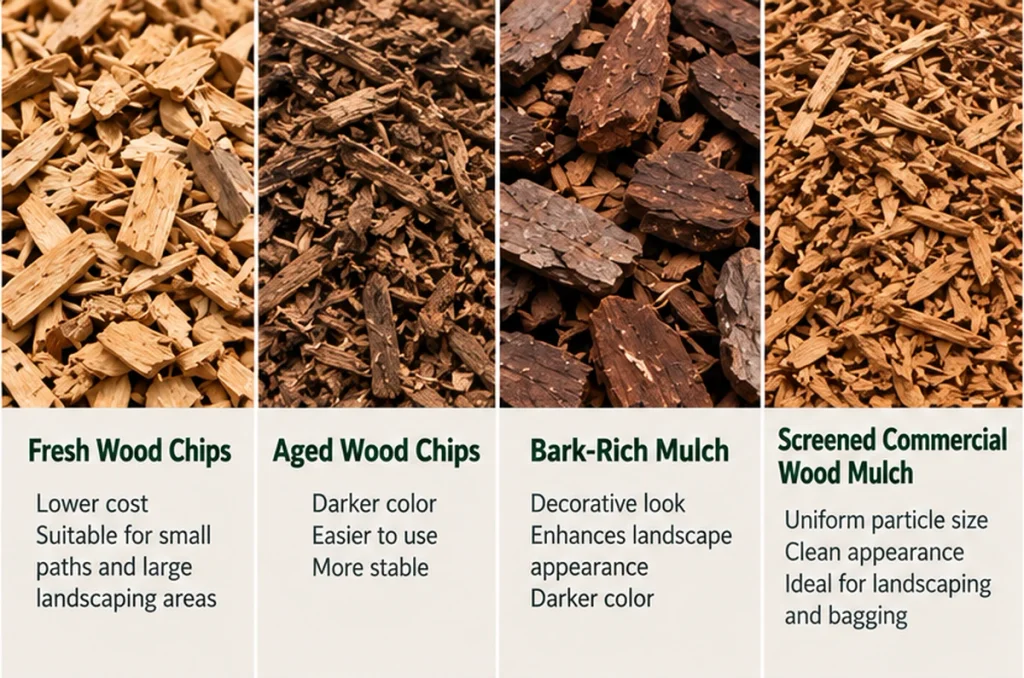
For commercial buyers, “screened” should not be the end of the question. Ask for the target size range, allowable fines, maximum oversize and whether the supplier uses clean or recycled wood.
What Are the Benefits of Wood Chip Mulch?
Wood chip mulch is popular because one material can perform several jobs.
It reduces moisture loss
A suitable mulch layer limits direct evaporation from the soil surface. This can reduce watering demand and help maintain a more stable root environment. The benefit is especially useful around established trees and shrubs.
Mulch is not a substitute for checking the soil. A thick layer can hide dry soil, but it can also keep poorly drained soil too wet. Move a small section aside and inspect the soil before watering.
It suppresses weeds
Wood chip mulch blocks light from reaching many weed seeds. A sufficiently deep, continuous layer usually works better than a thin decorative scattering. Existing perennial weeds should be removed before application because mulch is more effective at preventing new growth than eliminating established roots.
It moderates soil temperature
Bare soil heats and cools quickly. Wood chips create a buffer between the soil and the weather. This helps reduce extreme surface temperatures and protects the soil from direct rain impact.
It protects soil structure
Rain, foot traffic and equipment can compact or erode exposed soil. Wood chips provide a sacrificial surface layer. On paths, they also create a more comfortable walking surface and reduce mud.
It contributes organic matter
Wood chips decompose slowly at the soil surface. Over time, fungi and other soil organisms convert part of the material into organic matter. This is a gradual process, not a quick fertilizer treatment.
Where Does Wood Chip Mulch Work Best?
Wood chips are not the best answer for every area.
| Application | Suitability | Practical advice |
|---|---|---|
| Established trees and shrubs | Very good | Keep mulch away from trunks and root collars. |
| Landscape beds | Good | Use clean, reasonably uniform chips for a better finish. |
| Garden paths | Very good | Coarser chips normally provide better drainage and longer wear. |
| Slopes and erosion-prone soil | Good with limits | Check whether chips will move during heavy rain or wind. |
| Vegetable beds | Conditional | Keep coarse wood on the surface; avoid mixing fresh chips into the soil. |
| Seed beds and annual flowers | Limited | Large chips can interfere with planting and cultivation. |
| Play areas | Specialized product required | Use material produced and tested for playground surfacing requirements. |
| Near buildings in fire-prone areas | Use caution | Follow local fire-safety and defensible-space guidance. |
If the main goal is rapid nutrient addition, compost or another fine organic mulch may be more suitable. If the goal is durable ground coverage, a coarser wood chip product is often the more practical choice.
How Deep Should Wood Chip Mulch Be?
There is no single depth for every site. Soil type, climate, chip size and existing weeds all matter. As a practical starting point:
- use approximately 5–8 cm for maintained landscape beds;
- use approximately 8–10 cm for many tree, shrub and pathway applications;
- use a deeper initial layer only where site conditions justify it and plant crowns will remain clear.
Do not create a “mulch volcano” around a tree. Pull the chips back from the trunk so the root flare remains visible. Also avoid burying irrigation emitters without marking their positions.
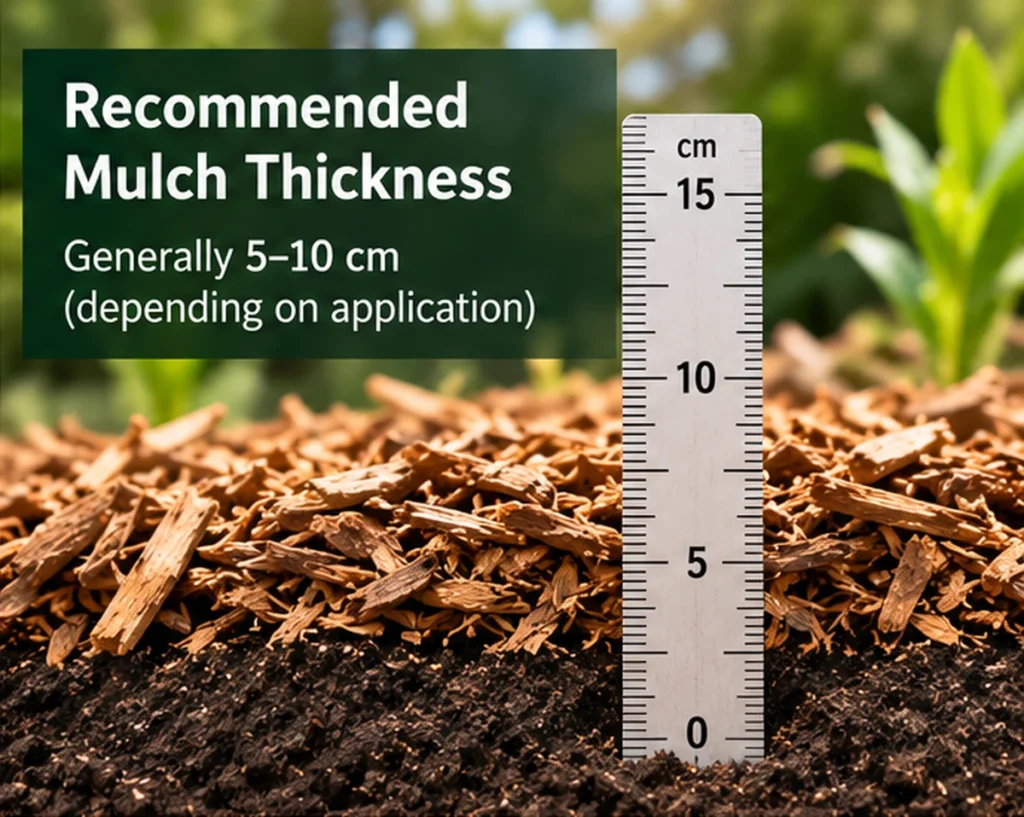
Before adding new material, measure what remains. Repeatedly adding a fresh layer without checking the old layer can create excessive depth and poor air movement.
Does Wood Chip Mulch Tie Up Nitrogen?
This question causes unnecessary confusion. Microorganisms use nitrogen while decomposing woody material, but the most important distinction is where the chips are placed.
Wood chips used on the soil surface mainly affect the narrow interface between the mulch and soil. This does not mean they remove all nitrogen from the plant root zone. Problems are more likely when large amounts of fresh, high-carbon material are mixed into the soil.
The practical advice is simple: use wood chips as a surface mulch, not as a substitute for compost incorporated into a planting bed. If a plant shows nutrient stress, diagnose the soil and irrigation conditions instead of assuming the mulch is the only cause.
Possible Problems and How to Avoid Them
Unknown or contaminated feedstock
Avoid chips made from painted, pressure-treated or chemically contaminated wood. Commercial producers should control incoming feedstock and remove metal, stone and other foreign material before finishing the product.
Excess moisture around trunks
Mulch piled against a trunk or stem can hold moisture where it is not wanted. Keep the root collar open and inspect it regularly.
Fungi and insects
Fungal growth is a normal part of wood decomposition. Most visible fungi in mulch are decomposers, although mushrooms should not be eaten. Wood chips can also provide shelter for insects and slugs. Good placement and routine inspection are more useful than assuming every organism is harmful.
Fire risk
Dry organic mulch can burn. Keep ignition sources away, follow local regulations and use noncombustible material where defensible-space rules require it. Fine, dry material usually presents a different risk profile from larger, moist chips.
Dust and rapid decomposition
A high percentage of sawdust and fines can create dust during handling and reduce the useful life of the surface layer. This is primarily a product-quality problem, and screening is the direct way to control it.
What Makes a High-Quality Commercial Wood Chip Mulch?
Appearance is important, but it is not the only quality measure. A commercial mulch producer should define the product before choosing equipment.
Start with five questions:
- What wood sources are accepted?
- What finished particle-size range is required?
- How much fine material is acceptable?
- What is the maximum permitted oversize?
- Which contaminants must be removed upstream?
A uniform product spreads more predictably, photographs better, fills bags more consistently and gives the buyer a clearer idea of what will arrive. It also allows the producer to separate different saleable fractions instead of treating every output as one mixed pile.
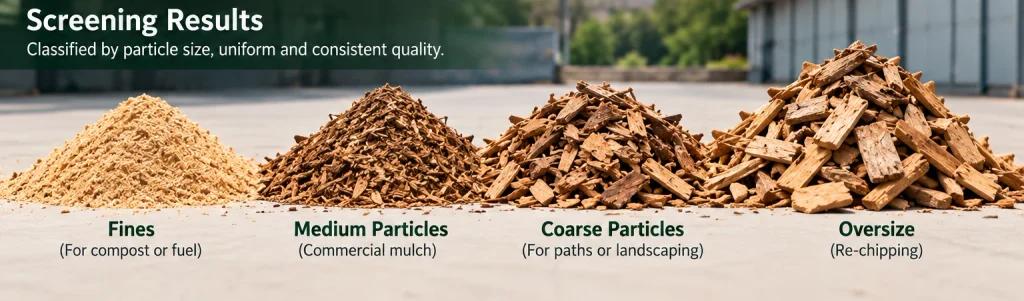
For example, a coarse fraction may be suitable for paths or landscape coverage. A controlled middle fraction may become the main commercial mulch product. Fine material may be directed to composting, fuel or another process when its cleanliness and specification allow it.
The exact sizes should be based on the target market. A universal “best mulch size” does not exist.
How Screening Improves Wood Chip Mulch
A chipper makes wood smaller, but it does not make every piece the same size. This is the point we often need to explain to customers. Chipping and screening are two different jobs. The chipper cuts the wood. The screen separates the mixed output into the sizes you need.
In a typical process:
- clean wood enters the chipper;
- a conveyor delivers the mixed output to the screen;
- fines pass through the smaller openings;
- the desired fraction is collected as finished material;
- oversize leaves from a separate outlet and may be rechipped.
The screen must match the real material. Moisture, bulk density, chip shape, required capacity and target cuts all affect the result. Long, flat chips behave differently from round granules, so equipment selection based only on nominal opening size is risky.
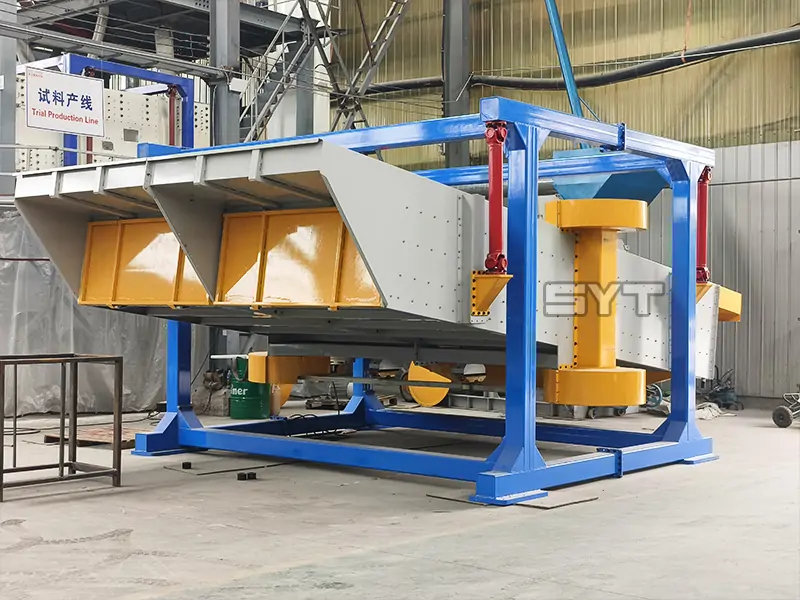
Sanyuantang manufactures an oscillating wood chip screener for wood chips, sawdust, mulch and biomass feedstock. The current FYBS-4060 specification supports 1–5 screening layers, 5–55 mm screening sizes and a stated capacity range of 600–1000 m³/h. Actual capacity depends on the material and separation requirement, so it should be confirmed through a material test rather than copied directly into a production plan.
Our advice is simple: do not choose a screen only from the capacity number. First show us the real material and tell us which sizes you want to keep. A short screening test can answer more questions than a long specification sheet.
A Practical Buying Checklist
Whether you are purchasing mulch or producing it, check:
- wood source and contamination controls;
- fresh, aged or composted condition;
- screened or unscreened specification;
- target and maximum particle size;
- amount of sawdust and fines;
- moisture condition;
- intended application;
- delivery volume and storage requirements;
- fire and environmental rules at the destination.
The right wood chip mulch is the one that fits the application. Garden owners need safe placement and reliable coverage. Commercial producers also need repeatable size, clean feedstock and a process that turns off-spec material into useful fractions.
Frequently Asked Questions
Is wood chip mulch good for gardens?
Yes, especially around established trees, shrubs and permanent paths. In vegetable or annual beds, keep coarse chips on the surface and consider whether they will interfere with frequent cultivation.
Can fresh wood chips be used as mulch?
They can be used on the soil surface when the feedstock is clean. Avoid mixing large quantities into the soil, and keep fresh piles away from trunks and structures.
Does wood chip mulch attract termites?
Wood mulch can provide a moist habitat, but it is not automatically a termite infestation. Keep it away from building foundations where local guidance requires and inspect the area regularly.
How long does wood chip mulch last?
It depends on chip size, wood species, moisture, climate and traffic. Coarser chips generally remain visible longer than fine material. Inspect the existing depth before topping it up.
Why should commercial mulch be screened?
Screening controls fines and oversize, improves visual consistency and creates separate product fractions. It also helps protect downstream equipment when screening is combined with suitable contamination controls.
Tell Sanyuantang What You Need to Screen
If you produce wood chip mulch, you do not need to prepare a complicated technical document. Send Sanyuantang four things: photos or a video of the raw material, the smallest and largest chip size, the sizes you want after screening, and the required capacity per hour.

We will check whether the material is dry or wet, whether it contains long pieces, and how many finished grades are needed. Then we can recommend the screen layers, screen openings and conveying arrangement. If necessary, you can send material to our factory for a test and see the screening result by video before choosing the machine.
Contact Sanyuantang to discuss your wood chip screening requirement.
Email: info@sanyuantang.com
Phone: +86-18639095165