
Fine powder does not automatically mean you need an ultrasonic sieve.
We see this misunderstanding quite often. A customer may tell us that the material needs to pass 200 mesh, 300 mesh or even finer, and assume that ultrasonic screening must be the next step. Sometimes it is. In other applications, a standard rotary vibrating screen can handle the material without serious mesh blockage.
 Vibratory Screen Separator
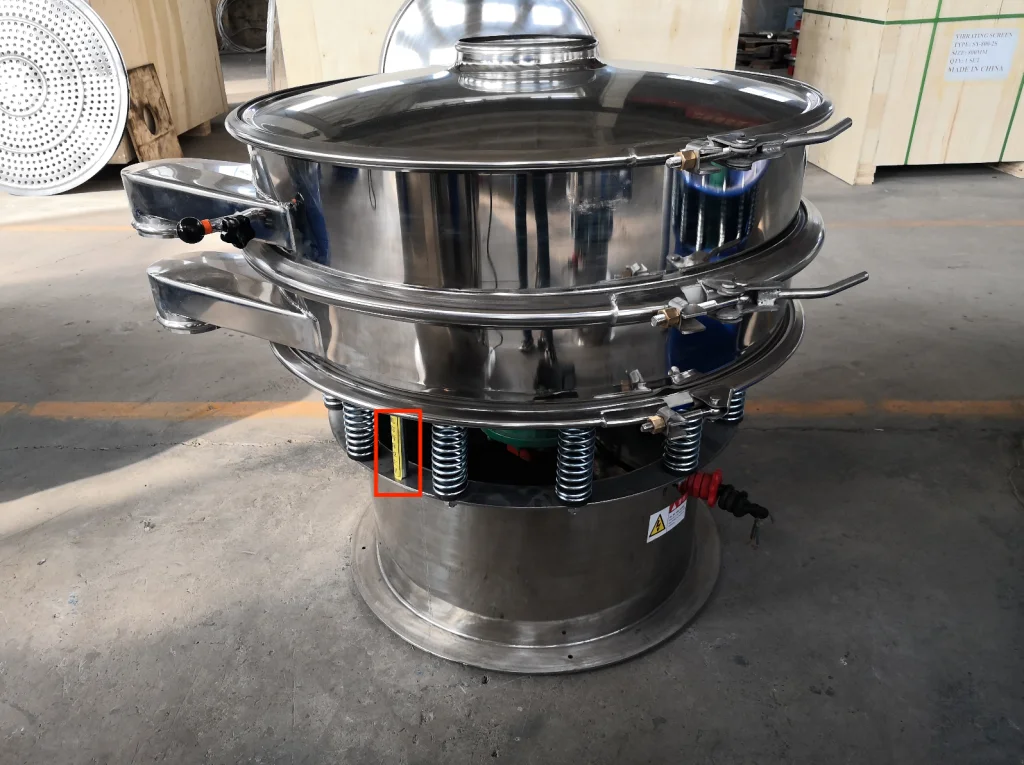
 Rotary Vibrating Screen
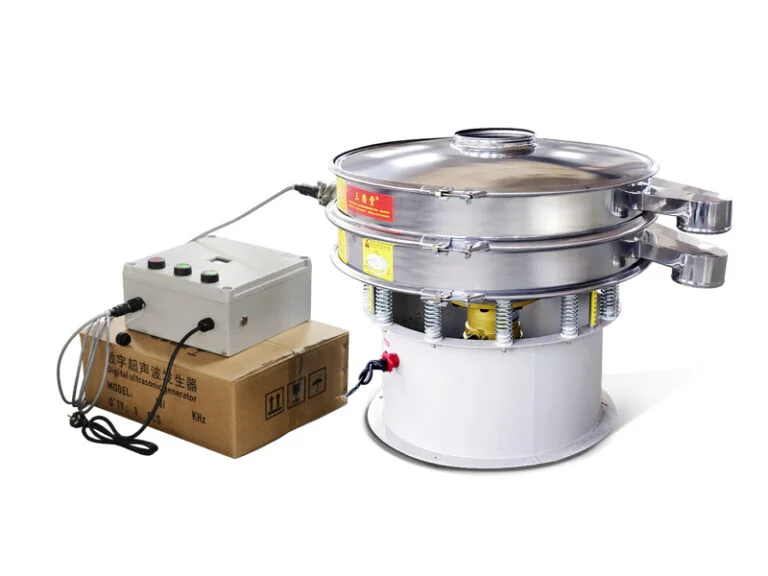

What matters is what the powder actually does on the screen. A dry, free-flowing mineral powder may continue passing through relatively fine mesh without much difficulty. Another material at a coarser mesh may start sticking to the screen, building static charge or forming soft agglomerates after only a short period of operation.
Particle-size distribution, moisture, bulk density, adhesion, static electricity and feeding conditions all affect the result. For this reason, mesh number should be treated as one part of the selection process rather than the whole answer.
Ultrasonic sieves become useful when the screen surface itself starts becoming the bottleneck. The additional ultrasonic vibration helps keep fine particles active around the mesh openings, reducing some of the adhesion, wedging and blinding that can make conventional fine powder screening unstable.
The practical question is therefore not simply, “How fine is my powder?” It is whether your existing screening method can maintain stable operation under actual production conditions.
What Does an Ultrasonic Sieve Actually Do?
An ultrasonic sieve is still a vibrating screening machine. The main vibration motor moves the material across the screen surface, allowing particles smaller than the openings to pass through while larger material is retained or discharged.
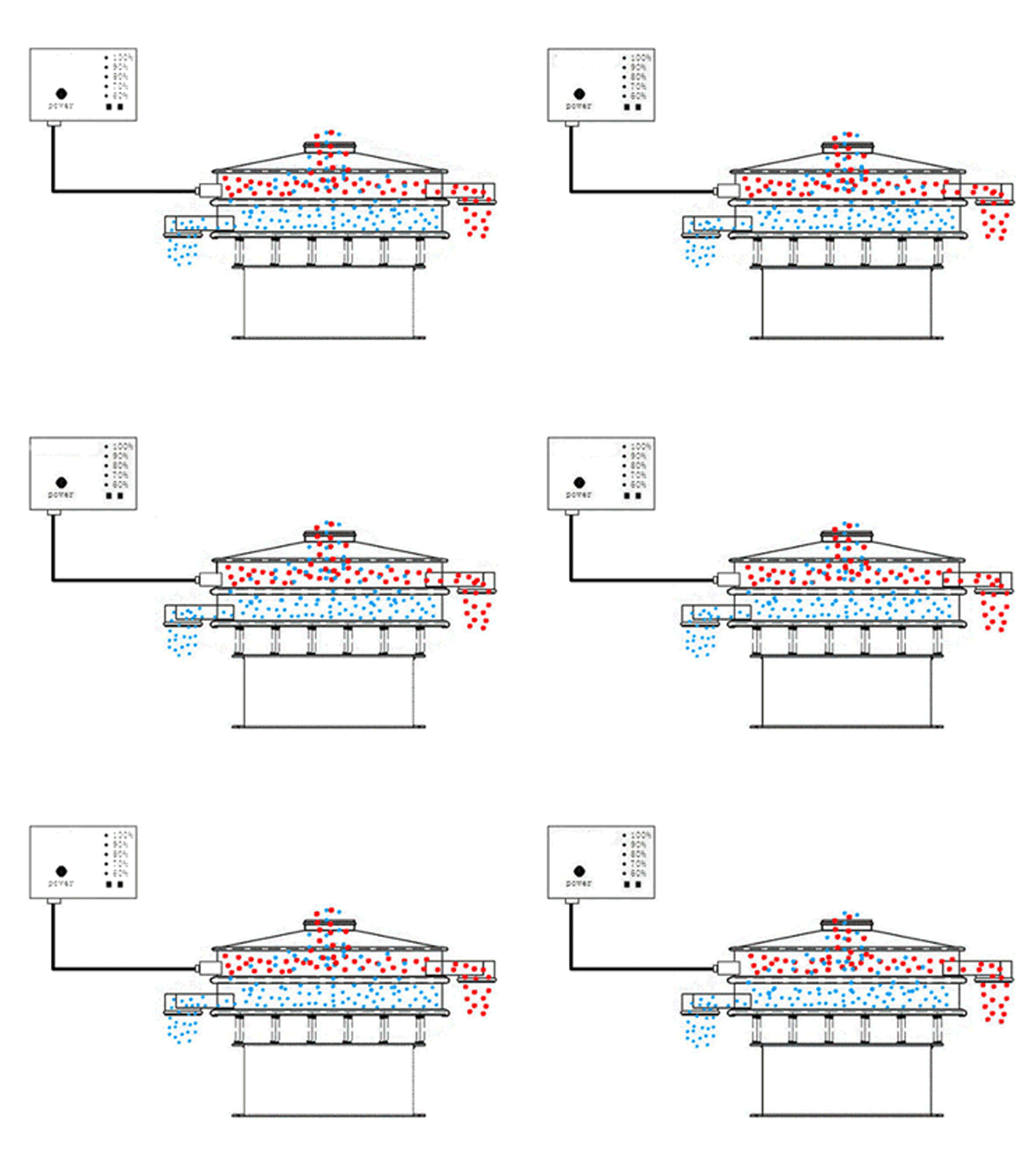
The ultrasonic system performs a different job.
A transducer introduces high-frequency, low-amplitude vibration to the screen mesh. Instead of relying only on the movement of the whole screening machine, the mesh itself receives additional vibration that helps fine particles remain active around the openings.
This becomes useful when powder tends to sit on the mesh rather than pass through it.
Typical problems include persistent mesh blinding, electrostatic adhesion, soft agglomeration and fine particles lodging in the openings. Operators may notice that the machine performs well when it first starts, but capacity gradually falls as more of the screen area becomes blocked.
Frequent manual cleaning is another warning sign. If production has to stop several times per shift just to brush or clean the mesh, the screen-cleaning method may no longer be suitable for the material.
One distinction is worth keeping clear: ultrasonic vibration is not simply “more powerful vibration.”
The main vibration moves the material through the machine. The ultrasonic system mainly changes what happens directly at the screen surface.
When Does Ultrasonic Sieving Become Worth Considering?
There is no single mesh number where a standard vibrating sieve suddenly stops working.
In practice, we pay more attention to screening stability. If the powder flows well, the mesh remains reasonably open and throughput stays close to the required production rate, there may be little reason to add an ultrasonic system.
The situation changes when performance deteriorates during continuous operation.
Imagine a screen that processes the material normally for the first 15 or 20 minutes. Fine particles then begin accumulating around the openings, less screen area remains available, and throughput falls. Eventually, an operator has to stop the machine and clean the mesh.
That is a more meaningful reason to investigate ultrasonic sieving than the mesh number alone.
| Screening Condition | Standard Vibrating Sieve | Ultrasonic Sieve |
|---|---|---|
| Dry, free-flowing powder and open mesh | Usually suitable | Often unnecessary |
| Fine powder gradually blinds the mesh | May become unstable | Worth considering |
| Strong static adhesion | Can be difficult | Common ultrasonic application |
| Soft agglomeration on the screen | Depends on material | May improve screening stability |
| Frequent manual mesh cleaning | Production interruptions likely | May reduce blinding-related cleaning |
| Stable capacity already achieved | Usually sufficient | Little reason to upgrade only for mesh size |
| Powder behavior is difficult to predict | Selection may be uncertain | Material testing can help |
Not every particle sitting on the screen means there is a problem. Some retained material is normal.
The issue is whether blockage keeps increasing until it begins to affect capacity, separation quality or continuous production.
When Is a Standard Vibrating Sieve Enough?
Ultrasonic equipment adds another system to the machine, along with additional electrical components and controls. If you do not need it, there is little benefit in adding complexity simply because ultrasonic screening sounds more advanced.
A standard rotary vibrating screen may already be suitable when the material is dry and free flowing, does not create serious static buildup, and can maintain an open screen surface during production. Conventional cleaning systems can also work well for many powders.
Capacity matters here too.
If a customer needs 100 kg/h and a standard vibrating sieve can continuously deliver that output without persistent blockage, then the process is already doing what it needs to do.
The better machine is not necessarily the one with more features. It is the one that meets the required separation and capacity with a stable, practical configuration.
This is why we avoid using a simple rule such as:
fine mesh = ultrasonic sieve
Real materials do not behave that neatly.
Why Mesh Size Alone Is Not Enough
Suppose two customers both need to screen material through 200 mesh.
One material is a dry mineral powder with good flowability. The second is lightweight, carries static charge and sticks to almost every surface it touches.
The opening size is the same. The screening difficulty is completely different.
Several material and process parameters can change the result:
| Parameter | Why It Matters |
|---|---|
| Particle-size distribution | A high percentage of near-size particles can increase mesh blockage |
| Particle shape | Irregular particles may wedge differently in the openings |
| Bulk density | Lightweight and dense powders load the screen differently |
| Moisture | Can increase adhesion and agglomeration |
| Oil content | Natural or process-related oils may make powder more adhesive |
| Static charge | Fine particles can stick to the screen or to each other |
| Agglomeration | Fine particles may form larger soft clusters |
| Feed rate | Excessive loading reduces the available screening area |
| Required capacity | A process stable at low throughput may change at higher feed rates |
| Screening purpose | Safety screening and accurate classification have different requirements |
This is also why statements such as “anything finer than 200 mesh requires ultrasonic screening” are not very useful during equipment selection.
Mesh tells us the opening size. It does not tell us how the material will behave when it reaches that opening.
A 150-Mesh Powder Can Sometimes Be Harder Than a 200-Mesh Powder
Actual screening applications make this easier to understand.
Matcha powder is a good example. The required screening size in one Sanyuantang project was 60 mesh and 150 mesh, which does not sound especially fine compared with many metal or mineral powders.
But matcha has its own screening behavior. Fine green tea powder can be adhesive and may accumulate on the screen during operation. In that project, the material was tested before the final ultrasonic sieve configuration was confirmed.
Now compare that with a dry, free-flowing powder.
A material at 200 mesh can sometimes be easier to process if it flows well and the screen-cleaning system is sufficient. That is why simply comparing 150 mesh with 200 mesh does not tell us which application is more difficult.
The material matters just as much as the opening size.
Very Fine Copper Powder Brings a Different Screening Problem
Fine metal powder presents another set of challenges.
In a Sanyuantang copper powder project, the customer needed 500-mesh and 800-mesh classification. During conventional screening, fine powder adhesion and mesh blockage affected continuous operation, and manual screen cleaning became part of the production problem.
The final configuration used ultrasonic assistance on the fine screens to help reduce powder adhesion and maintain a more stable screening condition.
This does not mean every 500-mesh or 800-mesh powder should use exactly the same machine.
Copper powder, graphite, ceramic materials and chemical powders may all behave differently at similar particle sizes. The application still has to be evaluated from the material and process requirements.
Not Sure Whether Your Powder Really Needs Ultrasonic Screening?
If your current screen is losing capacity, blocking repeatedly or requiring frequent cleaning, send us the material name, target mesh, required capacity and a description of what is happening during screening.
If available, also include bulk density, moisture, photos or a short operating video.
Sanyuantang can first review whether a standard vibrating sieve is likely to be sufficient, whether ultrasonic assistance is worth considering, or whether the material should be tested before the machine configuration is selected.
Email: info@sanyuantang.com
Phone: +86-18639095165
Ultrasonic Sieve vs Standard Vibrating Sieve
There is no useful reason to describe an ultrasonic sieve as simply “better” than a normal vibrating screen.
For an easy-flowing powder, the standard machine may be the more practical choice. Ultrasonic sieving becomes valuable when material behavior makes conventional screening unstable.
| Item | Standard Vibrating Sieve | Ultrasonic Sieve |
|---|---|---|
| Main material movement | Mechanical vibration | Mechanical vibration |
| Additional mesh vibration | No | Yes |
| General powder screening | Suitable | Suitable but may be unnecessary |
| Persistent fine-mesh blinding | Depends on material | Better suited |
| Static-prone powders | Can be difficult | Common application |
| Agglomerated fine powders | Depends on severity | May help keep the mesh active |
| Equipment complexity | Lower | Higher |
| Screen cleaning | Conventional cleaning methods | Ultrasonic mesh deblinding |
| Selection basis | Material, mesh and capacity | Material, mesh, capacity and powder behavior |
The important difference is not whether the machine is more advanced.
It is whether additional mesh deblinding is necessary to keep production stable.
 ultrasonic sieve
 vibration screen
What Ultrasonic Screening Cannot Fix by Itself
If a screen continues blocking, it is tempting to assume that the ultrasonic system needs more power.
Sometimes the problem is somewhere else.
Overfeeding is a common example. If material enters the machine faster than the available screen area can process it, powder will accumulate on the surface. Ultrasonic vibration cannot create additional screening area.
Feed rate may need to be reduced or distributed more evenly.
Mesh condition should also be checked. Poor tension affects vibration transmission, while damaged or incorrectly installed mesh can reduce screening performance even when the ultrasonic system itself is operating normally.
Moisture creates another type of problem. Slight adhesion and severe wet caking are not the same thing. Ultrasonic assistance may help one material while providing limited benefit when a product is heavily wet or forming hard lumps.
Static problems also need to be considered together with grounding and the wider production environment.
For very fine metal powder applications, screen tension, stable feeding and grounding can all influence the final result. In other words, ultrasonic vibration is part of the screening system, not a universal cure for every blocked mesh.
What Information Should Be Checked Before Selecting an Ultrasonic Sieve?
A material name and mesh number are useful starting points, but they are rarely enough for a reliable equipment recommendation.
We normally want to understand what is being screened, what needs to pass through the mesh, how much material must be processed, and what is currently going wrong.
Material and Feed Particle Size
The material name gives an initial indication of likely flowability, adhesion and handling behavior.
Maximum feed size matters as well. If large particles, agglomerates or foreign material enter the machine, they can change the load on the screen and the required machine structure.
Target Mesh or Cut Size
If more than one fraction is required, provide each target cut.
There is a large difference between removing a small amount of oversize contamination and accurately separating several fine powder fractions.
Required Capacity
Capacity should be given in a clear production unit such as kg/h or t/h.
Avoid descriptions such as “high capacity.” A screening process that works at 30 kg/h may behave differently at 300 kg/h because screen loading changes with feed rate.
Bulk Density
Bulk density is often overlooked when customers ask about machine capacity.
Two powders can occupy the same volume but have very different weights. That means a capacity figure from one material cannot simply be transferred to another material because the mesh and machine diameter happen to be the same.
Moisture, Oil and Static Behavior
If the powder is slightly damp, naturally oily, static-prone or easy to agglomerate, tell the equipment manufacturer.
These details often explain why a material is difficult to screen.
What Is Happening on Your Existing Screen?
If you already use a vibrating sieve, describe the actual problem.
For example:
- throughput drops after 20 minutes;
- powder sticks underneath the mesh;
- operators clean the screen several times per shift;
- fine powder remains with the oversize;
- material forms small agglomerates on the screen;
- the machine works at low feed rates but blocks when production increases.
This gives an engineer something specific to evaluate.
“Material is difficult to screen” does not.
When Is a Material Test Worth Doing?
Not every project needs a test.
If the material is common, the screening requirement is straightforward and there is enough previous application experience, equipment selection may be possible from the process information alone.
Testing becomes more valuable when the material is very fine, static-prone, strongly adhesive, expensive or difficult to describe from a specification sheet. It is also useful when a customer has already tried another screening machine without getting a stable result.
A good material test should answer more than:
Can this powder pass through the mesh?
We also want to see whether the mesh gradually blinds, whether throughput remains stable, how much material stays on the screen, and whether the selected deblinding method continues working as the test progresses.
For difficult powders, these observations can tell us more than another catalog capacity figure.
How Sanyuantang Approaches Ultrasonic Sieve Selection
We normally start with the material and screening problem rather than immediately selecting a machine model.
The basic logic is straightforward:
Material → Required separation → Capacity → Screening problem → Machine configuration
If a normal rotary vibrating screen can meet the requirement reliably, there may be no need to complicate the process.
When adhesion, static charge, agglomeration or persistent mesh blinding prevents stable production, an ultrasonic vibrating sieve becomes a more reasonable direction.
For uncertain applications, actual testing can be used before the final machine configuration is confirmed.
Capacity also has to be treated carefully. The same ultrasonic sieve can produce very different throughput when the powder, mesh, bulk density and feed condition change. This is why machine diameter and mesh number alone should never be used as a guaranteed production-capacity calculation.
FAQ
What is an ultrasonic sieve?
An ultrasonic sieve is a vibrating screening machine with an additional ultrasonic system connected to the screen mesh. The ultrasonic vibration helps reduce fine-powder adhesion, particle wedging and mesh blinding while the main vibration system continues moving material through the machine.
Do all fine powders need ultrasonic screening?
No. Many dry, free-flowing powders can still be processed effectively with a standard rotary vibrating sieve. Ultrasonic assistance becomes more useful when the mesh repeatedly blinds, static adhesion becomes serious or conventional screen-cleaning methods cannot maintain stable screening.
At what mesh size should ultrasonic sieving be used?
There is no universal mesh limit. A coarser but sticky powder can sometimes be more difficult to screen than a finer free-flowing material. Mesh size should be considered together with particle distribution, moisture, static behavior, agglomeration, feed rate and required capacity.
Can an ultrasonic sieve completely eliminate mesh clogging?
No. Ultrasonic vibration can reduce several types of fine-powder blinding, but excessive feeding, damaged mesh, poor screen tension, severe moisture or incorrect mesh selection still need to be corrected separately. The actual cause of the blockage should be identified first.
What types of powder are commonly screened with ultrasonic sieves?
Typical applications include fine metal powders, pigments, minerals, chemical powders and some food powders. The important factor is usually the material behavior—such as adhesion, static electricity, agglomeration or persistent mesh blinding—rather than the industry name itself.
What information should I provide for machine selection?
Provide the material name, feed particle size, target mesh, required capacity, bulk density, moisture, number of fractions and required contact material. If a screening problem already exists, photos, videos or a material sample can help the manufacturer understand what is happening.
Choosing the Right Screening Method
Choosing between a standard vibrating sieve and an ultrasonic sieve should begin with the material and actual production condition, not only the mesh number.
If the powder flows well, the screen remains open and the required capacity is stable, a conventional vibrating sieve may already be the correct machine.
When production is repeatedly affected by mesh blinding, static adhesion, agglomeration or unstable fine-powder flow, ultrasonic screening becomes much more relevant.
For difficult applications, testing the actual material can often provide better information than relying on a general specification table.
Need a Screening Recommendation for Your Material?
Send Sanyuantang the following information:
- Material name
- Feed particle size
- Required mesh or cut size
- Required capacity
- Bulk density
- Moisture or oil content
- Number of required fractions
- Current mesh-blocking or screening problem
If you have photos, videos or a material sample, include them as well. For difficult powders, we can evaluate whether a standard vibrating sieve is already sufficient, whether ultrasonic screening is more suitable, or whether material testing should be carried out before equipment selection.
Email: info@sanyuantang.com
Phone: +86-18639095165