
Chemical powders are not difficult to screen simply because they belong to the chemical industry. The real difficulty comes from the material itself.
A free-flowing resin granule may pass through a conventional vibratory screen without much trouble. A fine pigment at a similar production rate may behave completely differently because of static electricity, agglomeration or adhesion to the screen surface.
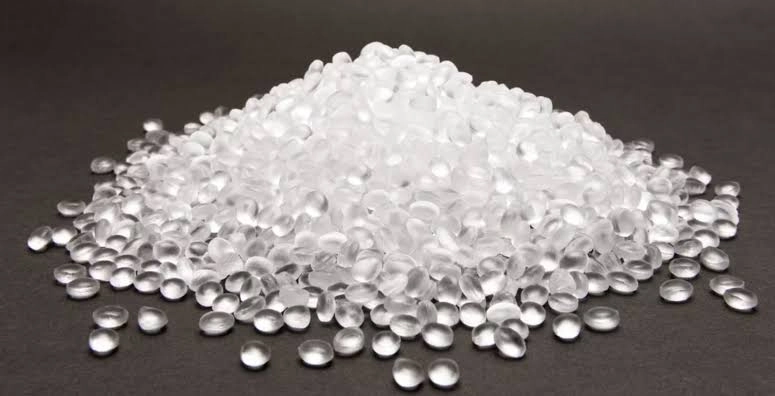
 Resin pellets
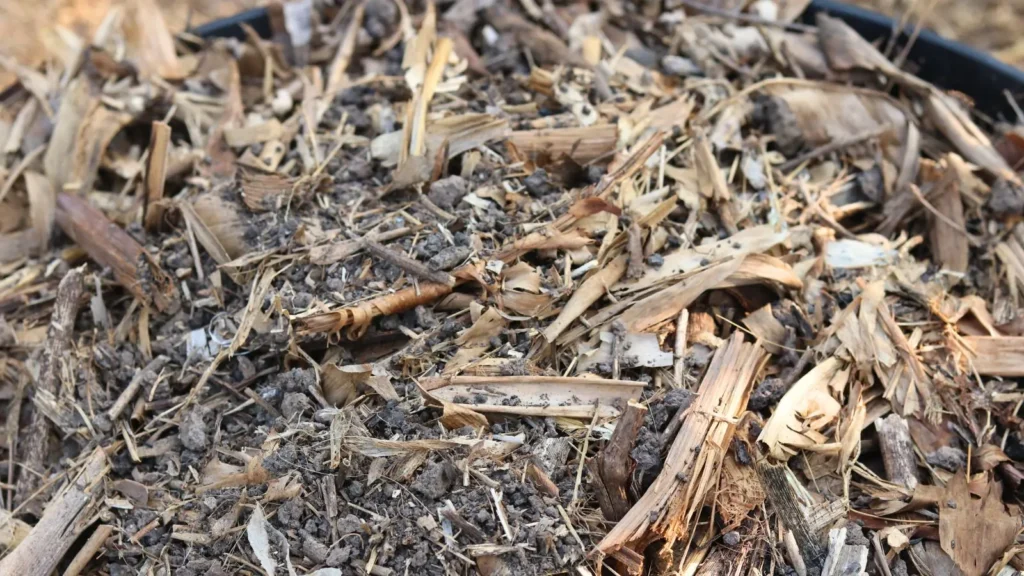
 Fine Pigments

This is why selecting industrial sifters for chemical industry applications should start with the material and the screening task, not with a machine model.
Industrial sifters are commonly used to remove oversized contamination, separate materials into controlled particle-size fractions, loosen agglomerated powder, and protect downstream processes. The correct equipment depends on what needs to be separated and how the material behaves during screening.
At Sanyuantang, chemical screening applications include materials such as resin, pigments, carbon black, activated carbon, polyethylene powder, PVC, PP, and powder coating. Different materials may require very different screening configurations.
Start With the Screening Task, Not the Sifter
Before comparing machines, define what the screen actually needs to do. This is one of the first questions we normally ask because two customers processing similar chemical powders may still need completely different equipment.
Check screening
Check screening removes unwanted oversized material before the product enters another production stage or before final packing. The purpose is not necessarily to create several accurate particle-size fractions. The screen acts as a quality-control step to remove contamination, large particles or agglomerates.
This type of application normally favors simple material flow, reliable discharge, and adequate throughput.
Particle classification
Classification is different. Here, particle size itself is part of the product specification. The material may need to be separated into two or more fractions.
This usually requires more attention to:
- cut size
- particle-size distribution
- number of fractions
- screen loading
- residence time
- required throughput
A multi-deck vibrating separator may be considered when several size fractions are required.
De-agglomeration
Some chemical powders form loose lumps during storage, conveying or mixing.
A screening stage can remove or loosen these agglomerates before downstream processing. However, screening should not automatically be treated as a substitute for milling.
If the particles are firmly bonded rather than loosely agglomerated, another size-reduction process may be required.
Fine powder screening
Fine powders introduce another set of problems.
As the openings become smaller, particles are more likely to remain on the screen surface, especially when the powder is adhesive, electrostatic or prone to agglomeration.
In these applications, simply installing a finer mesh may reduce throughput without solving the actual problem. That is when screen-cleaning or ultrasonic assistance becomes worth evaluating.
Which Industrial Sifter Fits the Screening Problem?
There is no single chemical powder sifter that is suitable for every material.
A useful first selection can be made by matching the screening problem to the equipment direction.
| Screening Requirement | Typical Condition | Equipment Direction |
|---|---|---|
| Remove oversize or contamination | Free-flowing powder or granules | Standard vibratory sifter |
| Separate several particle sizes | Two or more required fractions | Multi-deck vibrating separator |
| Fine powder repeatedly blinds the mesh | Adhesion, static or agglomeration | Ultrasonic vibrating screen |
| Difficult fine/light powder | Poor flow or difficult conventional screening | Evaluate airflow sifter |
| Fast impurity removal in a process line | Simple check screening | Evaluate inline/direct-discharge sifter |
| Unknown or difficult material | Screening result uncertain | Material test before final selection |
The table is a starting point, not a machine-sizing chart.
Actual selection still depends on the powder and production conditions.
When Is a Standard Vibratory Sifter Enough?
A conventional vibratory sifter should normally be considered before moving to a more complex screening system.
Sanyuantang’s vibrating screen separator is a circular rotary vibrating screen used for dry powders, granular materials, wet materials and liquids. The current product range supports single- or multi-deck configurations and lists chemical applications including resin, coatings and paint-related materials.
For a chemical powder that flows reasonably well and does not continuously blind the mesh, a standard vibratory screen may be enough for:
- impurity removal
- oversize control
- powder classification
- simple grading
- several particle-size fractions
The important point is not to assume that more technology automatically gives a better screening result.
If the required cut can be maintained at the required production rate without excessive screen blocking, adding an ultrasonic system may add cost and complexity without solving a real problem.
When Should You Consider an Ultrasonic Sifter?
Ultrasonic screening becomes more relevant when the screen surface itself is limiting the process.
Typical warning signs include:
- fine particles repeatedly blocking the apertures
- powder adhering to the screen
- strong static electricity
- material forming loose agglomerates
- poor passage through a fine mesh even when feed rate is controlled
Sanyuantang’s ultrasonic vibrating screen is based on a conventional round vibratory screen with an ultrasonic system added to the screen surface. Its product documentation specifically positions the system for fine powders affected by problems such as adhesion, agglomeration, static electricity and mesh blockage.
Sanyuantang’s existing pigment screening guidance follows the same selection logic: the mesh number alone is not enough. Feed particle distribution, required cut size, capacity, flowability and powder behavior must also be checked before deciding whether ultrasonic screening is necessary.
This matters because “200 mesh” or “500 mesh” describes only one part of the application.
When Does an Airflow Sifter Make More Sense?
Another option for difficult fine powders is a rotary airflow sifter.
Unlike a conventional flat vibratory screen, this type of equipment uses airflow and centrifugal action inside a cylindrical screen.
Sanyuantang positions its rotary airflow sifter for fine powders and materials that may have low specific gravity, static electricity, high viscosity or a tendency to agglomerate. The machine is also listed for chemical-industry applications.
That does not mean an airflow sifter should replace every ultrasonic or vibratory screen.
The choice depends on the complete process.
For example, an engineer should still confirm:
- required particle cut
- feed particle distribution
- throughput
- powder flowability
- upstream feeding method
- downstream conveying method
- installation arrangement
For an unfamiliar powder, a material trial is more useful than selecting equipment only from a catalog mesh range.
Why Mesh Size Alone Cannot Determine the Machine
One of the most common screening inquiries sounds simple:
“I need to screen this chemical powder at 100 mesh. Which machine should I use?”
The mesh is necessary, but it is not enough.
Imagine two powders that both need to pass the same screen opening.
Powder A is dense, dry and free-flowing.
Powder B is light, slightly adhesive and contains a large proportion of particles close to the required cut size.
Even though both use the same nominal mesh, Powder B may remain on the screen much longer and create a much higher screen load.
This is why theoretical capacity should not automatically be treated as actual production capacity.
The percentage of material close to the cut point can be particularly important. If most of the feed is already much finer than the opening, it may pass relatively easily. If a large proportion sits close to the opening size, separation becomes more demanding.
Material Properties That Change Sifter Selection
For chemical screening, these parameters should be considered together.
| Material Parameter | Why It Matters |
|---|---|
| Required cut size | Determines the basic separation target |
| Feed particle distribution | Shows how much material is close to the cut size |
| Bulk density | Influences screen loading and throughput |
| Flowability | Affects how material spreads and moves |
| Moisture | May increase adhesion and agglomeration |
| Static electricity | Can cause fine particles to cling to surfaces |
| Agglomeration | May create apparent oversize or block the screen |
| Particle shape | Influences the probability of passing an aperture |
| Chemical composition | Affects contact-material selection |
| Temperature | Can affect material behavior and equipment compatibility |
| Required capacity | Influences screen area and machine configuration |
This is also why actual material testing becomes important for difficult applications.
A test can answer questions that a specification sheet cannot.
How Should Contact Material Be Selected?
Chemical screening adds another requirement that is less important in many ordinary dry-powder applications: material compatibility. Do not select stainless steel, carbon steel or polymer construction simply because a material is described as a “chemical.”
The actual decision should consider:
- chemical composition
- concentration
- operating temperature
- moisture or liquid content
- contact time
- cleaning chemicals
- process environment
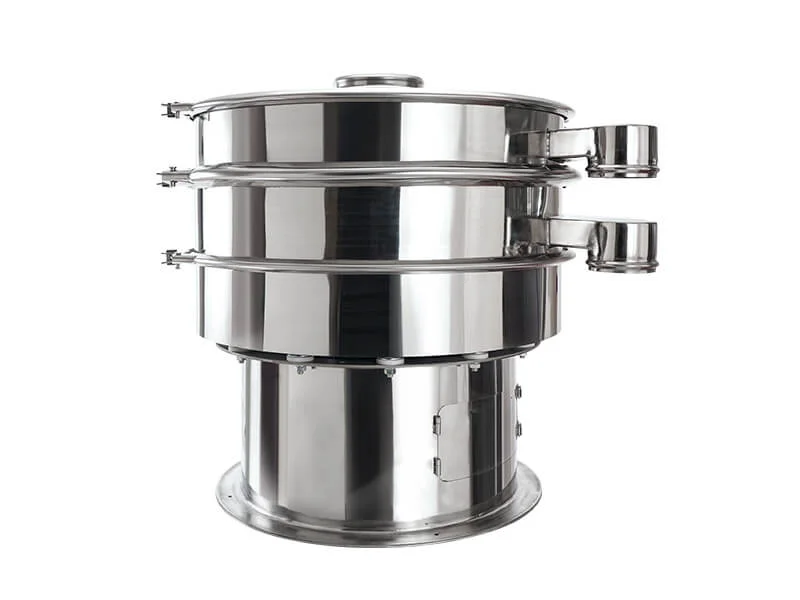
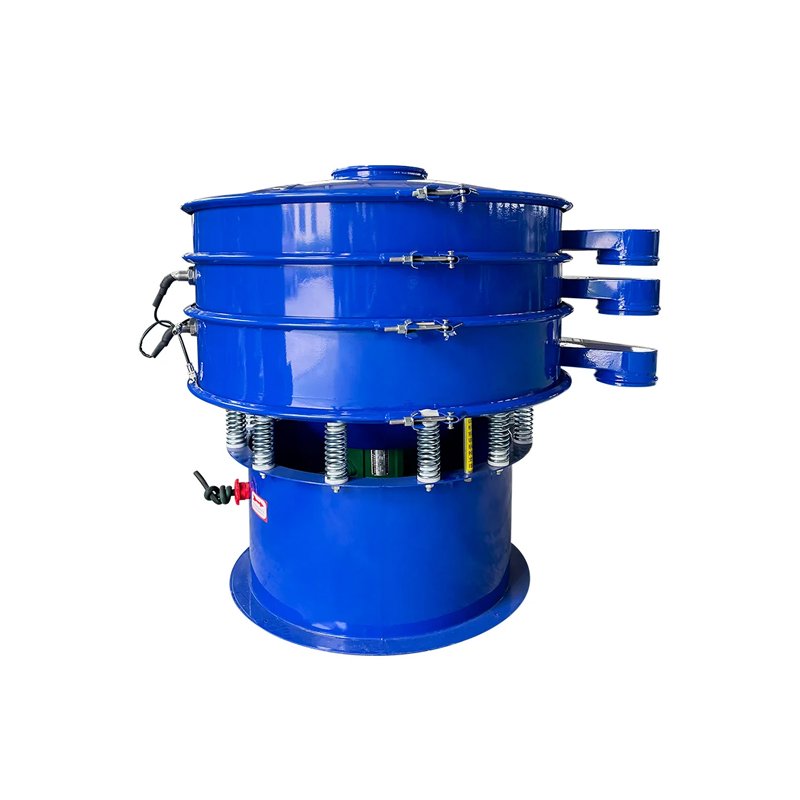
Sanyuantang offers chemical processing equipment made from materials such as stainless steel, carbon steel, and polymers like polypropylene (PP). However, the correct contact material still has to be confirmed against the specific chemical and operating conditions.
 stainless-steel-vibrating-screen
 Carbon Steel Vibrating Screen
 Anti Corrosion Plastic PP Material
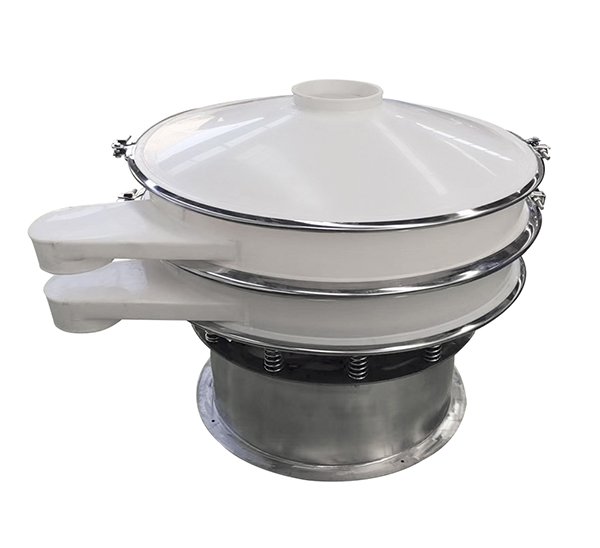
This is especially important for corrosive liquids, aggressive powders, or processes involving chemical cleaning.
What About Dust and Containment?
Dust control should be considered during the screening-system design rather than after installation.
A fine chemical powder can escape from:
- the feeding connection
- screen-frame joints
- discharge outlets
- downstream transfer points
An enclosed screen is only one part of the solution.
The complete system should be reviewed, including feeding, discharge, conveying and dust collection.
For enclosed powder transfer, our guide to inline pneumatic sieving explains the difference between screening inside a pneumatic conveying line and screening after a vacuum receiver.
If the powder is combustible or the installation is in a classified hazardous area, the electrical and mechanical requirements should be evaluated separately for the actual site. Do not assume that a standard machine configuration meets a hazardous-area requirement without confirming the required specification.
What Information Should You Provide Before Selecting a Chemical Sifter?
A good screening inquiry does not need to be complicated, but it needs more than a material name and mesh number.
Before requesting a machine recommendation, prepare as much of the following information as possible:
| Information | Example of What to Confirm |
|---|---|
| Material | Resin, pigment, PVC powder, carbon black, etc. |
| Screening purpose | Remove oversize, grade, de-agglomerate |
| Feed particle size | Approximate incoming particle distribution |
| Required cut size | Mesh or micron requirement |
| Number of fractions | One separation or multiple grades |
| Capacity | Required kg/h or t/h |
| Bulk density | kg/m³ or g/cm³ |
| Moisture | Dry, slightly damp or slurry |
| Powder behavior | Free-flowing, adhesive, electrostatic, agglomerated |
| Temperature | Normal and maximum operating temperature |
| Chemical properties | Composition and corrosiveness |
| Feeding method | Manual, screw feeder, vacuum conveying, etc. |
| Installation | Available space and discharge arrangement |
| Special requirement | Dust containment or hazardous-area requirement |
If you’re not sure what to do next, feel free to contact us. We have a professional team ready to guide you.
Email: info@sanyuantang.com
Phone: +86-18639095165
When Should You Test the Material Before Buying a Sifter?
A material test is particularly useful when:
- the powder is very fine
- flowability is poor
- static electricity is significant
- agglomeration is severe
- a large percentage of particles are close to the cut size
- required throughput is high
- actual screening behavior is unknown
- the material is new to the process
Testing is not only about proving that powder can pass through a mesh.
It can also show whether the chosen screen loads too quickly, whether the material blinds the apertures, whether an ultrasonic system is necessary and whether the expected capacity is realistic.
For difficult chemical powders, this information is often more valuable than selecting a machine from nominal mesh and capacity tables alone.
Choosing Industrial Sifters for Chemical Industry Applications
The first question should not be, “Which sifter has the highest capacity?”
Start with:
What needs to be separated, and how does the material behave while being screened?
A conventional vibratory sifter may already be suitable for many free-flowing chemical powders.
If fine powder repeatedly blocks the screen because of adhesion, static or agglomeration, ultrasonic screening becomes worth testing.
For some difficult fine powders, an airflow sifter may be another direction to evaluate.
Before the final configuration is selected, confirm the required cut size, capacity, particle distribution, bulk density, flowability, chemical properties and production arrangement.
If those parameters still do not clearly predict the screening result, test the actual material.
That gives Sanyuantang’s engineers a better basis for choosing the screen type, machine size and configuration than mesh size alone.
FAQ
What are industrial sifters used for in the chemical industry?
Industrial sifters are used to remove oversized particles and contamination, classify chemical powders by particle size, separate loose agglomerates and protect downstream processes. The required machine depends on the screening objective, powder characteristics, required cut size and production capacity.
Which sifter is suitable for fine chemical powders?
There is no single machine for every fine powder. A conventional vibratory sifter may work for free-flowing material. If fine particles repeatedly blind the mesh because of adhesion, agglomeration or static electricity, an ultrasonic or other specialized screening system may need to be evaluated.
When is an ultrasonic vibrating screen necessary?
Ultrasonic assistance is worth considering when conventional fine-mesh screening is repeatedly limited by mesh blockage, static electricity, adhesion or agglomeration. If a standard vibratory screen already maintains stable throughput and separation, adding an ultrasonic system may not be necessary.
Can mesh size determine the required sifter?
No. Mesh size defines the screening cut, but machine selection also depends on particle-size distribution, bulk density, capacity, moisture, flowability, particle shape and material behavior. Two powders screened through the same mesh can produce very different throughput and screening performance.
How does bulk density affect screening capacity?
Bulk density changes the mass of material loaded onto a given screen area. It should therefore be considered together with volumetric feed rate, particle distribution and screen behavior. A catalog capacity for one material should not automatically be used as the expected capacity for another powder.
What information should I send for a chemical powder screening inquiry?
Provide the material name, required mesh or micron size, feed particle size, required capacity, bulk density, moisture, number of fractions and any problems such as static electricity or agglomeration. For corrosive materials, also provide chemical composition, concentration and operating temperature.