
Inline pneumatic sieving is used when powder needs to be screened as part of an enclosed conveying process rather than transferred manually to a separate screening station. In a true pneumatic inline arrangement, the screening equipment becomes part of the conveying route, allowing acceptable powder to continue downstream while oversize particles or foreign material are separated.
That sounds straightforward, but the equipment choice is not.
A sifter installed somewhere in a production line is not automatically a pneumatic inline sifter. The difference matters because a machine working directly inside a positive-pressure or vacuum conveying line has to deal with air movement, sealing, material loading and system pressure conditions that do not exist in a normal gravity-fed screening application. Industrial pneumatic screeners from manufacturers such as Russell Finex, Kason and Palamatic are specifically designed around these conveying conditions.
For this reason, we normally start with the conveying system rather than the mesh size.
What Does Inline Pneumatic Sieving Actually Mean?
In a conventional screening process, powder may leave a bag dump station, hopper or conveyor and fall by gravity into a vibrating sieve. After screening, it enters the next machine.
Inline pneumatic sieving is different. The screening step is incorporated into, or closely integrated with, a pneumatic powder transfer process.
A simplified arrangement may look like this:
Powder source → Pneumatic conveying → Screening → Downstream process
The purpose is usually not precision particle classification into several narrow fractions. In many installations, the screen acts as a safety or check screen. It removes unwanted oversize material, packaging fragments, agglomerates or other contamination before the powder reaches a mixer, storage vessel, packing machine or other process equipment.
This can reduce extra handling steps and helps keep powder inside an enclosed transfer system.
There is an important distinction, however.
A production line arranged as:
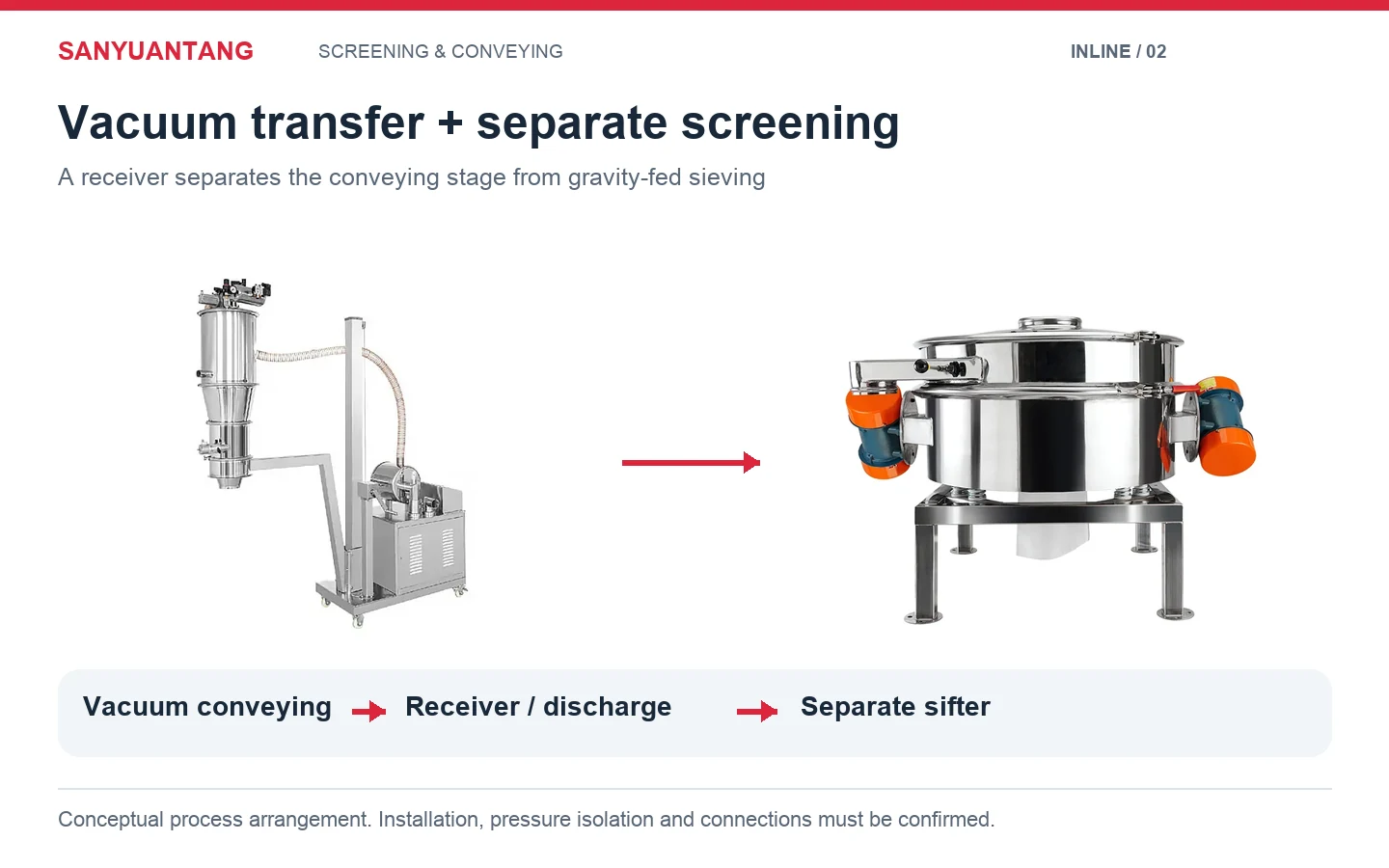
Vacuum conveying → Receiver → Gravity discharge → Vibratory sifter → Mixer
also combines pneumatic conveying and screening, but the sieve itself may not be operating inside the pneumatic pressure line.
Both arrangements can be useful. They simply require different equipment decisions.
Where Should Screening Take Place in a Pneumatic Conveying System?
There is no reason to force every powder process into the same configuration. The correct position depends on what the screen is expected to do and what conditions exist at that point in the line.
| Screening Arrangement | How It Works | Typically Considered When |
|---|---|---|
| Direct pneumatic inline screening | Sifter forms part of the pneumatic conveying route | Screening must occur without interrupting enclosed pneumatic transfer |
| Vacuum conveying + separate sifter | Powder is pneumatically transferred, then discharged into a gravity-fed screen | Closed transfer is required, but the screen does not need to operate under conveying pressure |
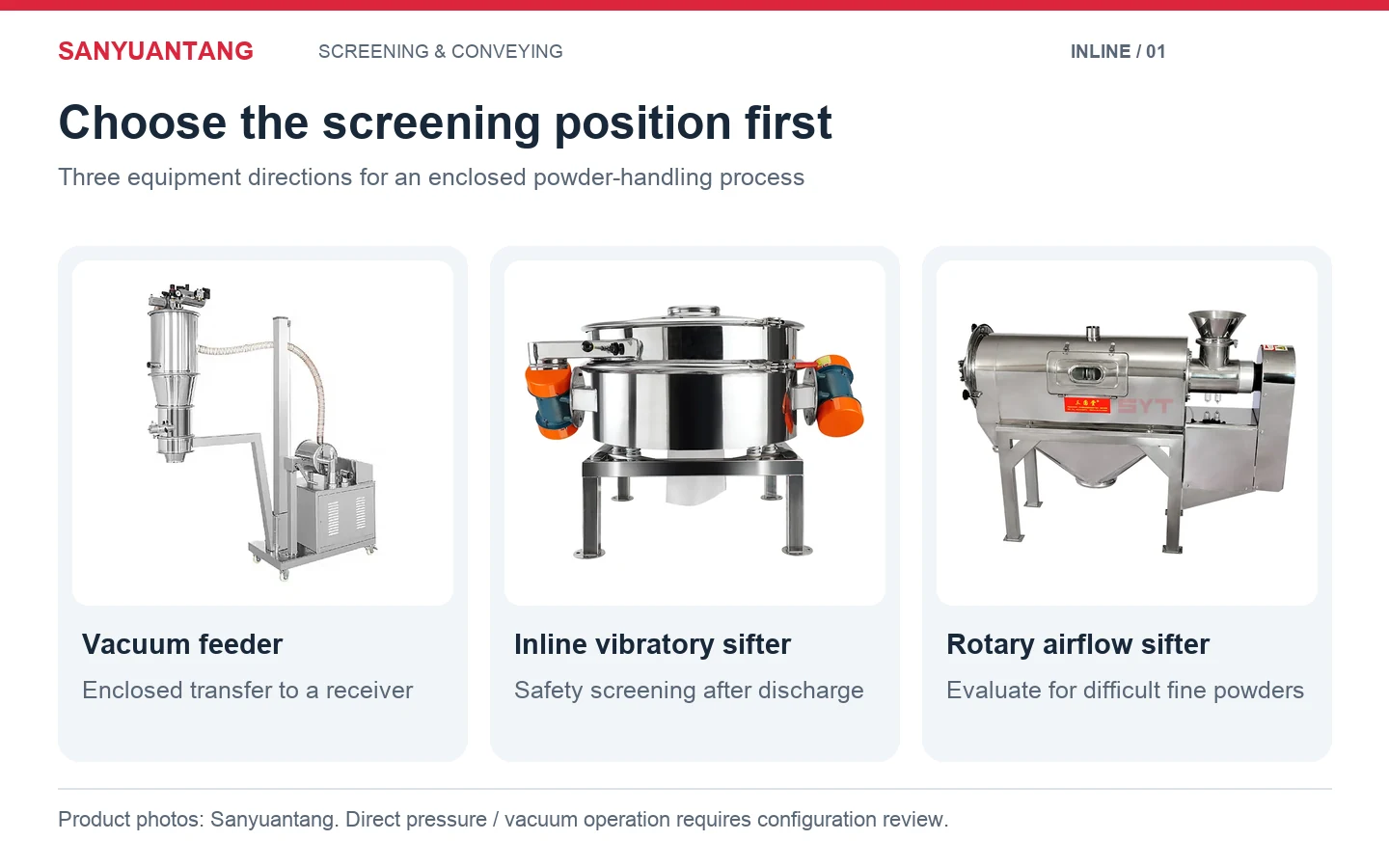
| Rotary airflow / centrifugal screening | Powder enters a cylindrical screen and is driven through it by rotating elements and airflow | Fine, light, agglomerated or difficult powders require a different screening mechanism |
The first arrangement has the most demanding integration requirements. Equipment intended for direct installation in a pneumatic conveying line must be selected for the actual positive-pressure or vacuum condition. Manufacturers of dedicated pneumatic inline sifters commonly design these machines specifically around enclosed conveying and pressure management.
A standard gravity-fed sifter should therefore not be assumed to perform the same job simply because its inlet and outlet can be connected to pipework.
How Does the Powder Move Through an Inline Pneumatic Sieve?
The exact internal arrangement depends on the machine design, but the process objective is similar.
Powder and conveying air arrive at the screening section. The screen retains material larger than the selected opening while acceptable powder continues toward the next process stage. Oversize material needs its own controlled discharge route so that removing contamination does not simply create another leak or open handling point.
In vibratory designs, vibration helps keep the screening surface active while material passes across or through the mesh. Pneumatic centrifugal sifters use a different principle: rotating paddles or blades move material through a cylindrical screen while oversize material travels toward a separate outlet. Kason, for example, uses both vibratory and centrifugal configurations for pneumatic inline applications.
Neither principle is automatically better for every powder.
The material itself decides much of the answer.
Why Mesh Size Alone Cannot Select the Sifter
We often receive screening requirements that contain only two numbers:
“40 mesh, 2 tons per hour.”
That is not enough information for a reliable pneumatic screening recommendation.
Two powders requiring the same screen aperture can behave completely differently. One may be free-flowing and pass rapidly through the mesh. Another may have low bulk density, carry static charge, form soft agglomerates or repeatedly blind the screen.
When pneumatic conveying is involved, there is another layer of variables.
Before choosing the screening equipment, the following conditions should normally be reviewed:
| Parameter | Why It Matters |
|---|---|
| Material name | Gives the first indication of flow and screening behavior |
| Feed particle size | Shows how much material must actually pass through the screen |
| Target mesh or cut size | Defines the required separation |
| Required throughput | Determines the screening load |
| Bulk density | Affects the relationship between volumetric and mass flow |
| Moisture | Can increase adhesion and mesh blinding |
| Agglomeration | May make a nominally easy mesh difficult to screen |
| Oversize percentage | Affects screen loading and reject handling |
| Conveying method | Determines whether the system uses pressure, vacuum or a separate receiver |
| Pipeline size | Important when integrating equipment into an existing system |
| Conveying distance | Helps describe the existing pneumatic system |
| Upstream equipment | Shows how material reaches the screening point |
| Downstream equipment | Determines where screened material must go |
| Available installation space | Often affects which machine structure is practical |
Air velocity and conveying conditions can also affect how material reaches the screen. These should be reviewed as system parameters rather than guessed from the screening capacity alone.
This is why a catalog throughput number should be treated as a reference, not as a guaranteed result for every powder.
Need Help Reviewing the Screening Point?
If you are not sure whether the sieve should operate directly in the pneumatic line or after a vacuum receiver, send us:
- Material name
- Feed particle size
- Target mesh or cut size
- Required capacity
- Bulk density
- Moisture
- Conveying method
- Pipeline diameter
- Conveying distance
- Current screening problem
- Process drawing, photos or video if available
Sanyuantang can review the material and process arrangement before recommending which screening direction should be evaluated.
Email: info@sanyuantang.com
Phone: +86-18639095165
Direct Pneumatic Screening or Vacuum Conveying Followed by Screening?
This is one of the most useful decisions to make early.
If the main objective is dust-free transfer from bags or storage equipment to a screening station, it may not be necessary to place the screen directly inside a pressurized pneumatic line.
A vacuum conveyor can move the powder in an enclosed negative-pressure system to a receiver or downstream feeding point. The material can then discharge into a suitable vibratory screening machine. Sanyuantang's Pneumatic Vacuum Feeder is designed for powder and granular material transfer and is listed for use together with equipment including vibrating sifters, mixers and packaging machines.
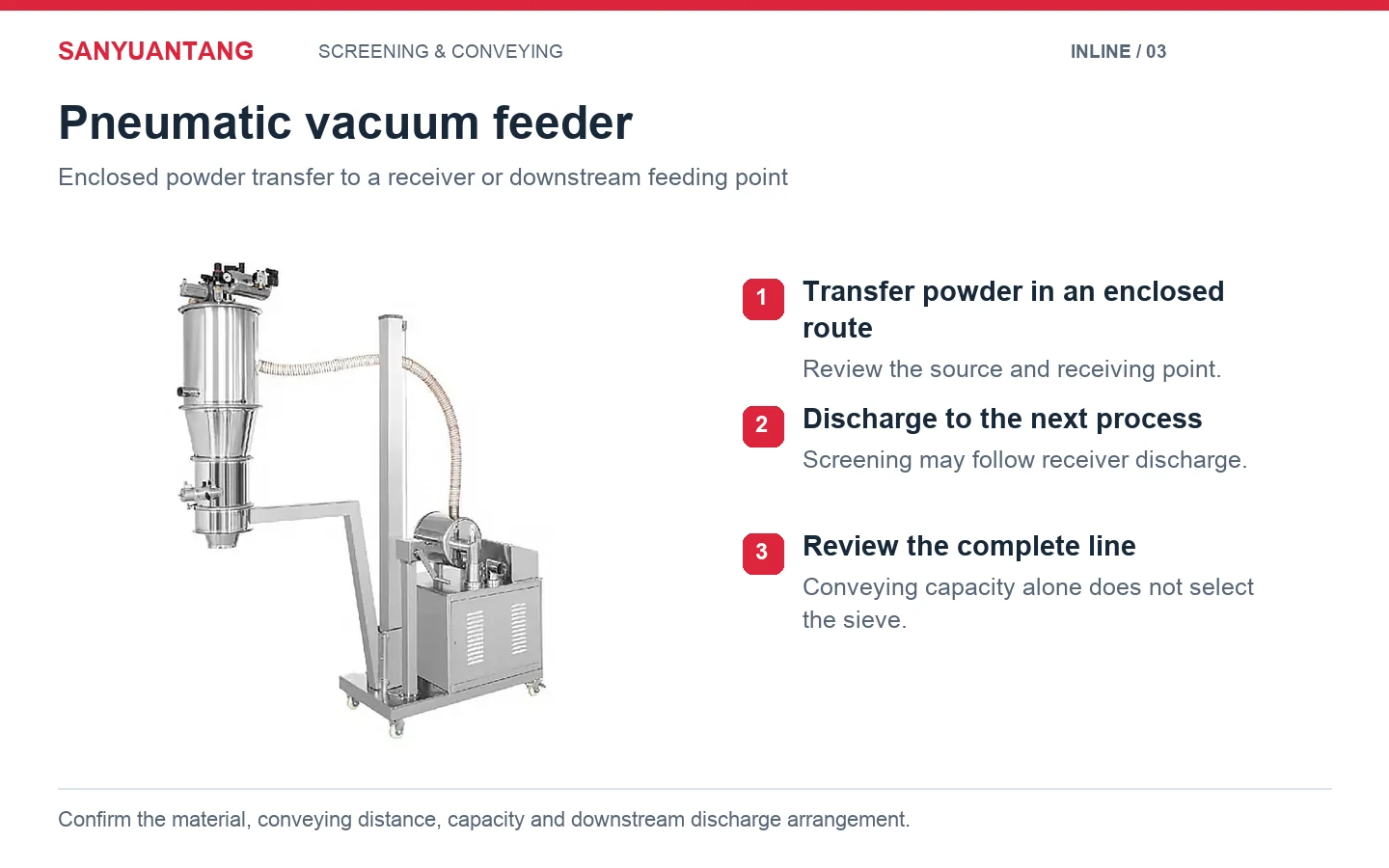
Sanyuantang also uses this type of process arrangement in complete lines. One published premix and breading production line combines a vacuum feeder, bag dump station, inline sifter, mixer and packaging equipment, with screening as a separate process stage after material feeding.
That configuration is quite different from putting a sieve directly inside a positive-pressure conveying pipe.
For many plants, the distinction can prevent unnecessary equipment complexity.
When Does an Inline Vibratory Sifter Make Sense?
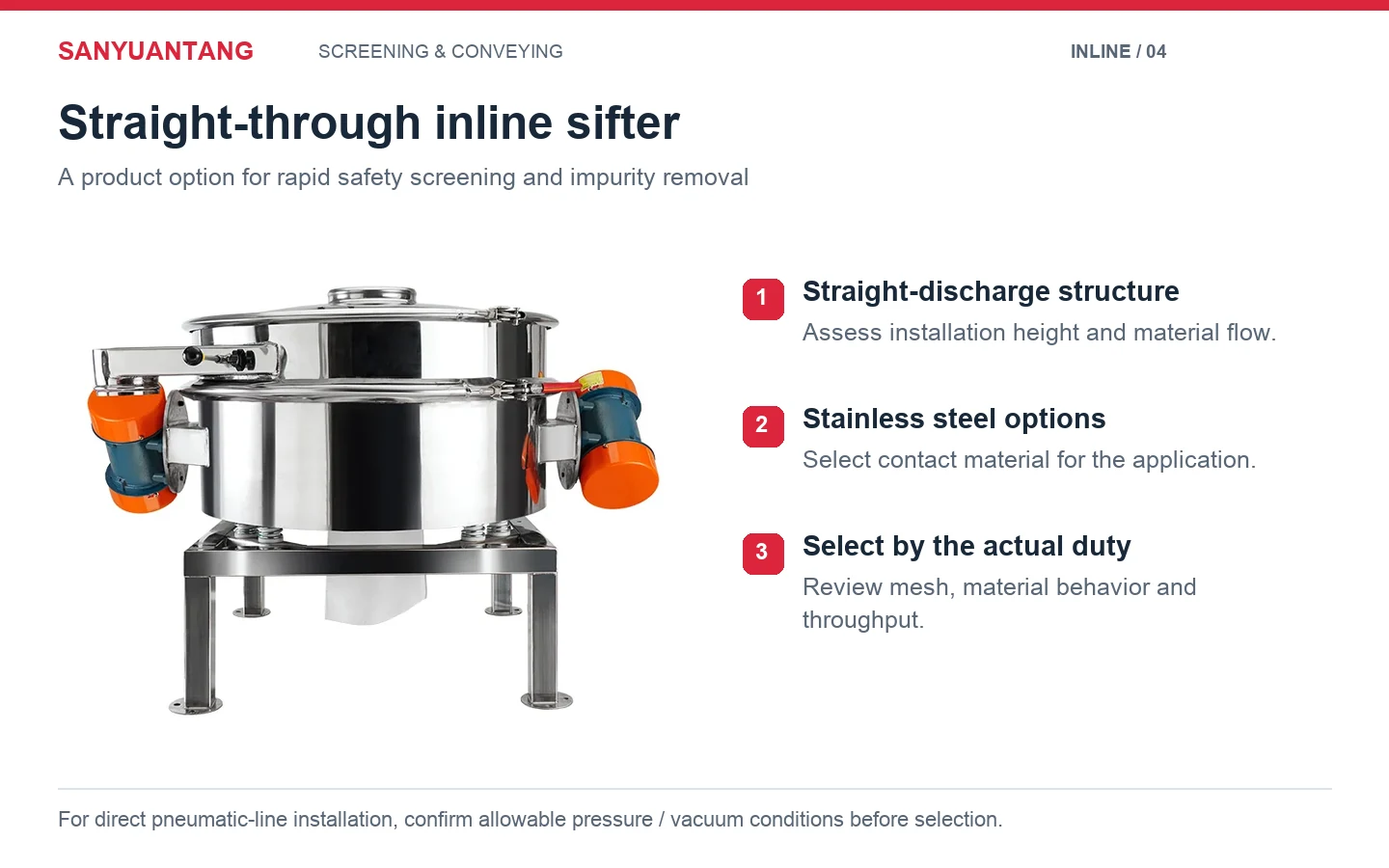
A straight-through inline vibratory sifter is particularly useful when the requirement is rapid impurity removal or safety screening and the material can discharge through the screen without difficult fine-powder behavior.
Sanyuantang's Inline Sifter Machine uses a straight-discharge structure and is designed for powder and granular material screening. The current product information lists stainless steel 304/316 options, one or two screening layers and customization according to the material, mesh, output, specific gravity and installation conditions. It is also described as suitable for integration into production-line piping arrangements.
The important engineering question is where that integration occurs.
If the machine is being installed after a receiver, feeder or other pressure-separation point, selection is relatively different from installing it directly inside a pressurized conveying line. For a direct pneumatic installation, the allowable pressure or vacuum condition should be confirmed before equipment selection rather than assumed from the term “inline.”
This distinction should be made before the machine is ordered, not during installation.
When Should You Consider a Rotary Airflow Sifter?
Fine powders do not always behave well on a conventional vibratory screen.
Low bulk density, static electricity, agglomeration and persistent mesh blinding can change the screening requirement. In such cases, a centrifugal or airflow-based machine may deserve consideration.
The Sanyuantang Rotary Airflow Sifter feeds material into a cylindrical screening section where airflow and centrifugal action move fine material through the mesh while coarse material exits separately. Its published applications include fine and difficult powders, and Sanyuantang states that the machine can be matched with a pneumatic conveying system.
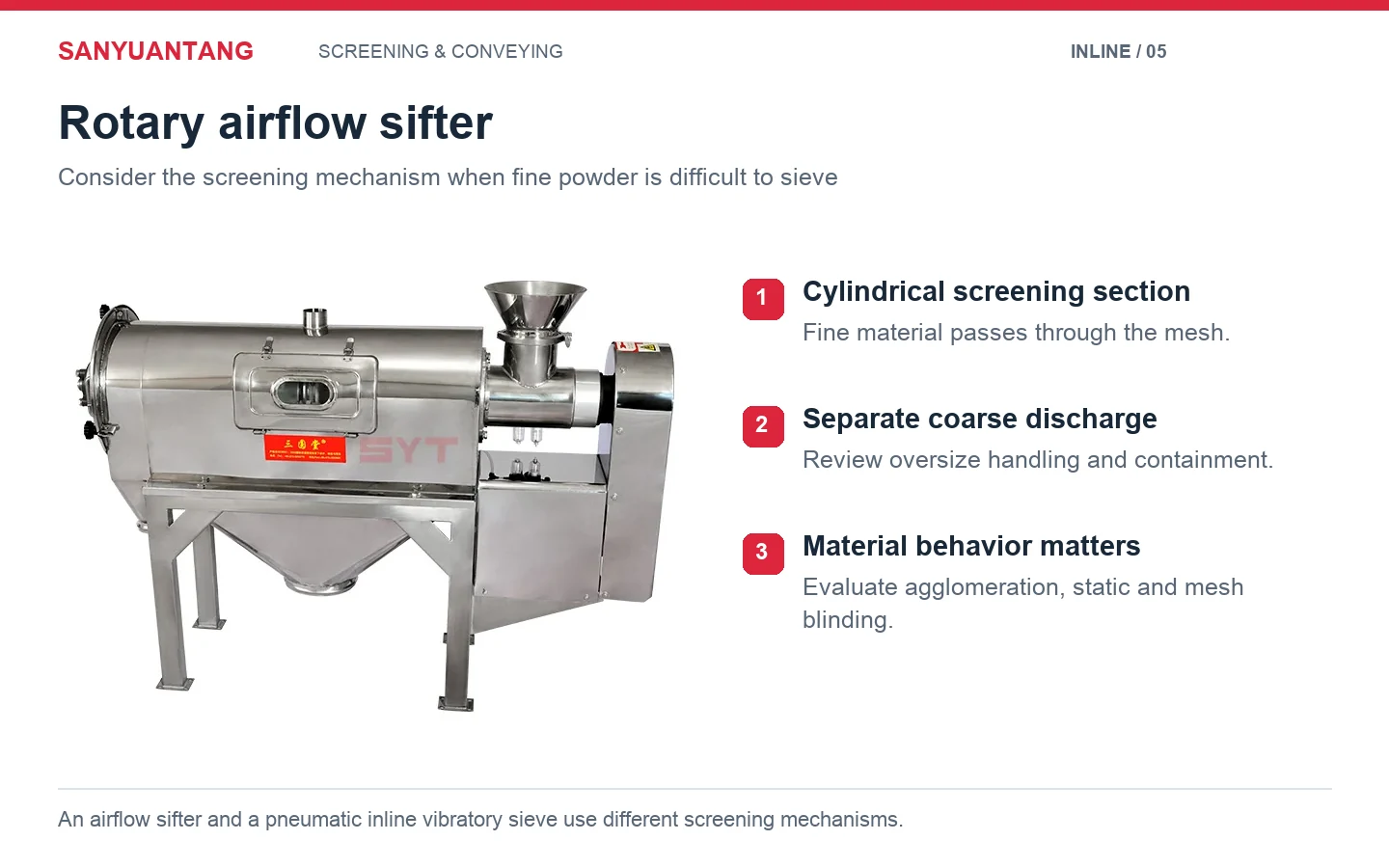
That does not mean an airflow sifter and a pneumatic inline vibratory sieve are the same machine.
They solve related powder-handling problems with different screening mechanisms. The decision should be based on material behavior and system arrangement.
| Condition | Direction Worth Evaluating |
|---|---|
| Free-flowing powder requiring safety screening | Inline vibratory screening |
| Vacuum transfer followed by impurity removal | Vacuum feeder + separate inline sifter |
| Fine powder with agglomeration or mesh-blinding problems | Rotary airflow or another anti-blinding screening approach |
| Screening equipment must sit directly inside pressure/vacuum conveying pipe | Purpose-designed pneumatic inline sifter, with line conditions confirmed |
| Screening behavior is uncertain | Material test before final machine selection |
What Happens to Oversize Material?
Oversize handling is easy to overlook when planning pneumatic screening.
The screen may remove only a small percentage of foreign material, but that material still needs somewhere to go. If the reject outlet is opened carelessly on a pressurized or vacuum system, it can interfere with containment or conveying conditions.
Dedicated pneumatic inline screeners therefore use controlled reject arrangements appropriate to their design. Some centrifugal pneumatic sifters, for example, discharge oversize through a sealed valve or collection system.
For a new project, tell the equipment supplier approximately how much oversize you expect and whether it consists of:
- Foreign contamination
- Agglomerated product
- Large raw-material particles
- Packaging fragments
- Product that should be recovered or reworked
A screen is only one part of the separation process. Reject handling belongs in the system design as well.
Common Mistakes When Planning Inline Pneumatic Sieving
1. Choosing the machine from mesh size alone
Mesh tells us the opening. It does not describe how the powder behaves on that opening.
Bulk density, moisture, particle shape, agglomeration and required throughput still matter.
2. Treating every “inline sifter” as a pneumatic sifter
An inline sifter may simply mean that the machine fits between two production stages. Direct pneumatic-line operation adds pressure, vacuum, airflow and sealing requirements.
3. Using conveyor capacity as screen capacity
A pneumatic conveyor may be capable of moving a given mass flow, but that does not prove the selected screen can pass the same powder through a specific aperture at the same rate.
4. Ignoring oversize discharge
Removing contamination is only useful if the reject can leave the system safely without creating another process problem.
5. Skipping material testing for difficult powders
If the material is very fine, sticky, electrostatic, fibrous or strongly agglomerated, a test can provide more useful information than selecting equipment only from a catalog.
What Should You Send to the Manufacturer Before Selection?
For a new pneumatic screening project, we normally recommend preparing the following information before discussing the machine model:
Material information
- Material name
- Feed particle-size range
- Target screen opening
- Bulk density
- Moisture
- Temperature if relevant
- Flow characteristics
- Expected oversize percentage
Process information
- Required throughput
- Positive-pressure, vacuum or gravity-fed system
- Existing conveyor type
- Pipeline diameter
- Approximate conveying distance
- Upstream equipment
- Downstream equipment
- Available installation height and footprint
- Required number of product fractions
For an existing line, a simple process drawing is especially useful. Photos of the current pipework, feeding point and receiving equipment can often explain more than a long written description.
FAQ
Can a sieve be installed directly in a pneumatic conveying line?
Yes, but the sifter must be suitable for the actual conveying condition. Direct pneumatic inline screening can operate as part of pressure or vacuum conveying systems when the equipment is designed accordingly. Do not assume that a standard gravity-fed inline sifter has the same pressure capability.
What is the difference between an inline sifter and a pneumatic inline sifter?
An inline sifter is simply integrated into a production line and may receive material by gravity. A pneumatic inline sifter operates as part of a pneumatic conveying route, so airflow, sealing, pressure or vacuum conditions and reject discharge become additional selection factors.
Can I use vacuum conveying and screening without putting the sieve inside the vacuum pipe?
Yes. Powder can be vacuum-conveyed to a receiver or feeding point and then discharged into a separate sifter. This arrangement can maintain enclosed powder transfer while keeping the screening machine outside the main pneumatic pressure section.
Does inline pneumatic sieving reduce conveying capacity?
It can affect overall system performance if the screening equipment creates excessive restriction or cannot pass material at the required rate. The actual effect depends on the sifter design, powder characteristics, screen aperture and conveying conditions, so the entire system should be evaluated together.
Is a rotary airflow sifter the same as a pneumatic inline vibratory sieve?
No. A rotary airflow or centrifugal sifter uses rotating elements, a cylindrical screen and airflow to separate powder. A vibratory sifter activates a screen using vibration. Either type may be integrated with powder conveying, but their internal screening mechanisms are different.
When should material testing be considered?
Testing is useful when powders are fine, sticky, electrostatic, lightweight, fibrous, moist or strongly agglomerated, or when the required throughput through a fine mesh is uncertain. A sample test can help identify whether ordinary vibratory screening is sufficient or another screening method should be evaluated.
Choose the Screening Position Before Choosing the Machine
The first question in an inline pneumatic sieving project should not be “Which model do I need?”
First decide where screening must happen.
If powder only needs enclosed transfer to a separate screening station, a vacuum conveying system followed by an inline sifter may be enough. If the screen must operate as part of the pneumatic conveying pipe itself, the actual pressure or vacuum conditions need to be confirmed before choosing the equipment. Difficult fine powders may require a different screening mechanism again.
The material, screen opening, required throughput and conveying system all need to work together.
Discuss Your Pneumatic Screening Application
If you are planning a new line or modifying an existing powder conveying system, send Sanyuantang your material information together with a simple process flow.
Please include:
- Material name
- Feed particle size
- Target mesh
- Required throughput
- Bulk density
- Moisture
- Conveying method
- Pipeline diameter and distance
- Current screening problem
- Photos, drawings or material samples if available
We can review whether the application should be approached with an inline vibratory sifter, vacuum conveying plus a separate screening stage, a rotary airflow sifter, or further material testing before the equipment configuration is finalized.
Email: info@sanyuantang.com
Phone: +86-18639095165