
The question behind most screener projects is not which machine is best in general, but which one removes the contaminant or holds the cut size your product requires at your throughput, and still comes apart for cleaning between batches. Four variables decide that: the separation objective, the ingredient, the duty point, and the cleaning regime. This guide covers what sieving can and cannot catch, how the three main equipment categories differ in access and limitations, and which hygiene details belong in the specification before you compare quotations.
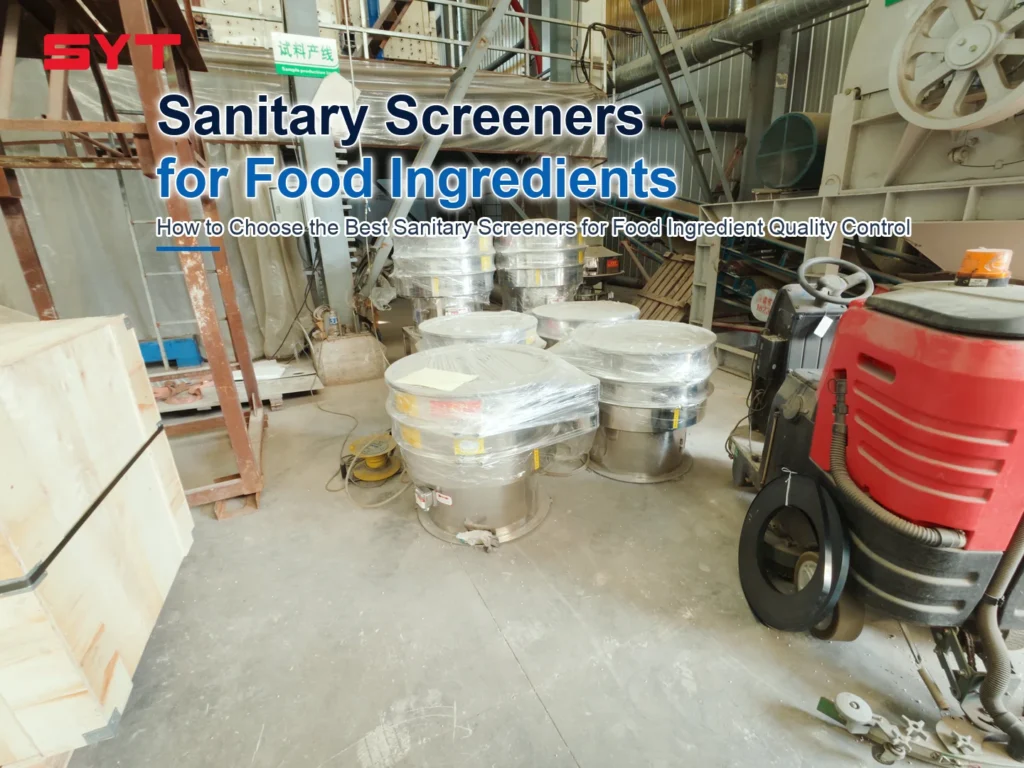
Ask five suppliers for the best sanitary screeners for food ingredient quality control and you will get five different machines, each defensible on paper. That is less sales noise than a sign the question is underspecified. A unit that performs well on fine icing sugar at moderate rate with dry cleaning will disappoint on a moist, fatty spice blend that has to be washed down between allergen runs, and the reverse is equally true.
The useful version of the question is narrower. Which screening step removes the contaminant or holds the cut size your product and your customer require, at your throughput, while staying cleanable and verifiable between batches? Answer that and the shortlist tends to fall out on its own.

Choosing the Best Sanitary Screeners for Food Ingredient Quality Control
The objective comes first: Three different jobs are routinely called screening. Safety screening removes oversize material and foreign bodies ahead of packing or a downstream process. Grading classifies product into size fractions, often on stacked decks. De-agglomeration and de-dusting break soft lumps and pull fines out of a granulated stream. They pull machine design in different directions: safety screening rewards low product retention, easy visual inspection and a mesh that cannot fail quietly; grading rewards repeatable, accurate cuts; de-agglomeration rewards residence time or shear.
The ingredient decides more than the datasheet admits: Bulk density, particle shape, surface moisture, fat content, temperature, fragility and abrasiveness all change how a powder behaves on a deck. So does dust explosibility: flour, starch and sugar dusts are combustible, and grounding, bonding and area classification belong in the plant’s dust hazard analysis rather than in a supplier’s brochure.
Throughput and position set the geometry: Tonnes per hour, batch or continuous, gravity feed or pneumatic conveying, available headroom, and whether the screener sits before or after a mill all constrain the choice before hygiene is even discussed. Catalogue capacity figures are usually quoted against a reference material, so treat them as a starting point for a trial, not a guarantee for your powder.
The cleaning regime is where projects go wrong: Sites buy on throughput and regret it on changeover. If a line runs eight products with two major allergens, a machine that takes four hours to strip and reassemble may be technically sanitary and operationally unusable. Decide early whether cleaning is dry (vacuum, brushes, wipe-down) or wet, how often, and what evidence your quality system needs afterwards.
What a Screen Removes, and What It Does Not
A woven screen separates on size, but size in three dimensions. A particle passes if it can orient so that its smallest cross-section fits the aperture. That single fact explains most of the surprises.
Needles of wire, fibres and splinters can travel lengthwise through a mesh that would retain them end-on. Soft or deformable contaminants, such as rubber fragments, string, dried dough or some plastic film, may squeeze through an aperture smaller than their nominal dimension. Contaminants close in size to the cut point, or close to the product in size and density, are not a sieving problem at all; a dark speck the same size as a sugar crystal will pass a screen sized for sugar crystals. Those hazards normally belong to metal detection, x-ray inspection, magnets or colour sorting, chosen through the plant’s hazard analysis rather than through the screener purchase.
Near-size material is also where capacity disappears. Particles just under the aperture pass slowly and can peg or blind the mesh, particularly with moist or electrostatic powders. Open area falls as wire diameter increases for a given aperture, so a heavy-duty mesh with the same nominal cut can behave very differently from a light one.
One more point worth stating plainly: a screen is a potential source of foreign bodies as well as a control against them. Wire can fatigue, clamps can be left loose, gaskets can perish. Inspection frequency, mesh condition records, spare screens and a downstream magnet or metal detector are all part of making the control credible, and none of them is a substitute for a validated food-safety system. Sieving is one control among several.
Sanitary Round Separator, In-Line Sifter or Centrifugal Sifter?
The three categories below cover most food ingredient screening duties. Table 1 compares them as general equipment types; it is not a product list, and no category is inherently more hygienic than another. Hygiene comes from design detail, not from the category name.
| Category | How separation happens | Typical duty | Access and cleaning | Limitations to check |
|---|---|---|---|---|
| Round (rotary) vibratory separator | Horizontal woven screen driven in a gyratory motion with a vertical component; oversize migrates to the rim and discharge | Batch or continuous safety screening and grading of powders and granules; multiple cuts with stacked decks | Lid and clamp ring removal exposes the full deck; large screen area is easy to inspect visually; needs headroom and lifting clearance | Footprint and dust sealing; mesh tension; product retained on deck and frame; capacity sensitive to deck loading |
| In-line (pneumatic) sifter | Screen element mounted in a pressure or vacuum conveying line; product is blown or drawn through | Check screening inside pneumatic transfer; low headroom, contained systems | Compact and enclosed, but access needs line isolation; smaller screen area; inspection is less visual | Short residence time; capacity tied to conveying air; harder mesh inspection; retained product in the housing |
| Centrifugal sifter | Rotating paddles or a feed screw throw product against a cylindrical screen; oversize exits at the discharge end | High-rate scalping and de-agglomeration of light or sticky powders on fine mesh | Cylindrical screen and rotor must be removed; more components to clean and reassemble | Shear and heat on fragile products; mesh wear; less precise grading; cleaning verification is harder |
What the table shows is a trade between screen area, containment and access. Round separators win on inspection and multi-cut flexibility, and lose on footprint and dust control if the covers are not properly gasketed. In-line sifters win on containment and headroom, and lose on visibility and screen area. Centrifugal sifters win on throughput per unit of floor space for difficult powders, and lose on gentle handling and on how easily the screen can be examined.
For a food plant the decisive column is usually access. A screen you can see, touch and re-tension in ten minutes gets checked. A screen buried in a housing gets checked when someone remembers.
If you’re unsure how to select the right model, feel free to contact us right away—our experienced engineers are here to help you choose the right one.
Email: info@sanyuantang.com
WhatsApp: +86-18639095165
Writing Hygiene Into the Specification
A 304 or 316 stainless label does not establish sanitary design, and it certainly does not establish legal compliance in your market. Food-contact requirements differ by jurisdiction, and declarations have to cover the actual materials and grades used, not the family of steel. The checklist in Table 2 is written so it can be sent to suppliers as part of an enquiry.
| Specification point | What to ask for | Why it matters |
|---|---|---|
| Product-contact materials | Material certificates for contact parts, food-contact declarations from the material suppliers, grade stated (for example 304 or 316L), and a list of non-metallic contact components | The generic steel family does not prove food-contact compliance; declarations must match the parts supplied |
| Welds, surfaces and crevices | Continuous welds ground flush on contact surfaces, no lap joints or exposed threads, radiused internal corners, surface finish stated numerically if your specification requires it | Product and cleaning fluid collect in gaps that cannot be seen or reached |
| Seals and elastomers | Seal material and grade, temperature and chemical compatibility, food-contact approval, replaceable and located in crevice-free grooves | Elastomers are the most common weak point in washdown and allergen changeover |
| Screen and mesh integrity | Aperture in microns, wire diameter, mesh certificate, edge bonding method, tensioning arrangement, spare screen availability, inspection interval | A failing mesh discharges metal into product; aperture in microns avoids confusion between mesh-count conventions |
| Tool and access | Disassembly with no tools or a single tool, hinged or lifting aids, clearance for gloved hands, no trapped-product pockets | Cleaning quality follows access; difficult machines are cleaned badly under production pressure |
| Dust containment and allergen changeover | Gasketed covers, dust extraction connections, minimum retained volume, dedicated or colour-coded screens, a written changeover procedure | Airborne dust spreads allergens across lines faster than contact surfaces do |
| Cleaning procedure and verification | Dry and wet cleaning instructions, drainability, water-trap avoidance, enclosure rating if washdown is used, support for swab or ATP verification | Cleaning must be validated on site; supplier instructions inform but do not replace that validation |
| Traceability and documentation | Serial numbers on the unit and on screens, material and mesh certificates, spare-parts list, any site-required qualification documents, hazardous-area certification where applicable | Quality systems need to trace what touched the product, and when |
Two footnotes to that table. First, hygienic design guidance from bodies such as 3-A Sanitary Standards, Inc. and EHEDG, and food-contact frameworks such as EU Regulation (EC) No 1935/2004 or, in the United States, the preventive-controls requirements in 21 CFR Part 117, may all be relevant, but only some of them apply to your product and market. Confirm the current text and its applicability before you cite it in a specification. Second, cleaning and safety procedures must follow the machine manual and your site’s validated procedures; a supplier’s cleaning advice is an input, not an approval.
Hypothetical Example: Sifting Wheat Flour at 6 t/h
The figures below are illustrative only, chosen to show how the four variables interact. They are not a capacity claim for any machine.
Suppose a bakery-ingredient plant screens wheat flour at 6 t/h before packing into 25 kg bags. The objective is safety screening: retain lumps formed by humidity and any fragment above roughly 500 µm, protecting the bagging line and the customer. Feed is fine, free-flowing and aerates easily, which means the deck must be sealed and vented properly or dust escapes at the lid.
The cut size follows from the hazard, not from habit. A 500 µm aperture (roughly 35 mesh on one common scale) retains visible plastic fragments and lumps but will not reliably stop fine metal wire from a worn mesh upstream, so a metal detector downstream remains part of the control set. Because wheat is a declared allergen, changeover matters: if the same line packs a soy-containing blend, the site needs either a validated dry-cleaning procedure with verification swabs, or dedicated screens and seals.
Now change one variable. If the same plant also runs a high-oil ground paprika, wet cleaning becomes attractive, and the seals, drainability and surface finish that suited dry flour may no longer suit the duty. The honest conclusion may be that one machine cannot serve both, which is cheaper to discover at the specification stage than after installation.
For the flour duty itself, a round separator is a reasonable category to evaluate: single deck, a screen area sized on a trial with the actual flour, clamped lid with dust connections, and documentation covering contact materials, mesh aperture and seal grades. A centrifugal sifter would be harder to justify here because gentle handling and visual inspection matter more than throughput per square metre. That reasoning, not a brand preference, is what a selection should rest on.
Where Sanyuantang Fits in That Selection
Sanyuantang manufactures industrial screening equipment, and the round separator category described above is represented by the rotary vibrating screen used for food ingredient screening. The product page lists food applications that include sugar powder, starch and rice flour, and material options covering 304 and 316 stainless steel as well as carbon steel. Treat those as options to be selected against your duty, not as a statement that every contact component, seal, surface finish or certificate you require is included by default, and not as evidence of suitability for every food application.
A productive first enquiry therefore carries the duty, not just the product name: ingredient and bulk density, feed size range and moisture or fat content, the target cut size in microns or the contaminant you need to remove, required throughput and whether the duty is batch or continuous, the cleaning and allergen changeover regime, available space and headroom, and the documentation your quality system will ask for. If you can provide representative material, we can discuss a trial, subject to agreement on scope and conditions.
Questions Buyers Ask Most Often
Q: Is a sanitary screener enough on its own to control foreign bodies?
A: No. It is one control in a set. Contaminants smaller than the aperture, deformable contaminants and material close in size to the product will pass, so metal detection, magnets or other inspection steps belong wherever the hazard analysis puts them.
Q: Should I specify the cut in mesh count or in microns?
A: In microns of aperture, with the wire diameter stated. Mesh-count conventions differ between scales, so “40 mesh” can mean different openings depending on who is quoting, and two screens with the same aperture but different wire thickness screen differently.
Q: Can one screener handle allergen changeovers between products?
A: Sometimes, if the design allows fast, verifiable cleaning and the site validates the procedure. For major allergens, dedicated screens or dedicated equipment are usually the more defensible route, and the decision should be documented in the allergen control plan.
Q: Does 316L stainless steel make a screener sanitary?
A: No. Grade affects corrosion resistance, which matters with certain products and washdown chemicals, but hygiene comes from welds, crevices, seal design, drainability and access. A certificate for the steel says nothing about the geometry built from it.
Bringing It Together
Choosing sanitary screeners for food ingredient quality control is a specification exercise before it is a purchase. What determines the outcome is whether the cut size matches the hazard or the grading requirement, whether the category suits the ingredient and duty point, whether the throughput has been checked against your material rather than a catalogue figure, and whether the machine can be cleaned and verified at the frequency your product mix demands. Documentation then has to support all of it, because a stainless label and a hygiene claim are not the same thing.
The next practical step is a one-page duty statement covering those four variables plus your documentation requirements, sent to a shortlist of suppliers with a request for drawings, material and mesh declarations, and cleaning instructions. Compare the answers, not the brochures.
To take that step with Sanyuantang, send your ingredient, target contaminant or size, throughput, current process, allergen and cleaning requirements through the contact page, and ask specifically which contact materials, seals and certificates would be supplied for your duty.
Email: info@sanyuantang.com
WhatsApp: +86-18639095165