
If a screen is passing too much oversize, blinding, or costing more per ton than it should, the deck angle is one of several settings to examine — not the single knob that fixes everything. Inclination changes travel speed and bed depth, which changes residence time and the chance a near-size particle finds an opening. This guide explains how angle, motion, aperture and feed rate work together, compares the main screen types, and sets out what to confirm before fixing a configuration.
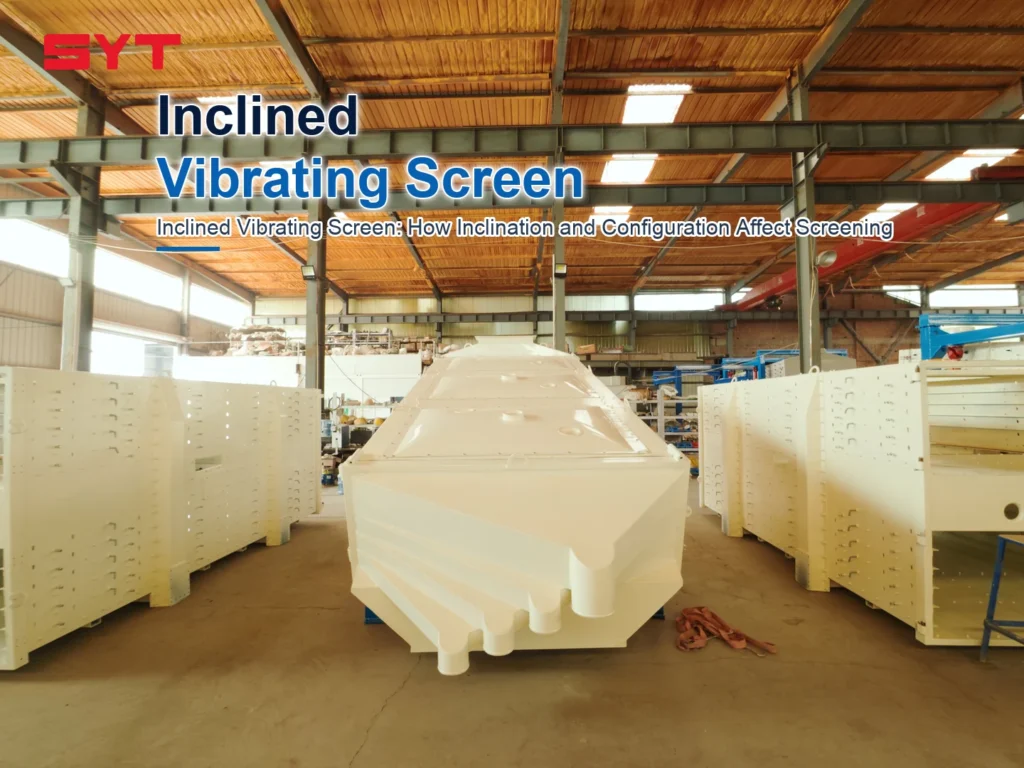
The problem usually is not the angle alone
Ask three people why a screen is underperforming and you may get three answers: the deck is too flat, the stroke is wrong, or the mesh is too small. All three can be right at once. On an inclined vibrating screen, slope, vibration direction, aperture, feed rate and material all push on one result — how long each particle spends on the deck and how many chances it gets to pass through. Change one and the others move: steepen the deck and the bed thins and capacity per square metre usually rises, but each particle has fewer chances to find a hole. That suits scalping a coarse, free-flowing feed and often hurts a fine cut with many particles close to the aperture.
How the variables actually interact
Inclination sets transport speed and residence time
Gravity does part of the conveying work on an inclined screen. A steeper deck accelerates material down the screen, thinning the bed and shortening residence time. Bed depth matters because screening happens at the layer touching the cloth; material buried above it must be restratified by the vibration before it can pass. Too deep a bed starves the apertures; too thin a bed lets coarse particles bounce across the cloth, reducing contacts with the mesh.
There is no universal optimum, but conventional inclined screens in aggregate and minerals duty are commonly installed between 15° and 30°, with roughly 20° a frequent starting point.
Deck inclination is not the same as vibration direction
The deck inclination is the physical slope of the screen surface, set at installation or by adjustment. The vibration direction — the throw angle or motor angle on linear-motion machines — is the straight line along which the box oscillates, set by the relative position of motor and exciter masses. It controls whether the machine throws material forward, upward or straight up, independent of how the deck is mounted. A deck at 20° with a throw line that also drives forward will convey aggressively; with a more vertical throw it lifts and turns the bed harder while conveying less, which can improve stratification at the cost of throughput. On circular-motion screens the path is elliptical and conveying comes largely from the slope, which is why they depend on inclination more than horizontal linear screens do. When a supplier quotes an angle, ask which one is meant.
Aperture, near-size material and the meaning of a cut
Aperture does not define the cut on its own. A 5 mm square opening will pass some particles larger than 5 mm if they approach edge-on, and reject many just under 5 mm if they arrive flat or in a crowd. The particles within roughly half to one and a half times the aperture — the near-size fraction — decide how hard the screen has to work. A feed with 30% near-size is a different duty from one with 8% at the same tonnage and cut, so capacity figures assume a typical feed and are no promise for your material; a machine that holds its cut on clean, dry feed may fail the same duty when near-size content or moisture rises.
Feed rate is the setting that drifts
Feed rate is the variable most likely to move in production. A screen configured for 60 t/h that receives 80 t/h runs a deeper bed, screens less efficiently and blinds more readily; if the angle was chosen for the lower rate, the machine then looks “wrong” when it is simply overloaded. Before changing the angle, confirm the feed is what the duty assumed — a belt scale or regular sampling tells you more than an adjustment made by feel.
Comparing three configurations
The table describes equipment types; a specific machine’s suitability still has to be confirmed against the duty.
| Configuration | Mechanism | Appropriate duty | Main trade-off | What to confirm |
| Conventional inclined screen (circular or elliptical motion) | Sloped deck; gravity assists conveying; circular throw stratifies the bed | Scalping, sizing and grading of free-flowing aggregate and minerals | Slope drives capacity, so fine or near-size-heavy cuts can lose efficiency; higher headroom | Achievable cut at your near-size content; angle range and adjustability; structure height |
| Horizontal linear screen | Level deck; a straight-line throw angled to convey; motion does the conveying work | Wet or sticky feed, fine cuts, low headroom, duties needing longer residence time | Lower capacity per unit area than a steep inclined machine of the same width; conveying duty falls on the drive | Stroke, speed and throw angle for your material; bed depth at discharge; spray arrangement if wet |
| High-inclination probability screen | Stack of steeply inclined decks with apertures larger than the target cut; separation by probability of passage, not size exclusion | High-tonnage grading of free-flowing granular material — manufactured and natural sand, mineral powders — with several cuts in one pass | Aperture selection is system-specific; deck aperture is not the final cut size and must be established for the material | Proposed aperture set for your cut; expected size distribution of each product; behaviour with your moisture |
The probability principle is often misread. Instead of a cloth at the cut size, a probability screen uses openings larger than the target separation and relies on deck geometry and steepness to make the effective opening smaller than the physical one. The aperture arrangement depends on the material and the screen design. For a 1.2 mm product the deck aperture might be considerably larger; how much larger is for the manufacturer to confirm on representative material. That is also why such machines are not interchangeable with a conventional inclined screen: motion, the means of separation, and the number and angles of decks are all part of the design.
A hypothetical example: dry manufactured sand
To make the trade-offs concrete, consider a plant grading dry manufactured sand: a 0–4.75 mm feed at about 60 t/h, a 1.18 mm cut, and a limit on fines below 0.3 mm. These figures are illustrative, not a recommendation or a predicted result. A conventional inclined screen at a shallow angle should hold residence time well and make a clean cut, but may run a deep bed at 60 t/h and blind if the sand carries moisture. Steepening the deck raises throughput and reduces blinding, at the risk of carrying near-size particles into the oversize. A high-inclination probability design approaches the same duty differently: several decks in one pass, each making a progressively finer separation.
None of this can be settled on paper. The next step is a trial on representative material, agreed with the supplier, recording:
Accepted size distribution — sieve analysis of each product stream, not just oversize and undersize.
Useful yield — the share of feed landing in the saleable product; a clean cut that rejects good material is not a good result.
Capacity — tonnes per hour sustained over a shift at the bed depth the machine was set up for.
Blinding and pegging — how quickly effective open area falls off, and whether it recovers with the standard cleaning method.
Wear — where cloth and deck structure abrade, and how accessible those parts are for replacement.
Record the settings alongside the results — deck angle, stroke or throw, speed, feed rate and moisture. A trial without those is a demonstration, not data. Put the same points into the written specification: the inclination range of the quoted model, whether a quoted angle is deck or vibration angle, the proposed aperture and deck arrangement, the size distribution to expect from each product, and the feed rate and bed depth the capacity figure assumed. For wet or dusty duties, the manual and your site’s validated procedures govern cleaning and isolation; ask what access they require.
Where Sanyuantang fits
Sanyuantang manufactures industrial screening equipment, including gyratory and probability-type machines alongside conventional vibrating screens. For duties where a single inclined screen struggles — multi-cut grading of dry manufactured or natural sand, dry mortar and mineral powders — the large-inclination swing probability screen is a related option worth discussing. It is a specific oscillating, probability-principle design rather than a conventional inclined circular-motion screen, and not the default answer for every inclined duty; suitability depends on the material and the cuts you need.
A useful first conversation covers the material and its bulk behaviour, feed size range and moisture, target separation and how tight the specification is, required output, and site constraints such as headroom, dust control or cleaning. With those, a configuration can be discussed properly and a trial on representative material arranged by agreement. To start, contact Sanyuantang with your duty details.
Email: info@sanyuantang.com
WhatsApp: +86-18639095165
Bringing it together
Inclination matters, but it is one variable in a set that must be chosen together. Deck angle sets transport speed and residence time; vibration direction sets how the bed is thrown and conveyed; aperture and near-size content set how hard the separation is; feed rate decides whether the bed stays where the design intended. A configuration is suitable when those four agree with each other and with the material, not when the angle matches a number in a catalogue. Write the duty down — material, feed size range, target cut and tolerance, output, moisture, site conditions — then ask each supplier to state the angle they mean, the aperture they propose, the basis for their capacity figure, and what a trial would record. That comparison is what turns an inclined screen selection from a guess into a decision.
FAQ
Q: What deck angle should an inclined vibrating screen run at?
A: There is no universal figure. Conventional inclined screens are commonly installed between about 15° and 30°, with 20° a frequent starting point; the right value depends on feed rate, near-size content, and whether the duty is scalping or a fine cut. Ask the manufacturer for the range their model supports, and why.
Q: Is deck inclination the same as motor or vibration angle?
A: No. Deck inclination is the physical slope of the screen surface; vibration angle is the direction of the throw, set by exciter or motor position on linear-motion machines. They act on the material differently, and a quotation that does not say which one it means is ambiguous.
Q: Can a steeper angle solve wet or sticky feed?
A: Partly, and not reliably. A steeper deck helps a damp feed move, but shortens residence time and can push near-size particles into the oversize. For persistently wet or sticky duties, a horizontal linear screen or a different screening principle is often more robust. Confirm any recommendation against your actual material, not a dry sample.
Q: How do I choose between a conventional inclined screen and a high-inclination probability screen?
A: Start from the duty: cut size, number of products wanted in one pass, tonnage and the material’s flow behaviour. Conventional inclined screens are the general-purpose choice for sizing and scalping; probability designs suit high-tonnage grading of free-flowing granular material where several cuts are needed. On a probability screen the aperture is not the final cut size, so the deck arrangement has to be confirmed for your feed.