
When a finished pile keeps drifting out of spec — too many fines in the 10–20 mm product, a deck that blinds halfway through every shift, a plant that only runs clean on dry feed — the machine is usually the last place the problem started. Choosing aggregate screening equipment is a matching exercise: your material, cut sizes and tonnage on one side, the screen’s motion, surface and configuration on the other.
The short answer: start with the feed and the finished fractions, not the machine. Establish the feed’s particle size distribution, the exact cut sizes and tolerances your buyers accept, the accepted tonnage per hour, the moisture and clay content, and how steady the feed is. Those answers eliminate most of the wrong options before anyone quotes a price.
There is no single best screen for every aggregate application. A machine that grades dry, washed sand beautifully can be the wrong tool for scalping blasted rock.
Six things to establish before you compare machines
- Feed material and particle size distribution
Not just the rock type, but the range of sizes arriving at the deck. A spread from fine dust to 300 mm lumps behaves very differently from a narrow, pre-crushed feed. - Required finished fractions
The cut sizes you actually sell, and the tolerance around each. “0–5 mm” and “0–5 mm with no more than a stated percentage passing 75 microns” are two different duties. - Required accepted output
Tonnes per hour of product that meets specification, not tonnes per hour passing over the deck. - Moisture and clay content
Surface moisture makes fines agglomerate; clay coats apertures and bridges openings. Both reduce open area and cause blinding. - Feed consistency
A steady feed lets a screen be tuned once. A feed that swings between dry and wet forces the machine to run at its worst condition all day. - Installation and maintenance conditions
Footprint, headroom, support structure, access for changing screen media, and who does the work. A machine nobody can service is not high-capacity for long.
What screening actually does
Screening separates particles by size: material finer than the aperture passes through the surface, coarser material stays on top and is carried to the discharge. The separation is never perfect — particles close to the aperture size may pass or be retained depending on orientation, bed depth, moisture and time on the deck.
The stage usually does one or more of four jobs. Scalping removes a small amount of oversize ahead of a crusher or a final product — a coarse cut aimed at protecting downstream equipment. Grading or sizing splits material into the fractions you sell, where accuracy matters most because a contaminated fraction gets rejected or discounted. Fines removal takes out material below a stated size to meet a specification or control dust. Feed preparation keeps downstream processes steady.
A limestone plant might scalp the crusher feed, grade the crushed output into three saleable fractions, then strip fines from one fraction to meet a spec. Three duties, three different screen setups.
The main categories of screening equipment
These categories are in general industrial use. They are not interchangeable, and grouping them here does not imply that every type suits every material.
| Screen type | Duty it may suit | Main selection trade-off | What to verify |
| Inclined vibrating screen | Scalping, coarse and medium grading, high volume with free-flowing feed | Steep slope and short residence time favour throughput over sharp separation in fine cuts | Maximum feed size against deck width; slope and stroke for your gradation; wear protection at the feed end |
| Horizontal linear vibrating screen | Accurate grading where material needs longer residence time | Lower capacity per unit of deck area; needs an even, controlled feed | Stroke and acceleration for damp or sticky feed; structural loads on the support frame |
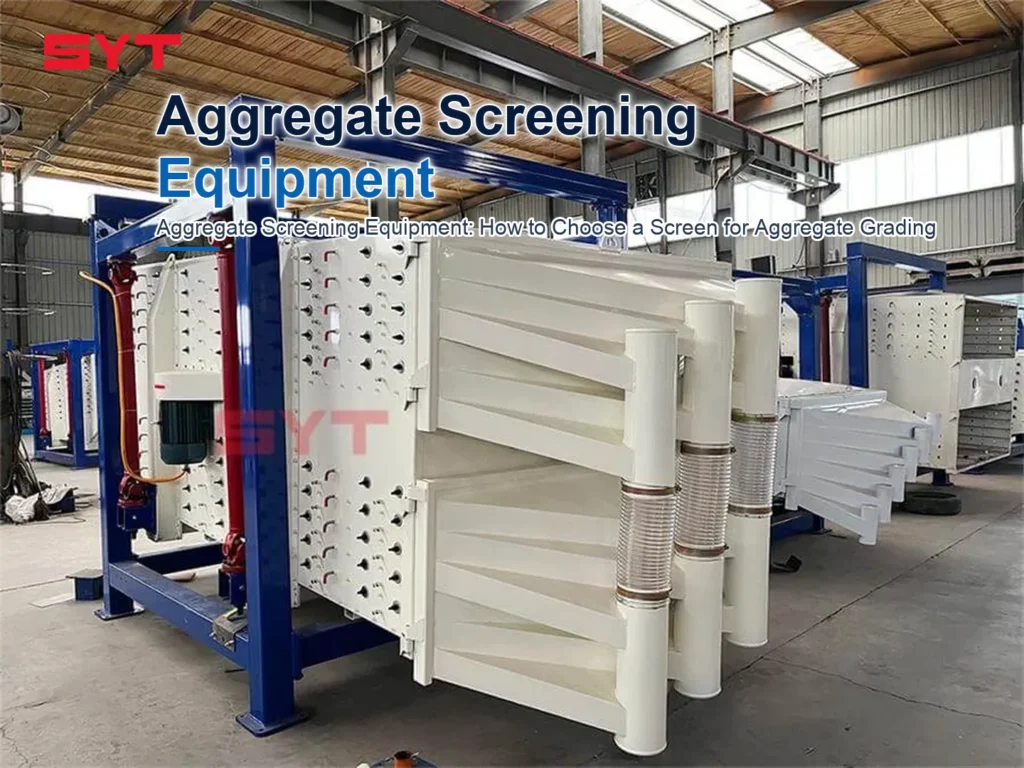
| Gyratory sand screening machine | Grading prepared sand and fine aggregate into several fractions; removing coarse particles from crushed sand | A fine-material tool — feed size, impact loading and abrasion limits are narrower than on heavy quarry screens | Maximum feed size; decks and achievable cut sizes; capacity for your material, not a nominal figure |
| High-inclination probability screen | Fine, damp or sticky material where conventional decks blind | Separation relies on the probability of particles meeting an aperture, so cut accuracy is generally lower | Whether your specification tolerates the achievable accuracy; aperture and surface options |
The practical lesson: screen type follows duty. A gravel screening machine sized for scalping coarse abrasive feed and a fine-material deck grading damp sand into four fractions are different machines solving different problems that share the word “screening.”
If you’re unsure how to select the right model, feel free to contact us right away—our experienced engineers are here to help you choose the right one.
Email: info@sanyuantang.com
WhatsApp: +86-18639095165
The factors that decide the specification
- Maximum feed size and gradation
- The largest lump sets the minimum deck width and the robustness of the feed arrangement; the gradation sets how load distributes across the deck.
- Cut sizes and screen aperture
- The aperture is the physical opening. The product size is what actually comes off the discharge. They are not the same number, and the gap widens with near-size content, moisture and bed depth — which is why a supplier should ask for the tolerance on each fraction, not only the cut size.
- Screen surface
- Woven wire, perforated plate, polyurethane and rubber behave differently with abrasive, damp or elongated material. The choice affects open area, wear life and how readily the deck blinds.
- Number of decks
- Several decks can produce several fractions from one feed: broadly, the number of decks corresponds to the number of cuts, with coarse material leaving first and fines passing the last deck. The actual arrangement depends on the machine configuration. Decks do not add capacity — each has to handle the tonnage reporting to it.
- Moisture, clay and sticky material
- Damp fines agglomerate into balls that behave like coarse particles; clay smears across apertures. Screening aggregate wet therefore needs a different approach: check moisture at the screen rather than at the pit, and establish whether the material can be dried, washed or blended first.
- Near-size particles
- Material within roughly the aperture dimension is the hardest to separate. A feed heavy in near-size particles needs more residence time, a different surface or a different motion — and will give a less clean cut than a feed with a gap in its gradation.
- Feed rate and distribution
- A screen performs at its design rate only when material is spread across the full width. Feeding to one side or in surges creates a thin bed in one area and an overloaded bed in another, and the overloaded area separates badly.
- Abrasion and maintenance access
- Quartz-rich and crushed material wear media and discharge lips quickly. Check what is replaceable, how long a change takes, and whether it can be done without dismantling half the plant.
Why capacity is not the same as quality
A high feed rate says how much went in. It says nothing about how much came out as saleable product.
The number that matters is accepted output: tonnes per hour meeting specification, per fraction. Four things separate a good result from a poor one. Oversize carrying useful product away with it means losing saleable material to waste. A fraction contaminated by unwanted sizes means the cut is not holding. Blinding reduces open area through the shift, so output falls even though the feed rate never changed. And an unsteady feed hides all three, because the plant is always reacting instead of running at a stable point.
Assess performance over a period that represents real conditions — a full shift with sampling at intervals, not a short run on dry material. A machine that looks good for ten minutes and blinds by the third hour has not been evaluated yet.
A hypothetical example: grading crushed sand into three fractions
The following is an illustrative example, not a customer project or a record of results.
A plant producing crushed sand wants to split output into 0–1 mm, 1–2.5 mm and 2.5–5 mm fractions, with oversize returned to the crusher. It has a routine sieve analysis of its feed but has been running a single-deck screen and blending afterwards, so results vary.
What a supplier needs before proposing a configuration: the full feed gradation including near-size particles around each cut, moisture at the screen, clay content of the source rock, accepted tonnage per fraction, tolerance on each cut, and available footprint and headroom.
None of that can be inferred from the words “crushed sand.” Two plants working the same nominal material at different moisture levels may need different deck arrangements, surfaces and motions. A plant at 6% surface moisture faces a blinding problem a plant at 1% does not.
This is where a trial on representative material earns its cost. Running a sample of the actual feed on a proposed configuration shows how it behaves on that surface at that bed depth, and whether the cuts hold — along with problems specifications never describe, such as pegging on elongated particles. Trial availability should be discussed with the supplier rather than assumed.
Where a gyratory sand screening machine fits
Once the duty is defined as grading prepared sand or fine aggregate into several fractions, a gyratory sand screening machine is a reasonable option to examine. Sanyuantang’s Vibrating Sand Screening Machine is described as a gyratory sifter used to screen crushed sand: it removes coarse particles from crushed sand and separates sand into different size fractions, and the product page lists sand and gravel production lines among its applications.
Its motion is gyratory or reciprocating rather than the circular or linear motion of a conventional vibrating screen, which gives material a longer, gentler path across the surface — useful when the priority is a clean cut on fine material rather than moving large tonnage of coarse rock.
It is not a universal answer. For coarse gravel, large rock, heavy impact loading or highly abrasive feed, confirm with Sanyuantang whether a heavier-duty screen or another configuration is required.
What to send a supplier
Material description and source, including rock type
Maximum feed size
Particle size distribution, if available
Required finished fractions and cut sizes, with tolerances
Required accepted output per hour for each fraction
Moisture at the screen, and clay or fines content
Current screening problems: blinding, pegging, contamination, lost product
Available installation space, headroom and support conditions
Photos, a material sample or a description of the current process
A material trial can be discussed with Sanyuantang where a sample is available and the duty warrants it. It is not automatically part of every enquiry.
FAQ
Q: What is the difference between aggregate screening and aggregate grading?
A: Screening is the operation — separating material by size on a screen surface. Grading is the result — the distribution of sizes across the fractions you produce, measured against a specification. A plant can screen material and still ship a poorly graded product if the cut is not holding.
Q: How do I choose screen openings for aggregate?
A: Work back from the finished fraction and its tolerance, not from the aperture alone. The opening sets what can pass; product size depends on near-size content, moisture and bed depth, so the required opening is usually not identical to the cut size. Confirm the relationship on a representative sample rather than a table, using a laboratory sieve analysis of feed and intended products.
Q: Why does wet or sticky aggregate cause screening problems?
A: Surface moisture creates liquid bridges between fines, so they clump and behave like larger material, while clay smears across apertures. Both cut open area and cause blinding, pushing fines into the oversize and letting contamination into finished fractions. Reducing moisture, changing the surface, or splitting the duty often helps more than running the existing machine harder.
Q: Is a gyratory screen suitable for all gravel applications?
A: No. A gyratory sand screening machine is built around prepared sand and fine aggregate grading. Coarse gravel, large rock, heavy impact loading and highly abrasive feed call for a different duty class, and suitability should be confirmed with the manufacturer.
Discussing your application
If you are working through a grading problem, the most useful first step is a short description of your material, the fractions you need and the output you expect. Send those through the Sanyuantang contact page and the conversation can start from your numbers rather than a general catalogue.
Email: info@sanyuantang.com
WhatsApp: +86-18639095165