
At a glance, a horizontal vibrating screen separates material on a deck that sits level or close to level, using a directed vibratory stroke to lift and convey the feed along the deck instead of letting gravity do the work down a slope. That layout earns its place where headroom is short or an existing structure cannot carry a tall inclined machine. It is not automatically the better screen: cut point, near-size load, moisture and the real installation envelope decide whether it fits. This guide explains the motion, compares horizontal and inclined arrangements on the criteria that affect a running plant, and sets out what to establish before a machine is quoted.
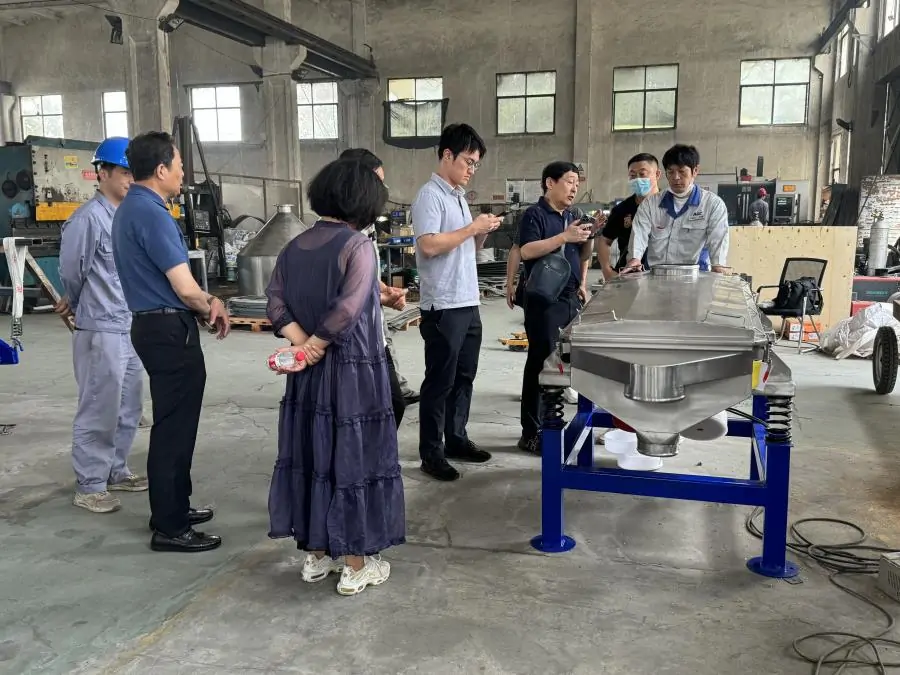
Most screening problems do not arrive as a question about machine type. They arrive as a constraint: the building has 2.6 m of clearance, the steel is already there, the conveyor discharge is fixed, and the product still has to make a clean cut. Someone then asks whether a horizontal vibrating screen would do the job, usually because an inclined unit will not physically fit above the existing bin.
The short answer is that it can, but only when the deck configuration, the stroke direction and the duty have been checked together. A screen sold as “horizontal” is a family of designs, not a single specification, and two units with the same footprint can behave very differently depending on how the drive is arranged and what the deck is actually set to.
What a horizontal vibrating screen is, and how material moves on a level deck
In a conventional horizontal screen, the deck is mounted level or with only a slight downhill slope, and the drive produces a straight-line, or linear, stroke at an angle to the deck surface. The stroke has two components. The vertical part throws material up and off the deck so apertures can clear and particles can reorient; the horizontal part pushes the bed toward the discharge end. Conveying comes from the drive, not from the slope.
On many linear-motion machines, two counter-rotating vibrating motors are mounted so that their axes sit at a relative angle to the deck. The resultant force of the pair defines the direction in which material is thrown. Changing that relative angle changes the throw direction, and therefore how much of the energy lifts the bed and how much of it conveys. Material then moves forward in a series of short hops rather than sliding, which is why the bed stays reasonably flat and thin along the deck.
Two angles get confused in conversation, and the confusion causes real problems at commissioning. The deck angle is the physical slope of the screening surface relative to horizontal. The stroke or throw angle is the direction of the vibratory force relative to that surface. A machine can have a level deck and a steeply directed stroke, or a sloped deck and a shallow stroke. The relative angle between the motor axes is a drive setting; it is not a statement that the deck is level. When you review a proposal, ask for deck slope and stroke direction as separate values on the general arrangement drawing.
Actual designs vary more than the category name suggests: truly flat decks, a few degrees of downhill slope to help wet or sticky feed, different drive architectures, or a combination of slope and stroke. That is why “horizontal” should open a layout discussion rather than close one.
Horizontal vs inclined screen: where each layout earns its place
An inclined screen uses gravity as a free conveyor. Feed enters at the top, accelerates down the slope, and the bed thins as it travels, which helps expose near-size particles to the apertures. The trade-off is height: a deck at a working incline needs a tall support frame, a tall feed arrangement and enough clearance above it for material to be thrown without hitting structure.
A horizontal screen removes that height requirement but asks more of the drive, because every metre of travel has to be generated by the stroke. Retention time is set by the stroke and deck length rather than by gravity, which gives more control over how long material stays on the deck — useful when a cut needs dwell time, and a liability when the bed is overloaded and material rides over the apertures.
Neither arrangement is universally more accurate or more productive. What changes is the kind of duty each one handles gracefully, and how much structure and space each one demands.
| Consideration | Horizontal (level or near-level) deck | Inclined deck | Why it matters in practice |
| Headroom | Low profile; suits existing buildings and retrofit | Needs a tall frame and clearance above the deck | Often the first constraint that rules one option out |
| Material travel | Generated by the stroke; length and angle set the conveying rate | Assisted by gravity down the slope | Affects retention time and bed depth on the deck |
| Retention time | Adjustable through stroke and deck length | Shorter, because gravity keeps material moving | Longer dwell can help difficult cuts but risks overloading |
| Feed distribution | Feed must be spread across the width; the deck does not self-level as readily | Gravity helps the bed spread and thin | Poor spreading shows up as uneven wear and misplaced product |
| Support structure | Often lower but heavier; dynamic loads go into the frame and floor | Taller structure, loads carried higher up | Check both static and dynamic loads with the structural engineer |
| Maintenance access | Decks and drive sit close together; plan access before you fix the layout | More open access around the deck | A screen you cannot inspect will be run blind |
| Screening performance | Depends on stroke, bed depth and near-size load | Depends on slope, speed and bed depth | Verify with representative material, not with a general rule |
Read the table as a set of trade-offs rather than a scorecard. The row that usually decides the outcome is headroom, because it is the one constraint a supplier cannot design around; everything else can be adjusted within limits.
If you’re unsure how to choose, please contact Sanyuantang Machinery. Our experienced engineers will recommend the right model for you.
Email: info@sanyuantang.com
WhatsApp: +86-18639095165
A selection checklist that survives commissioning
The information that determines whether a horizontal machine works is the same information that determines whether any screen works; what changes is how carefully it has to be gathered, because a level deck has less margin for a badly characterised feed.
Start with feed gradation: a full sieve analysis of the material as it will actually arrive, not the specification of the product you intend to make. Include the fines and the oversize, because both load the deck. From that analysis, identify the cut points — the aperture sizes that define your product streams — and then calculate the near-size percentage, the fraction of feed sitting within roughly half an aperture of each cut. Near-size particles either pass with difficulty or blind the aperture, and they set the practical capacity of the deck far more than total tonnage does.
Then record moisture content and how it behaves: surface moisture, clay content, whether the material cakes when squeezed. A dry granular feed and a damp one with the same sieve analysis can behave like different materials. Add bulk density and angle of repose, because both affect bed depth and how feed spreads at the inlet. State the target accepted throughput for each product stream, not just the feed rate, and be clear about which stream is the saleable one.
The remaining inputs are geometric. Deck count follows from how many cuts you need; usable area follows from the deck dimensions after deducting the areas occupied by the feed box, discharge lips and any blanking plates. The installation envelope is the space you can actually give the machine: height under the existing steel, footprint, support point positions, and clearance for feed and discharge chutes. Leave room for maintenance access — deck inspection, screen media changes, motor and bearing access — and decide in advance how the machine will be isolated and cleaned, following the manual and your site’s validated procedures rather than a generic routine.
One further item deserves its own line in the specification: what counts as product loss. Oversize reporting to the fines stream, or undersize carried out with the oversize, is lost product or a quality claim waiting to happen. Set the acceptable limit for each stream before the machine is sized, then ask how the proposed configuration is expected to meet it.
A hypothetical example: dry sand with a low ceiling
Consider a plant that screens dry quartz sand into three streams at cuts of roughly 0.5 mm and 1.2 mm, with a target of about 40 t/h of accepted fine product. The building has 2.6 m of clearance under the steel, the feed arrives by conveyor at a fixed height, and there is no room to raise the roof. This is a hypothetical case, used to show how the decision is made rather than to report a result.
An inclined deck is the obvious first choice on a greenfield site, and the first thing to check is whether it fits. At 2.6 m it almost certainly does not, once the frame, feed box and discharge lips are accounted for. That is when a horizontal or near-horizontal arrangement becomes a serious candidate.
What would decide the question is not the machine label but four pieces of evidence. First, the sieve analysis: if the feed is tightly graded with very little near 0.5 mm, the deck has an easier job than the tonnage alone suggests; if a third of the feed sits within half an aperture of either cut, the effective load is much higher than 40 t/h. Second, moisture: dry quartz sand at low surface moisture is a forgiving feed, but the same material at 2–3 % can blind a fine deck and force a different aperture strategy. Third, the layout drawing: deck slope, stroke direction and drive position relative to the support points all have to be visible on the same drawing, because a proposal that says “horizontal” without those values has not yet answered the question. Fourth, support and access: the machine’s dynamic loads into the existing steel, and whether the decks can be reached for inspection without dismantling the chutes.
If those four check out, the arrangement is worth pursuing to a quotation. If the near-size load is high and moisture is uncontrolled, a horizontal deck will still screen, but the honest expectation is a lower stable throughput or a coarser first cut — a trade-off better discovered in the specification than in the first week of production.
Where a linear vibrating screen fits, and what Sanyuantang needs to know
The energy and conveying behaviour described above is what linear-motion machines are built around. Sanyuantang manufactures industrial screening equipment, and its linear vibrating screen with dual vibrating motors is the relevant starting point for a horizontal or near-horizontal layout: two vibrating motors produce linear material movement along the deck, and the published applications include building sand and quartz sand.
That describes the equipment type and its listed applications, not a guarantee for every duty. A linear-motion drive does not by itself establish that a given deck is level or near-level; whether the proposed configuration suits a low-headroom installation has to be confirmed from the actual deck arrangement, stroke direction and support layout for your site. Treat the product page as the opening of an engineering conversation rather than its conclusion.
To make that conversation efficient, send the material and the constraints together: material type and bulk density, a full sieve analysis of the feed, the cut points you need, moisture content and behaviour, target accepted throughput per stream, the near-size percentage, the installation envelope with support point positions, and your access and cleaning requirements. With those in hand, a supplier can propose a deck configuration and show the assumptions behind it. A trial on representative material is worth discussing, subject to agreement on quantity, logistics and what the trial is meant to prove; it will not replace a layout review, but it can settle questions about blinding and bed behaviour that no drawing will answer.
Questions that come up before a decision
Q: Can a horizontal screen really convey material on a level deck?
A: Yes, provided the stroke is directed so that part of the force acts along the deck. Material is thrown forward in short hops by the horizontal component of the stroke and lifted by the vertical component, so forward travel does not depend on slope. The practical limit is bed depth: if feed arrives faster than the stroke can move it, material builds up and screening efficiency falls, even though the deck is level.
Q: Is deck angle the same as the motor setting?
A: No, and the two are set independently. The deck angle is the physical slope of the screening surface; the motor setting determines the direction of the vibratory force relative to that surface. A machine with a level deck can have a steeply inclined stroke, and the relative angle between two motor axes is a drive parameter, not evidence that the deck is flat. Ask for both values on the drawing.
Q: Are horizontal screens better than inclined screens?
A: Neither is better in general. An inclined deck uses gravity to help convey and thin the bed and is often simpler to run on dry granular duties where height allows. A horizontal deck solves a height problem and gives more control over retention time, at the cost of a drive that must do all the conveying and a layout that needs careful feed spreading. The right choice follows the duty, the space and the feed, not the category.
Q: What trial data would justify choosing one?
A: Data that reflects your material and your cut: throughput at steady state, the size distribution of each product stream, the proportion of near-size material misplaced into the wrong stream, and observation of the bed — depth, blinding, and whether the deck clears itself between cycles. A trial that only shows material moving from one end to the other proves very little.
A horizontal vibrating screen is the right answer when headroom or structure rules out an inclined machine and the feed is characterised well enough to size a level deck honestly. What determines suitability is a small set of facts: the sieve analysis, the near-size load around each cut, the moisture behaviour, the throughput you need from each stream, and the envelope you can actually give the machine. Get those right and the machine type follows; skip them and the layout will be adjusted on site, which is the most expensive place to adjust anything.
The next step is to put those facts in front of an engineer with a drawing. Send your material data, cut points and site constraints through the Sanyuantang contact page and ask for a proposed deck configuration with deck slope, stroke direction and support arrangement shown explicitly. That single request will tell you more than any comparison of machine categories.
Email: info@sanyuantang.com
WhatsApp: +86-18639095165