
Recycled concrete fines not grading out as expected?
This guide compares concrete screening equipment for scalping, grading and fine-sand duty.
At a glance
Grading crushed concrete into saleable fractions usually takes more than one screen, because scalping, sizing and fine classification place different demands on a deck. The difficult stream is the fines, where adherent cement paste, dust and moisture make recycled sand behave quite unlike natural sand. This guide separates those duties, shows where each screen category fits and where it fails, lists the measurements that decide the specification, and explains when only a trial on your own material can settle the question.
The fine fraction decides the choice
Most recycling plants handle the coarse end without much trouble. A crusher reduces the demolition concrete, a magnet pulls the rebar, and a scalper takes off the oversize. Trouble starts downstream, when someone tries to turn the minus-several-millimetre stream into a graded sand product and finds that it blinds the mesh or will not hold the grading curve a buyer asked for.
The reason is that crushed concrete is not simply smaller concrete. Once cured, a proportion of cement paste stays attached to the original aggregate, and crushing generates a large quantity of paste-rich dust. That dust is soft, absorptive and cohesive when damp, and it reports to the fine fractions — precisely where screening is least forgiving. In practice, concrete screening equipment is chosen around the behaviour of the smallest particles in the feed, not around tonnage. Nor is wet fresh concrete from a mixer or truck chute part of this discussion: it is a different material with a different handling problem, and the equipment logic does not transfer.
Where screening sits in a recycling line
A typical installation runs roughly like this: inspect and remove unsuitable material, crush, separate metals, then screen and manage the fractions.
The order is not fixed: some plants pre-scalp to protect the crusher, some remove steel both before and after it, and fines may be pulled off at more than one point. The sequence behind any concrete recycling screening equipment choice depends on the feed, which is why a line built for clean block looks different from one built for mixed construction and demolition material.
Screening separates by size; it does not clean. A deck cannot take wood, plastic, gypsum or soil out of a fraction except incidentally, when the contaminant happens to be coarser or finer than the cut. Where a buyer’s specification limits those contaminants, they must be controlled upstream — by inspection, air classification, density separation, or by refusing the load.
Scalping protects the line; grading defines the product
Scalping is coarse, high-impact work, judged on throughput and survival rather than grading accuracy. Heavy-duty scalping decks are built for it: robust frames, steep angles, thick wear protection, apertures wide enough that the cut is unambiguous. The limitation is precision. A scalper makes a rough split, and its oversize still carries fines clinging to lump surfaces. It governs top size; it does not make a product.
Grading screens make the cuts that define products, and inclined versus horizontal is a real trade-off rather than a preference. Inclined screens use gravity to help move material, which generally gives good throughput per unit of area on free-flowing feed. Horizontal screens convey with a straight-line or elliptical motion, suiting flat decks, low headroom and feeds that need longer retention to separate. For recycled concrete the deciding constraint is usually moisture rather than mechanism: damp fines are cohesive, and cohesion turns a grading problem into a conveying problem.
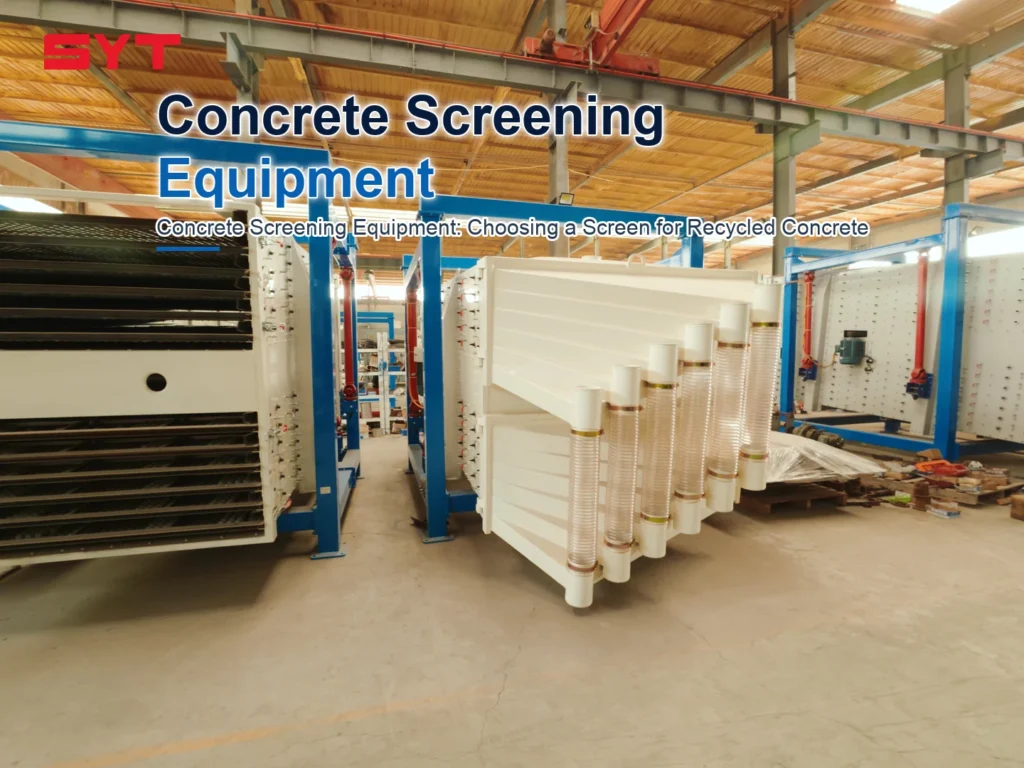
The final duty — splitting a prepared fine stream into sand grades — is the one this article is really about, and a gyratory sifter is one option among several. A gyratory machine imparts a horizontal, gyratory motion rather than the vertical throw of a conventional vibrating screen, and is typically built with multiple decks to make several cuts in one pass. On free-flowing, reasonably dry and consistent feed it can produce a tight, repeatable split with gentle action on the particles. Whether it suits recycled concrete fines is a separate question no product page answers, because the material is abrasive, variable and often damp — three characteristics that all work against fine screening.
What recycled concrete does to a screen
Six factors dominate, and they interact.
- Steel: Rebar, wire mesh, tie wire and prestressing strand are often ferrous, but magnets may not capture every fragment. Strand can whip, wrap or pierce a deck, while small fragments pass a magnet and then peg in a fine aperture. Whatever remains after metal separation has to be anticipated in the deck specification, not discovered on the first shift.
- Wood and plastic: These float on top of the bed, riding over the deck or wrapping around cross members — and they bias sampling, because a grab sample that looks clean may simply have shed its light fraction.
- Dust and adherent fines: Crushing coats coarser particles with fines, so some of that coating reports to the oversize product and affects both yield and perceived quality.
- Abrasion: Recycled concrete contains hard original aggregate, and frames, side plates and mesh wear unevenly — fastest near the feed point. Mesh cost per tonne is a genuine operating number. Wear is also a quality issue: a worn mesh produces an off-specification cut that may go unnoticed until a customer tests the product.
- Variable feed: Demolition material changes lot by lot, and a screen specified around one week’s material may be wrong for the next.
- Moisture: The factor most often underestimated. Damp fines blind apertures and bridge across them; dry fines generate dust. Somewhere between the two is a window where fine screening works, and finding it usually means controlling moisture upstream rather than adjusting the screen.
Between residual steel, wear and moisture variation, crushed concrete screening is more expensive to run well than the tonnage alone suggests.
Choosing between the three categories
The table compares the three general categories above. It describes industry-wide equipment types, not a claim that any one supplier offers all three. Read it as a placement guide: find the duty you need, then check the limitation against your feed.
| Screen category | Typical placement in a recycling line | Main limitation for recycled concrete | Questions to settle before selecting |
| Heavy-duty scalping screen | Ahead of or after primary crushing; top-size control and protection of downstream equipment | Rough split only; oversize carries adhering fines; vulnerable to tramp steel and impact | What is the maximum lump size and impact energy? What steel remains? What top size must the oversize meet? |
| Inclined or horizontal grading screen | Product sizing after crushing and metal removal; the main multi-fraction cut | Moisture and cohesion cause blinding and carry-over; efficiency falls on damp fines | What fractions and tolerances are required? What is the feed moisture range? Is there height for an inclined unit? |
| Gyratory fine-sand sifter | Final classification of a prepared, relatively dry fine stream into sand grades | Sensitive to damp, cohesive or abrasive feed; not a scalper and not a contaminant remover | What is the actual size distribution of the fines? What is the moisture? What contamination remains? What output is needed? |
These are not competing options for the same job. A plant that buys a fine sifter hoping it will also scalp, or a scalper hoping it will grade, is asking a machine to work outside its purpose. Most lines need at least two of the three, and the sequence matters more than the individual choice.
If you’re unsure how to choose, please contact Sanyuantang Machinery. Our experienced engineers will recommend the right model for you.
Email: info@sanyuantang.com
WhatsApp: +86-18639095165
A hypothetical example: grading prepared concrete fines
Consider a plant that crushes demolition concrete to a nominal minus-20 mm, removes ferrous metal with an overband magnet and a drum, and screens the result into 20–10 mm, 10–5 mm and minus-5 mm. The first two fractions move readily. The minus-5 mm stream is the problem: roughly half the output, high in paste-rich dust, and the local market will pay for a graded 0–2 mm and 2–5 mm split but not for an unclassified blend.
Several things are unknown at the outset, and none can be settled by reasoning alone. The size distribution of the minus-5 mm stream is unknown until measured, and one sieve analysis on a dried sample says nothing about moisture sensitivity. Service moisture is unknown and probably varies by season and by whether the stockpile is covered. Residual steel and light contamination are unknown. Abrasiveness is unknown in any quantitative sense, and the acceptable output rate is a commercial decision as much as an engineering one.
A representative-material trial is the standard way to close those gaps: a sample taken across the stream rather than from the surface of a stockpile, at production moisture, with contamination intact, and acceptance criteria agreed in advance — sieve analysis of each fraction, visible contaminants, deck behaviour over a run long enough to show blinding, and mesh condition afterwards. Two cautions. A trial on dried, hand-picked material proves nothing about the plant, because it removes the two variables most likely to cause failure. And a grading result is not an approval: passing a grading curve is one requirement among several. ASTM C33/C33M, the standard specification for concrete aggregates, illustrates the pattern — it permits crushed hydraulic-cement concrete as a coarse aggregate constituent while setting grading, fineness modulus, organic impurity and other requirements that must each be demonstrated (ASTM C33/C33M-24a). End-use acceptance remains a matter for the specifying engineer and the governing standard in your market.
What to measure before you request a quotation
A supplier cannot size a screen from a description; the useful enquiry is a data set. Collect the feed maximum size and full size distribution rather than an average; the steel and wire left after metal separation; other contaminants present, and which the specification limits; service moisture with its seasonal variation; abrasiveness, for which the original aggregate is a reasonable indicator; required fractions, tolerances and intended end use; output as a rate at a stated availability rather than a peak; and installation conditions — height, floor area, support, power, and access for mesh changes. Site and cleaning requirements are easy to omit and hard to retrofit: a deck that is difficult to inspect rarely gets inspected.
Where Sanyuantang fits, and where it does not
Sanyuantang manufactures industrial screening equipment, and the relevant machine here is a gyratory sifter for screening crushed sand, the vibrating sand screening machine. Its product page presents a multi-deck unit that removes coarse particles and divides sand into grades — the fine-classification duty described above.
Scope needs to be precise. That page does not establish suitability for unprocessed demolition concrete, for feed containing reinforcing steel, or for high-impact or large-lump duty. The machine is a candidate for the prepared fine stream — already crushed, with metals removed and scalped to a controlled top size — and its fitness for a specific recycled fines duty should be confirmed against a representative sample. Sanyuantang does not supply a complete demolition recycling plant, so scalping and coarse grading remain separate decisions.
Questions we are asked about recycled concrete screening
Q: Can one screen produce all my fractions?
A: Sometimes, if it has enough decks and the feed is prepared. More often the answer is two stages: a coarse split, then fine classification. What decides it is the number of cuts, the width of the size range and how much of the feed is fine.
Q: Why does mesh blind when the material is damp?
A: Damp fines are cohesive, and cohesion makes particles bridge across apertures instead of falling through. Adding water helps in some circuits by turning dust into slurry; drying helps in others. Test rather than guess.
Q: Can screening remove wood and plastic?
A: Only incidentally, where the contaminant is coarser or finer than the cut. Size separation cannot tell a 10 mm wood chip from a 10 mm concrete particle. Control these upstream.
Q: How do I know the machine will perform before I buy?
A: Ask for a trial on representative material and define acceptance criteria in advance. A trial on a prepared or dried sample is not representative, and a grading result alone does not establish an end-use specification.
The decision, in short
A suitable screen follows from three things: what the feed contains, which cut each stage must make, and what the output has to satisfy. Scalping protects the line and sets top size; grading screens make product cuts and are limited by moisture and cohesion; fine classification of the sand fraction is the most demanding duty and the one most dependent on a prepared, consistent feed. Screening divides by size and does not, by itself, deliver contaminant-free or specification-compliant aggregate.
So the next step is not machine selection but a sample and a set of numbers: maximum size, distribution, remaining steel, moisture, abrasion, required fractions and output, and the specification the product must meet. With those in hand, contact Sanyuantang to discuss whether a gyratory fine sifter suits your prepared fines stream, and to agree the scope of a representative-material trial where one is warranted.
Email: info@sanyuantang.com
WhatsApp: +86-18639095165