
Liquid sifting solutions pass a process liquid through a screen with a specified aperture to retain coarse particles, lumps and some foreign material. The liquid and smaller particles continue to the next process. Selecting the equipment starts with deciding which fraction you need to keep, then testing aperture size, sustained flow, product loss and cleaning requirements with the actual material. Mesh count and a nominal hourly output are not enough to select a machine.
At Sanyuantang, we recommend looking at the liquid and the production conditions together. Starch slurry, ceramic slurry and paint may all need screening, but viscosity, particle shape and the cost of losing useful product can differ substantially. A useful equipment discussion turns these differences into trial conditions and acceptance criteria.
What should the liquid screening process retain
For liquid scalping, the undersize stream is usually the product and the retained material is discharged as reject. Check both contaminant removal and the amount of useful product leaving with the reject. When recovering valuable solids is the objective, the retained fraction may instead be the product; solids recovery, residual liquid and downstream treatment then become the priorities.
A screen separates particles according to their relationship with the aperture. It does not remove dissolved salt, sugar or other dissolved substances. Fine dispersed particles smaller than the aperture may also pass through. If the target is lower turbidity, colloid removal or a low-moisture solid, assess finer filtration, membrane separation, centrifugation or filter pressing as appropriate to the process.
| Process task | Streams to examine | Question before equipment selection |
|---|---|---|
| Remove coarse particles and foreign material | Undersize product and retained reject | Do contaminant and useful-product sizes overlap? |
| Control lumps or skins | Retained material and finished product | Would breaking the lump release material that should still be rejected? |
| Recover valuable solids | Retained product and losses in the filtrate | What solids loss and residual liquid are acceptable? |
| Preliminary dewatering | Drained liquid and retained solids | Will centrifugation or drying still be required? |
How the liquid changes the screening requirement
The material determines which operating conditions deserve the most attention. One machine configuration should not be assumed to handle every liquid in the same way. Confirm the aperture, wetted materials and sustained flow with representative samples before selecting equipment.
| Example liquid | Typical screening objective | Condition that needs checking |
|---|---|---|
| Starch slurry | Control fibres and coarse contamination | An overly fine aperture may retain useful starch; analyse the reject |
| Fruit juice or plant extract | Control coarse pulp and fibres | Pulp to be retained and fibres to be removed may overlap in size |
| Syrup or honey | Remove coarse foreign material and lumps | Viscosity changes with temperature; test close to production conditions |
| Paint or ink | Control skins and agglomerates | Rheology, solvent compatibility, foam and cleaning affect operation |
| Ceramic slurry or glaze | Remove coarse particles and foreign material | Solids loading, abrasion and metal-contamination limits affect screen selection |
For a starch-specific application, see our starch slurry screening guide. Whatever the liquid, inspect the retained fraction before treating everything on the screen as waste.
How viscosity and solids content affect sustained flow
The same screen can pass clean water and concentrated slurry at very different rates. Higher viscosity increases resistance through the apertures. More solids or a heavier contaminant load can cover the screen more quickly. As deposits build up, the initial flow may no longer be sustainable.
Report viscosity with the test temperature and measurement method. For thixotropic or shear-thinning liquids, record mixing, resting and sampling conditions as well. A freshly mixed sample may behave differently from material restarting after a production stoppage. If viscosity data are unavailable, a sample and process video can start the discussion; descriptions such as “like water” cannot establish the final operating range.
State whether solids content is a mass fraction or a volume fraction. These cannot be interchanged without the necessary conversion data. Particle-size distribution, shape and fibre content can change screen loading even when the overall solids concentration is the same.
We encourage customers to provide samples from actual operating conditions. Comparing sustained flow, useful-product loss and cleaning time gives a firmer basis for assessing equipment and operating cost than selecting by a general description alone.
How to choose liquid screening equipment
Set the product-quality requirement before comparing equipment size. Aperture, wire diameter and effective screening area need to be considered together. A smaller aperture may retain more coarse material while reducing flow and increasing useful-product loss. Enlarging it simply to increase output may send the target contamination downstream.
The Sanyuantang 450 vibrating filter screen is a candidate for limited-space, batch-transfer or smaller-flow duties. Suitability for a particular liquid depends on sustained-flow, reject-discharge and cleaning trials. “450” is a model designation; confirm the effective screening diameter, screen construction and supplied configuration for the order.
Where a larger screen area, continuous reject discharge or production-line integration is needed, assess a rotary vibrating screen configuration suited to the liquid. Check feed distribution, liquid discharge, reject routing and whether the installed height allows gravity drainage.
A process that must operate inside a pressurised pipeline requires a filtration system designed for the working pressure, temperature and cleaning method. A lid and gasket do not make an atmospheric vibrating screen pressure-rated. Pump-fed installations also need suitable pressure relief, buffering, overflow protection and shutdown interlocks.
How feed distribution and reject discharge affect operation
Concentrated feeding can overload one part of the screen while leaving other areas underused. During a trial, observe distribution, pooling, splashing and foam, and check the pump’s instantaneous flow. Meeting an average flow target does not establish that the screen can accept startup or tank-change peaks.
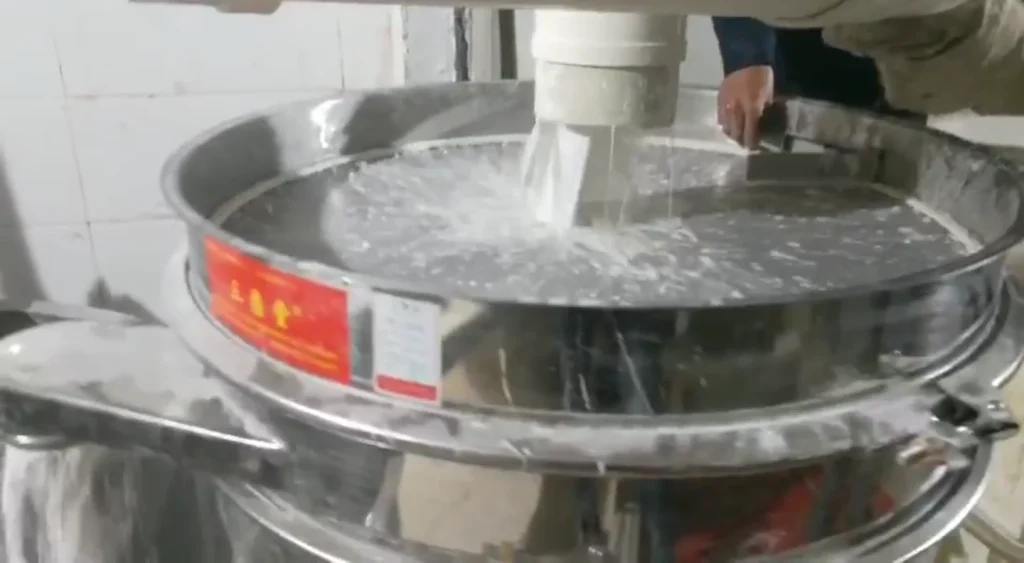
For uneven distribution, first examine the feed position and distribution method. Where the equipment is designed to accept a rotating scraper or distribution device, assess that option with the actual liquid. Check clearances, screen wear, product shear and cleaning access. Such a device may improve use of the existing screen area; it does not increase the physical screen area or establish a capacity improvement without a trial.
Retained material needs a controlled discharge route. Discharging too quickly may carry useful product out with the reject; insufficient discharge allows contamination to accumulate and reduces flow. Collect the undersize and reject separately, then test both target contaminants and useful components.
Check the compatibility of wetted metal, mesh, gaskets and any product-contact bonding materials with the liquid and cleaning agents. Food applications also need defined material documentation, weld finish, dismantling and drainage requirements. Stainless steel alone does not establish hygienic suitability for the complete machine.
What to check when a liquid screen blinds or blocks
Start by identifying the deposit. Near-aperture particles wedging into openings, sticky deposits, wrapped fibres and dried skins need different responses. Stop the machine, isolate the relevant energy sources and drain it as instructed before inspection or adjustment.
- Check whether temperature, concentration or material condition has changed from the trial, including upstream settling and lump formation.
- Check uneven feeding, excessive peaks and restrictions at liquid or reject outlets.
- Inspect screen tension, support and seals for looseness, deposits and bypass leakage.
- Compare screen and cleaning options within the product-quality limits, then measure flow and product loss again.
Ultrasonic or mechanical screen cleaning may be candidates for some duties, but liquid-compatible construction, wetted materials and sample results must be checked. A dry-powder trial does not establish performance with a viscous liquid. Dilution or heating also needs process approval because it may change formulation, quality or downstream energy use.
If the cause remains unclear, send Sanyuantang the liquid conditions, screen specification and an operating video. Our engineering team can help review the material state, feed distribution and reject arrangement before discussing a configuration change.
How to verify continuous liquid screening capacity
Use representative samples from normal production and reasonably adverse operating conditions. These may include lower process temperatures, startup concentration changes or batches with more contamination. A water test can check drainage and mechanical operation; it cannot verify production capacity for the actual liquid.
Record the batch, temperature, viscosity and measurement method, solids-content basis, aperture, wire diameter, screen configuration, feeding method, run time, sustained flow, reject quantity and cleaning time. Distinguish L/h, m³/h and kg/h. Record liquid density when converting between mass and volume.
For example, a requirement to remove coarse contamination continuously at 1 m³/h is a trial target, not a stated capacity for a machine. Acceptance should cover pooling during the run, oversize contamination in the product, useful-product losses in the reject and performance after cleaning and reassembly. A short bucket test cannot establish continuous production capacity.
Frequently asked questions about liquid sifting
Can a vibrating screen handle a high-viscosity liquid
Sometimes. Suitability depends on viscosity, rheology, aperture and solids loading together. Some liquids can be screened with an appropriate screen, drive and feeding arrangement. If the sample cannot maintain the target flow, compare a larger screening area or another filtration method.
Does cloudy undersize liquid mean the screen has failed
Not necessarily. If turbidity comes from particles smaller than the aperture, the liquid may remain cloudy after successful coarse-contaminant removal. Judge the result against the specified contamination and product requirements, not visual clarity alone.
Is mesh count enough to select a liquid screening machine
No. Mesh count can start the discussion, but final selection also needs aperture size, liquid properties, normal and peak flow, and the process interfaces. The same mesh does not give the same capacity with different liquids.
Can a clean-water trial verify slurry capacity
No. It can help check drainage and mechanical condition, but it does not reproduce slurry viscosity, solids loading, deposit formation or useful-product loss. Test representative process material before agreeing capacity.
Can liquid sifting remove dissolved substances
No. Ordinary particle screening does not remove dissolved salts, sugars or other dissolved components. Select a separation method that addresses the actual substance and required product quality.
Sanyuantang’s approach to a liquid screening proposal
Our recommendation is to agree what must be retained, turn the process conditions into a representative trial, and compare configurations against both output and product quality. A higher initial flow is of limited value if useful product leaves with the reject or frequent cleaning interrupts production.
When you discuss a liquid sifting solution with Sanyuantang, provide the liquid name, useful fraction, target contaminants and sizes, aperture, normal and peak flow, temperature, viscosity, solids content, cleaning method, available height and piping arrangement. Include food-contact, corrosive-media or flammable-solvent requirements where relevant. For an existing installation, add the screen specification, reject photographs and flow changes over time. These details help us discuss the equipment, trial and acceptance conditions around your process.
Sanyuantang manufactures screening and material handling equipment in Xinxiang, Henan, China. Learn more about our factory and discuss a material trial with our team before finalizing equipment acceptance requirements.

Email: info@sanyuantang.com
WhatsApp: +86-18639095165