
Dust escaping during manual bag emptying, a loaded screen and interrupted downstream flow may come from a mismatch between bag-emptying speed, extraction, screening and discharge. Review bag opening, emptying, foreign-material retention, dust collection and downstream conveying as one workstation, with separate checks for peak loading and sustained operation.
This guide covers manually emptied small bags followed by protective screening. For bulk bags, fully automatic opening or materials requiring a higher level of containment, Sanyuantang recommends a system matched to the packaging, material hazards and operating method.
Where dust comes from during bag emptying
Dust can escape while cutting the bag, displacing air as powder falls, shaking out residues and removing the empty bag. Looking only at the front of the loading opening can miss the stages that release dust into the operator’s working area.
Observe a complete cycle. Record the bag-opening position, drop height, the relationship between the bag and extraction opening, shaking method and empty-bag route. Dust escaping at one action suggests a need to review containment and the working path at that location. Persistent emissions across the workstation call for a review of capture airflow, filter resistance and leakage together.
| Observation | Where to check first | Possible explanation to investigate |
|---|---|---|
| Dust bursts out as emptying starts | Bag mouth and loading opening | Excessive drop or displaced air exceeding capture capacity |
| Dust appears when shaking a bag | Opening area and operator movement | The shaking action leaves the effective capture zone |
| Operation starts clean but later becomes dusty | Filters and filter-cleaning system | Filter loading or resistance rises during the run |
| Material accumulates despite normal extraction | Screen and material outlet | Bag-emptying peaks exceed screening or discharge capacity |
| Dust blows back from the outlet | Downstream conveying connection | Pressure relationships or sealing interfaces are mismatched |
How to check peak bag-emptying load
Hourly throughput does not describe the load entering the screen during a short bag-emptying event. Supply the bag mass, bags per hour and actual emptying time per bag when discussing equipment. Check whether the screen, buffer and downstream conveyor can accommodate that loading pattern.
For example, 40 bags of 25 kg each represent an average of 1,000 kg/h. If one bag is emptied in 15 seconds, the average feed rate during those 15 seconds is equivalent to 6,000 kg/h. This is a short-event loading calculation, not a stated equipment capacity or a requirement for continuous operation at 6,000 kg/h.
If screening and conveying can only process the hourly average, the installation needs a suitable emptying sequence, usable buffer volume or controlled feeding. Do not rely solely on telling operators to pour more slowly. Define how the station handles successive bags, intervals between bags and a temporary downstream stop without keeping the buffer permanently full.
How bulk density affects the buffer volume
For an initial estimate, material volume equals mass divided by the actual bulk density. Then account for permitted fill height, hopper geometry, bridging and space that cannot be used as buffer capacity. A lightweight powder and dense granules of equal mass occupy different volumes.
Do not substitute true particle density for bulk density or count the entire hopper volume as usable buffer. Aerated powder may be more expanded immediately after emptying than after it has settled.
Why more extraction airflow is not always better
Extraction must capture dust at the opening and emptying positions while overcoming the resistance of the enclosure, ducting and filters. Fan nameplate airflow alone does not establish workstation performance. Opening size, enclosure, operator movement, cross-draughts and filter condition all affect the capture path.
Insufficient extraction can allow dust to escape. Excessive local airflow can remove useful fine components, load filters and change the material composition reaching the next process. During a trial, examine dust exposure and the quantity collected; a clean-looking opening alone is not enough.
Decide where collected powder will go. Returning it to the batch depends on formulation, hygiene and traceability requirements. Residues in the collection system can become a source of cross-contamination after material or allergen changes.
Why the product screen and dust filter serve different tasks
The product screen retains out-of-size lumps and some foreign material. The dust filter separates particles from the extracted air. A dust-filter rating is not the product-screening cut size, and neither component replaces the other.
Choose the screen aperture around the product requirement, feed particle size and the shape of likely contaminants. Flexible packaging fragments, thin fibres and particles smaller than the aperture may not be reliably retained. Screening does not replace every foreign-material control; packaging management and appropriate detection or separation may also be needed.
Before specifying a deagglomerator, establish whether lumps are acceptable loose agglomerates or material that is damp, degraded or contaminated. Breaking up something that should have been rejected can send it into production.
How to compare integrated and separate stations
An integrated loading and screening station can shorten the transfer route and reduce intermediate connections. A separate arrangement can make it easier to position or maintain individual stages. Compare operating height, screen-removal space, dust-system access and the connections as part of the same layout.
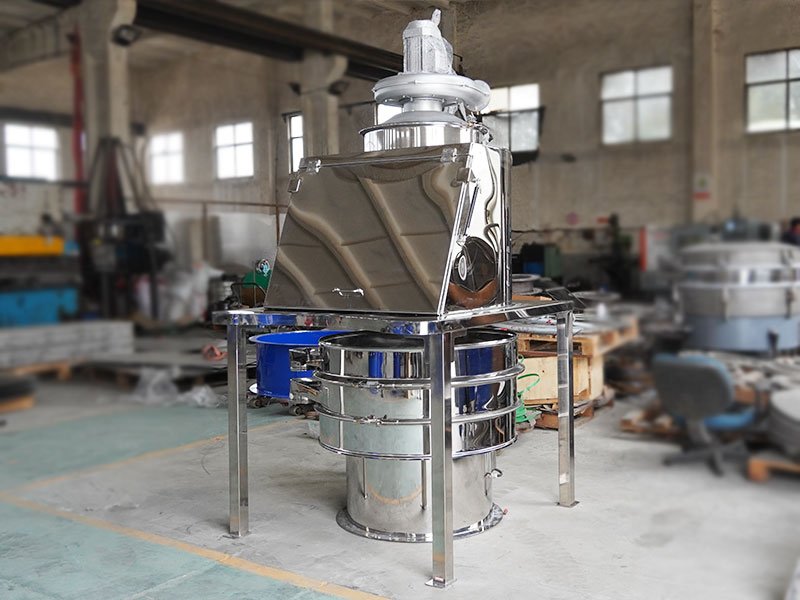
Factory example of an integrated bag dump station and vibrating screener. Final layout depends on loading height, access and downstream connections.
| Configuration | Condition worth assessing | Limitation to check |
|---|---|---|
| Integrated loading and screening | Short transfer route at a concentrated workstation | Operator height and screen-removal clearance |
| Separate screen after loading | Restricted equipment positions or independent maintenance | Transfer connections and intermediate accumulation |
| Screw conveying after screening | Controlled continuous discharge is required | Feed loading and loaded-start conditions |
| Vacuum conveying after screening | Enclosed transfer or movement between levels | Make-up air and the effect of negative pressure on the screen |
Our bag dump station provides a product starting point for the discussion. Select the actual workstation around material load, airflow and operation rather than bag count or screen diameter alone.
Where vacuum conveying equipment is connected, define make-up air, suction timing, seals and allowable negative pressure. An ordinary loading screener should not be treated as a pressure-rated or vacuum-rated vessel.
What to include in cleaning and material changeovers
Cleaning must include hidden product-contact and powder-return locations, not just the visible loading platform. Inspect the bag support grid, screen edges, gasket grooves, hopper corners, conveying connections and dust-return route.
Match the cleaning method to the powder and equipment design. After wet cleaning, hygroscopic-material duties need suitable drainage, drying and reassembly. For dry cleaning, use tools and collection methods appropriate to the dust. Avoid uncontrolled blowing that redistributes deposited powder into the working area.
For combustible dust, provide material-hazard information so appropriately qualified personnel can assess electrical selection, static control, explosion protection and isolation. A dust collector or stainless-steel construction alone does not establish suitability for the hazardous duty.
How to test the complete bag-emptying cycle
A useful trial covers opening, successive bags, shaking, empty-bag handling, reject discharge, downstream stoppage and changeover cleaning. Use the actual packaging and representative powder. A small bucket of material will not reveal all of the operating problems created by the complete cycle.
Record bag mass, emptying time, operating bag rate, aperture, product particle size, surrounding airflow, filter condition, retained material, collected powder and downstream flow. Assess dust control against the project’s requirements; “no visible dust” does not replace necessary measurement.
Agree acceptance in terms of continuous loading at the required cycle, screened-product quality, useful components lost in rejects or collected dust, emissions, blockage and blowback. Confirm whether cleaning and reassembly restore comparable performance. Set limits for the process rather than applying a universal bag rate or percentage.
Frequently asked questions about bag dump station dust control
Why does dust escape when a dust collector is already fitted
The capture position may be unsuitable, cross-draughts may interfere, filters may have excessive resistance or a short emptying event may displace air faster than the system captures it. Observe the escaping action and location, then check airflow, resistance and sealing under actual conditions.
Will a larger screen aperture solve material buildup
Only if the product requirement permits that aperture. Excessive feed, restricted discharge or powder bridging may be the real cause. Enlarging the openings without checking quality can send unacceptable material downstream.
Does an integrated station provide accurate dosing
Not automatically. Loading, screening and precise dosing are different tasks. A weighing or metered-feeding requirement needs defined weighing equipment, batch logic and permitted error.
Should the screen be sized only for average hourly throughput
No. Check bag mass and emptying time as well as the hourly average. A short feed surge may need buffering or controlled feeding even when the average output is within the screen’s sustained capacity.
Can collected dust go straight back into the product
Only where formulation, hygiene and traceability requirements permit it. Assess material changes, allergens and retained powder in the collection system before deciding the return route.
Sanyuantang’s recommendation for a loading and screening proposal
Review the whole workstation before replacing individual components. Match bag-emptying peaks to usable buffer and screening capacity, check extraction without excessive product loss, and confirm that the downstream connection can accept the discharge. Trial the complete operating cycle, including cleaning and a downstream stop.
To discuss a bag loading and screening workstation with Sanyuantang, prepare the material name, bulk density, particle size, moisture, packaging, bag mass, average bag rate, emptying time, aperture and conveying method. Add available height and space, changeover frequency, cleaning method and dust requirements. For an existing problem, a video from bag opening through empty-bag removal, reject photographs and the blockage location help us review the conditions together.
Sanyuantang manufactures screening and material handling equipment in Xinxiang, Henan, China. Learn more about our factory and discuss a material trial with our team before finalizing equipment acceptance requirements.

Email: info@sanyuantang.com
WhatsApp: +86-18639095165