
Quartz sand, as a fundamental raw material in industries such as glass, photovoltaics, electronics, and casting, has its particle size distribution directly affecting final product performance and market value. In the core upgrading process of screening, Screening Machine and Gyratory Screen are two mainstream but fundamentally different types of equipment. The choice is not simply “good” or “bad,” but rather a precise match based on material characteristics, product positioning, capacity requirements, and overall economic return.
Equipment selection should begin with the product cut size. This guide explains how to choose the right mesh size for sand by comparing mesh numbers, millimeters, microns and material condition.
 Rotary Vibrating Screen
 Gyratory Screen
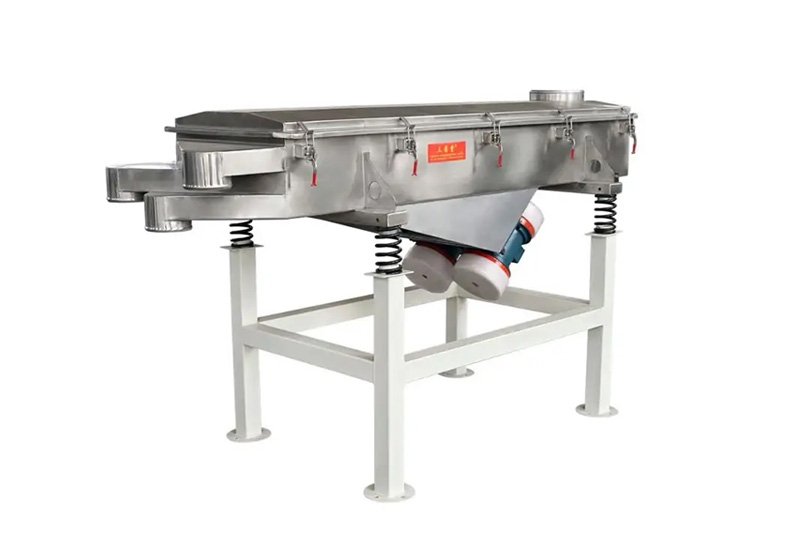

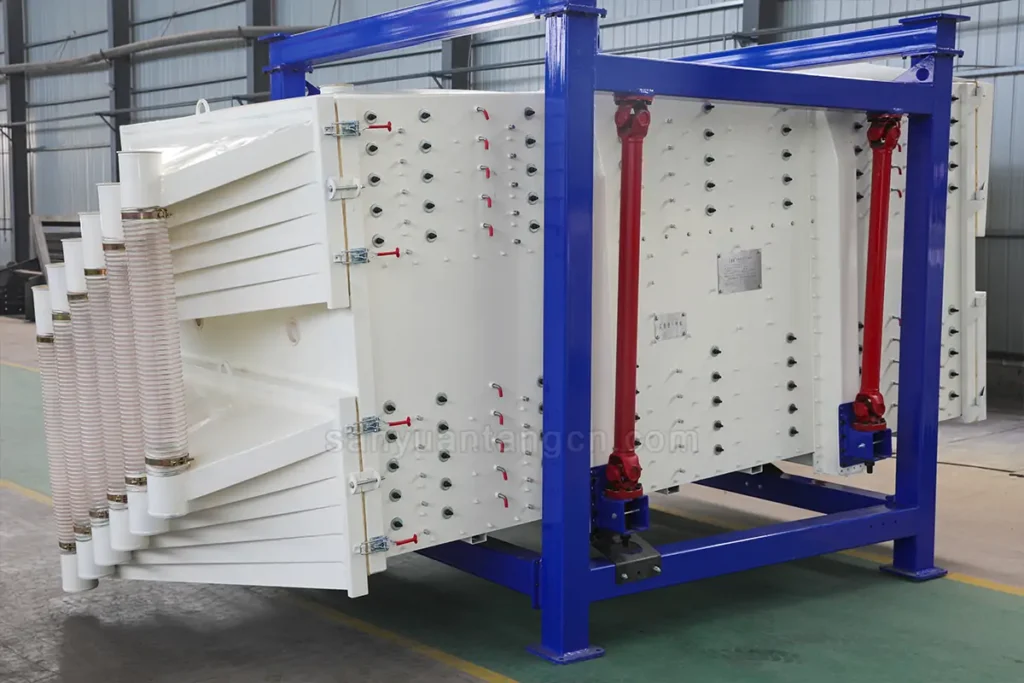
This article is provided by powder screening expert Sanyuantang Machinery’s technical team, offering you a professional selection guide for quartz sand from perspectives such as working principles, material adaptability, and comprehensive ROI.
Principle and Motion Trajectory:
Screening Machine (including Linear Screening Machine, Rotary Vibrating Screen):
Its working principle is to generate high-frequency linear or circular vibration through an exciter, causing the material to jump and be thrown violently across the screen surface. This motion provides a strong impact force and a fast processing speed, enabling rapid stratification and screening of materials. It is suitable for large-capacity, coarser particles, and materials without strict requirements on particle integrity.
However, the intense vibration can cause fine particles to “jump off” the screen without fully passing through, affecting accuracy. It may also cause excessive breakage for fragile materials or those requiring crystal integrity.
Gyratory Screen:
It simulates gentle and delicate manual screening. Driven by an eccentric mechanism, the screen box performs a plane gyratory motion. Materials move in a spiral path across the screen surface with long contact time and gentle relative movement.
This low-frequency, large-amplitude motion ensures every particle has sufficient opportunity to pass through the mesh, achieving extremely high screening accuracy (stable at 95%-99%) while maximizing the protection of quartz sand particle shape and roundness, with extremely low breakage rate.
For high-value quartz sand products that are prone to clogging and require high purity, its advantages are particularly significant.
Parameter Comparison: Screening Machine VS Gyratory Screen
To make the selection clearer, the Sanyuantang Machinery R&D team summarized the key technical indicators for quartz sand screening:
| Comparison | Screening Machine (Linear / Rotary Vibrating Screen) | Gyratory Screen |
|---|---|---|
| Screening Accuracy | 85%-96%, fine particles may mix | 95%-99%, precise grading, low misclassification |
| Particle Breakage Rate | High, violent vibration causes collisions | Extremely low (<3%), gentle motion |
| Capacity | Very high, 20–100 tons/hour | 10–30 tons/hour, precise large-scale grading |
| Blinding Tendency | High, frequent cleaning needed | Low, anti-blocking design |
| Multi-layer Capability | 2–3 layers | 1–10 layers available |
| Noise & Environment | 85–95 dB, dust leakage risk | 65–75 dB, sealed negative pressure design |
| Energy & Maintenance | Low cost but high wear | Higher initial cost, low long-term cost |
Quartz Sand Application Selection Logic
1. Based on product positioning and particle size:
- Construction sand, filter sand, casting sand: 0.5mm–4mm → Screening Machine preferred
- Photovoltaic glass sand, high-purity quartz sand, electronic-grade silica powder, frac sand: 40–200 mesh → Gyratory Screen recommended
2. Based on raw material and process:
- Wet process / dewatering → High-frequency dewatering screen
- Dry fine classification / impurity removal → Gyratory Screen performs better in precision and anti-blocking
3. Based on capacity and layout:
- Ultra-high capacity rough screening → Screening Machine
- Medium-large scale fine grading → Gyratory Screen (multi-layer, compact line)

Three Major Industrial Pain Points in Quartz Sand Screening and Solutions
Quartz sand, due to high hardness (Mohs hardness 7), static electricity, and strong adsorption, often faces the following challenges. Sanyuantang Machinery provides targeted engineering solutions:
1. Blinding Problem
Pain Point: Fine sand (especially above 80 mesh) easily blocks screen openings, reducing capacity.
Solution: Gyratory Screen equipped with Ultrasonic De-blinding System + high-elastic silicone bouncing balls. High-frequency micro-vibration changes adhesion force, ensuring continuous production without blockage.
2. Screen Wear & Tear
Pain Point: Quartz sand is highly abrasive, and standard screens may require replacement every 3–5 days.
Solution: Gyratory motion reduces vertical impact force, extending screen life significantly. Custom stainless steel high-tension screens and dual-layer support design further reduce maintenance frequency.
3. Dust & Environmental Compliance
Pain Point: Quartz powder easily becomes airborne, causing pollution and compliance issues.
Solution: A fully sealed gas-tight structure combined with a negative-pressure dust removal system ensures zero dust leakage during 24-hour continuous operation.

Brand Recommendation and Selection Consideration: Sanyuantang Machinery Example
After selecting the equipment type, choosing a reliable manufacturer is critical. Taking Sanyuantang Machinery as an example:
- Customization capability: Tailored screen layers, mesh size, material (304/316 stainless steel for high-purity sand)
- Technical strength: Mature gyratory screen design with adjustable eccentric system and automatic tensioning
- Full service: From testing, design, manufacturing, to installation and commissioning
Conclusion:
Choose Screening Machine: if particle size is within 40 mesh, capacity above 30 tons/hour, and cost-sensitive mass production is required.
Choose Gyratory Screen: if the product is 40–200 mesh high-end quartz sand with strict PSD requirements and low breakage demand.
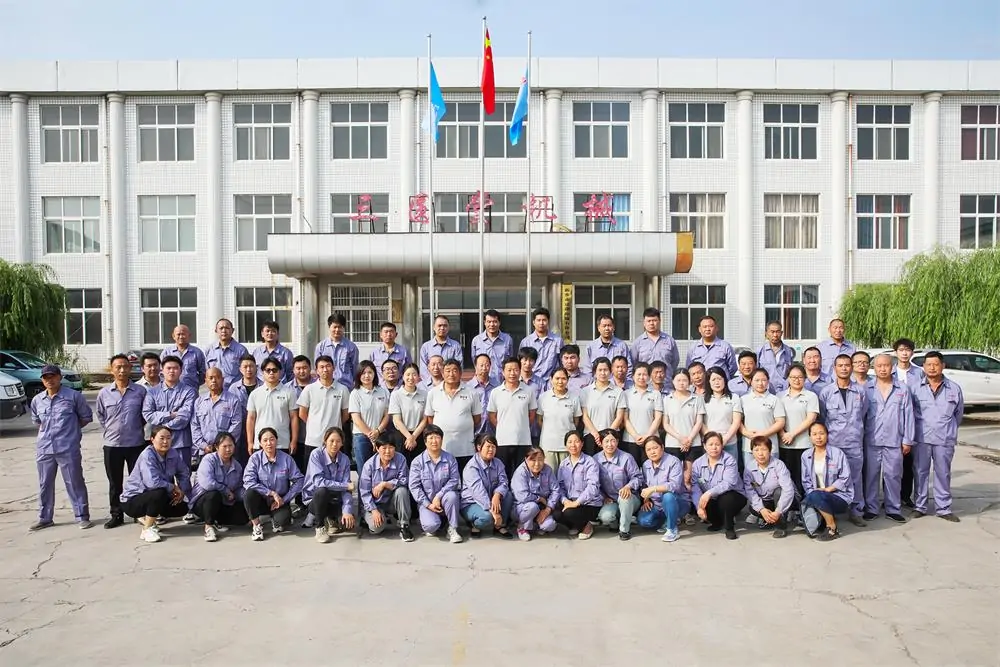
As a global leader in powder screening technology, Sanyuantang Machinery provides standardized quartz sand testing facilities. If you need process design or selection support, engineers can provide free customized production line solutions.
Email: info@sanyuantang.com
Phone: +86-18639095165