
When customers send material samples to Sanyuantang for a screening test, one of the first things we want to know is the particle size distribution. Not just the average particle size. We want to know how much is coarse, how much is fine, what percentage is already below the required cut size, and how much material the screen actually needs to separate.
Once the objective is defined, the next step is to follow a complete sieve analysis procedure, including representative sampling, sieve selection, weighing, calculations and interpretation.
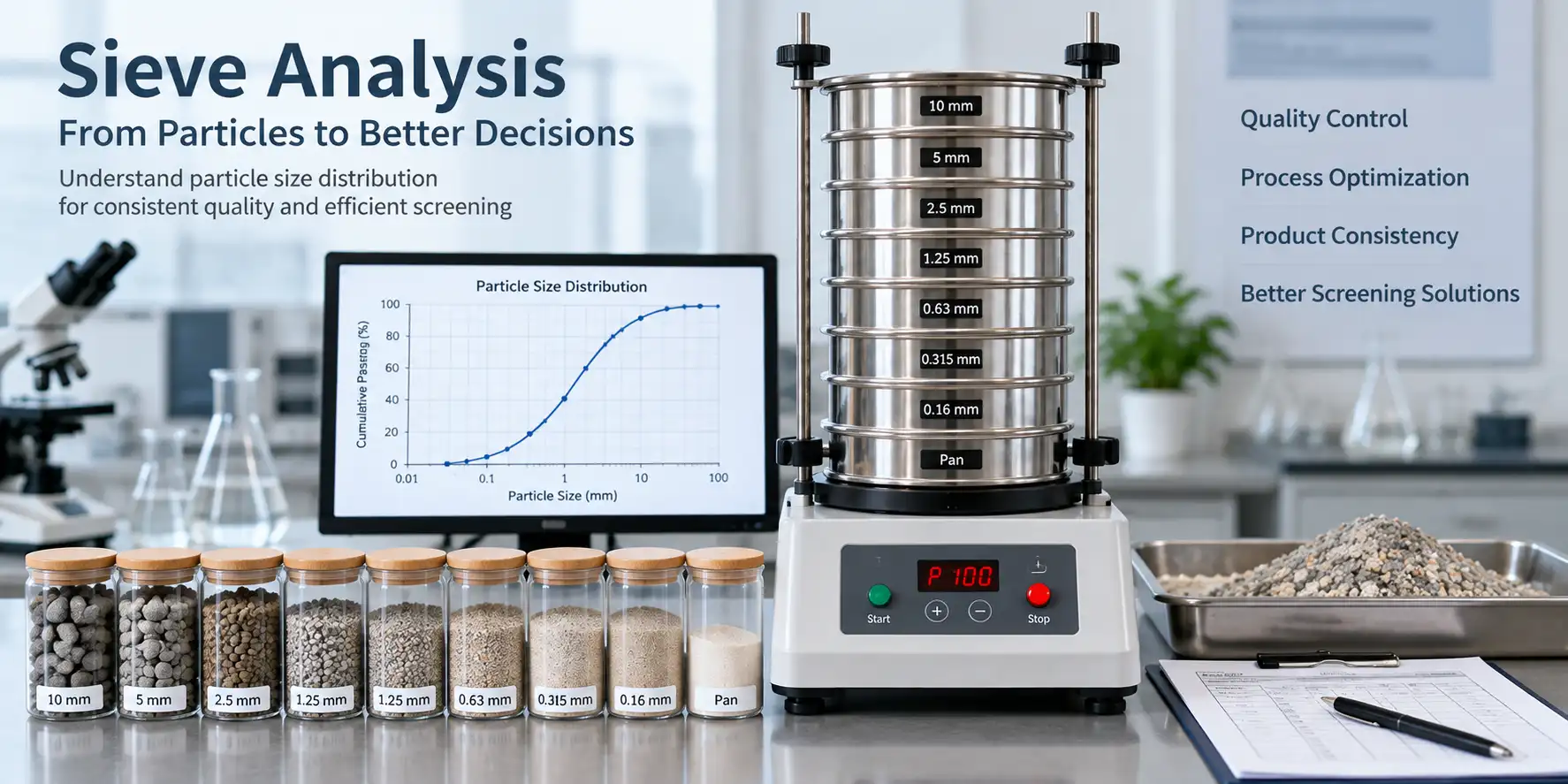
This is exactly the purpose of sieve analysis.
Sieve analysis separates a representative material sample through a series of sieves with known openings. By weighing the material retained on each sieve, we can determine how particles are distributed across different size ranges.
For a laboratory, this is particle size data.
For a production engineer, the same data can help answer a much more practical question: Is the material within specification, and what should we do if it isn’t?
What Is the Main Purpose of Sieve Analysis?
The main purpose of sieve analysis is to determine the particle size distribution of a granular or powder material. But measuring particle size is only the first step. The useful part is what you can do with the result.
A sieve analysis can help you:
- determine the percentage of coarse and fine particles;
- check whether a material meets a particle size specification;
- compare incoming raw materials from different suppliers;
- monitor consistency between production batches;
- detect changes in crushing, grinding or screening;
- evaluate the efficiency of an existing screening process;
- determine suitable separation sizes for production screening;
- provide useful data when selecting a vibrating screen.
This distinction matters.
The purpose of sieve analysis is not simply to separate a small sample. Its purpose is to produce particle-size data that can be used to make decisions.
ASTM C136/C136M, for example, uses sieve analysis to determine the particle size distribution of fine and coarse aggregates. The results can then be used to evaluate compliance with specifications and provide data for production control.
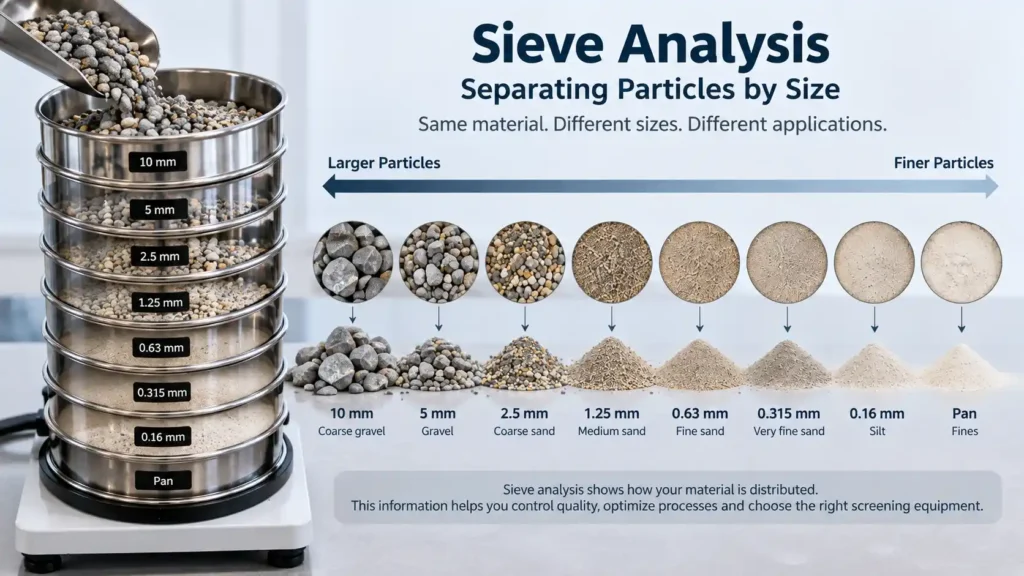
A Simple Example: What Does Sieve Analysis Actually Tell You?
Suppose we have a 1,000 g granular material sample.
After sieving, we obtain the following results:
| Sieve Opening | Weight Retained | % Retained | Cumulative % Passing |
|---|---|---|---|
| 2.00 mm | 50 g | 5% | 95% |
| 1.00 mm | 250 g | 25% | 70% |
| 500 μm | 400 g | 40% | 30% |
| 250 μm | 200 g | 20% | 10% |
| Pan | 100 g | 10% | 0% |
Example data for explanation only.
Now we know much more than “this material is about 1 mm.”
We know that:
- 95% is smaller than 2 mm;
- 70% is smaller than 1 mm;
- 30% is smaller than 500 μm;
- 10% is smaller than 250 μm.
That is the real value of sieve analysis. It turns a vague description such as “fine powder” or “1 mm material” into measurable information.
Why Particle Size Distribution Matters
Two batches can contain the same material and have the same total weight while behaving very differently in production.
Consider these two samples:
- Sample A: Most particles are between 500 μm and 1 mm.
- Sample B: Contains a mixture of very fine powder, 500 μm particles and particles above 2 mm.
Calling both materials “1 mm powder” would hide an important difference.
Their flowability, screening behavior, packing, mixing and downstream processing may not be the same.
This is why particle size distribution is often more useful than a single particle-size number.
What different sieve analysis results may indicate
| Test Result | Possible Meaning | What to Check |
|---|---|---|
| Oversize suddenly increases | Crushing or screening has changed | Crusher setting, screen condition, feed rate |
| Fines increase | Material may be over-ground or degraded | Grinding process and material handling |
| Batch distribution changes | Production consistency has shifted | Raw material and process parameters |
| Too much near-size material | Separation may become more difficult | Screen area, mesh and operating conditions |
| Product outside specification | Process adjustment may be required | Upstream process and screening stage |
A sieve analysis does not automatically tell you why a problem occurred. It tells you where the particle distribution changed, which gives the production team somewhere useful to start looking.
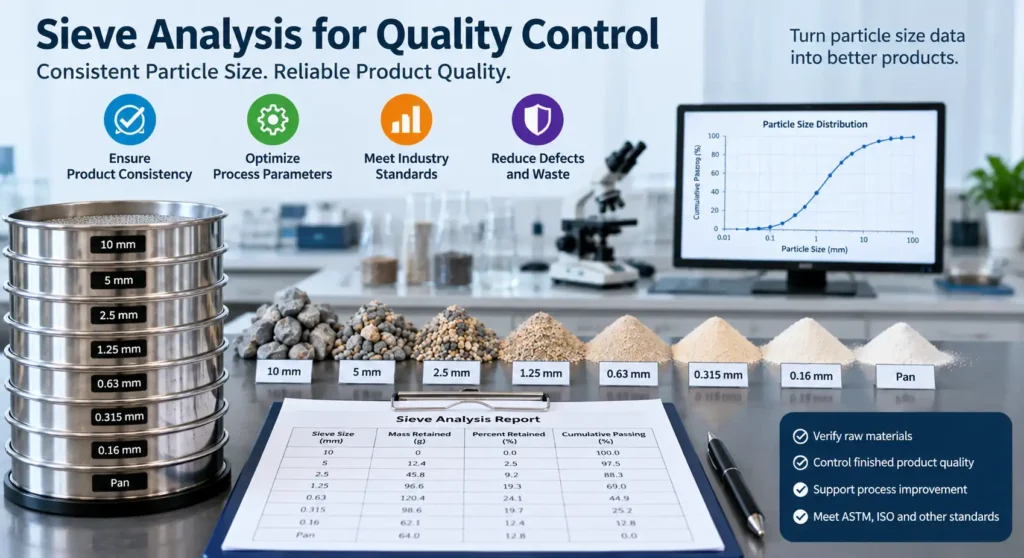
7 Practical Purposes of Sieve Analysis
1. Determine Particle Size Distribution
This is the fundamental purpose.
A series of test sieves divides the sample into different particle-size fractions.
The basic calculation is:
Percentage Retained = (Weight Retained on the Sieve ÷ Total Sample Weight) × 100
From this, cumulative percentage retained and percentage passing can be calculated.
Instead of describing the material as simply “coarse” or “fine,” you now have numbers that can be compared.
2. Check Whether a Product Meets Specification
Many products have defined particle-size limits.
For example, a specification might require:
- at least 95% passing 2 mm;
- 60–80% passing 1 mm;
- no more than 10% below 250 μm.
Once the sieve analysis is completed, the measured values can be compared directly with those limits. This makes the test useful for both incoming material inspection and finished-product quality control.
If you buy material from several suppliers, the same method can also help determine whether their actual particle distributions are comparable.
3. Monitor Batch-to-Batch Consistency
One test tells you about one sample.
Repeated tests can tell you something about the production process.
Suppose a product normally has 8–10% material below 250 μm.
Then the results begin to change:
| Production Batch | <250 μm |
|---|---|
| Batch 01 | 8.4% |
| Batch 02 | 8.8% |
| Batch 03 | 9.1% |
| Batch 04 | 12.7% |
| Batch 05 | 15.3% |
The important information here isn’t simply that Batch 05 contains 15.3% fines. The trend itself is useful. Something in the raw material, grinding process, handling system or screening process may have changed. For routine QC, this is one of the most useful roles of sieve analysis.
4. Find Problems in a Screening Process
Suppose a production vibrating screen is separating material at 1 mm.
Theoretically:
Oversize outlet: >1 mm Undersize outlet: <1 mm
In actual production, separation is rarely that perfect.
To check performance, samples can be collected from three locations:
Feed → Oversize → Undersize
Then perform sieve analysis on each sample.
If a large percentage of particles below 1 mm remains in the oversize stream, good material is being lost.
If particles above 1 mm appear in the undersize stream, product quality may be affected.
At that point, operators can investigate:
- screen mesh condition;
- screen blinding;
- feed rate;
- material moisture;
- vibration parameters;
- screen loading;
- material distribution across the screen surface.
This is where laboratory particle-size testing becomes directly useful to production.
5. Determine the Right Screen Opening
We often receive inquiries that say:
- “I need a vibrating screen for powder.”
For screen selection, that isn’t enough information.
A much more useful inquiry looks like this:
| Parameter | Example |
|---|---|
| Material | Plastic powder |
| Feed particle size | 0–3 mm |
| Required cut size | 500 μm |
| Material >500 μm | 20% |
| Material <500 μm | 80% |
| Bulk density | 0.7 g/cm³ |
| Required capacity | 800 kg/h |
| Moisture | <1% |
With this data, we can begin discussing the actual screening issues.
The sieve analysis has told us not only the desired mesh opening, but also how much material is expected to pass through that opening. That information matters when evaluating screen area and expected capacity.
6. Compare Raw Materials from Different Suppliers
Suppose two suppliers both sell the same powder.
Their technical data sheets may list the same nominal particle size, but a sieve analysis shows:
| Size Fraction | Supplier A | Supplier B |
|---|---|---|
| >1 mm | 3% | 12% |
| 500 μm–1 mm | 42% | 38% |
| 250–500 μm | 45% | 31% |
| <250 μm | 10% | 19% |
These materials may not behave identically in your production line.
One may generate more fines. The other may place a larger oversize load on the production screen. That does not automatically mean Supplier A is better than Supplier B.
It means you now have actual particle-size data to determine which distribution is more suitable for your process.
7. Provide Data for Selecting a Vibrating Screen
This is where sieve analysis connects directly with industrial screening.
Before selecting equipment, Sanyuantang engineers normally need more than a mesh number.
Useful information includes:
- material name;
- particle size distribution;
- required separation size;
- bulk density;
- moisture;
- temperature;
- flowability;
- required capacity;
- number of final fractions;
- whether the material tends to agglomerate or block the mesh.
Particle size distribution is one part of this picture, but it is an important one.
It helps us understand what the machine actually has to separate.
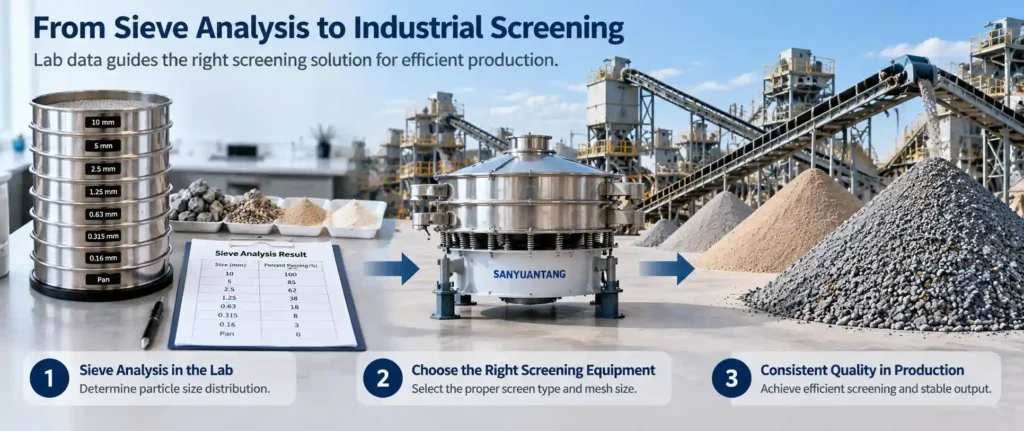
From Laboratory Sieve Analysis to Industrial Screening
There is an important distinction here. A test sieve shaker measures the particle size distribution of a relatively small sample. An industrial vibrating screen separates production material continuously or batch by batch.
They are related, but they do different jobs.
| Equipment | Main Purpose | Typical Use |
|---|---|---|
| Lab Test Sieve Shaker | Particle size analysis | Laboratory and QC |
| Rotary Vibrating Screen | Production classification | General powders and granules |
| Ultrasonic Vibrating Screen | Fine powder screening | Fine or difficult powders |
| Linear Vibrating Screen | High-capacity classification | Granules and bulk solids |
| Gyratory / Oscillating Screen | Multi-deck classification | Larger-capacity precision separation |
This is why we don’t recommend choosing an industrial screen based only on a laboratory sieve number.
The test tells us the particle distribution.
The production machine still has to deal with capacity, continuous feeding, moisture, particle shape, screen blinding and the physical behavior of the material.
Which Sanyuantang Screening Equipment Fits Each Stage?
For Particle Size Analysis: Sanyuantang Lab Test Sieve Shaker
For laboratory particle-size testing and routine QC, the Sanyuantang SY-200 / SY-300 Lab Test Sieve Shaker is designed to separate a small material sample through stacked test sieves.
It is suitable when your objective is to:
- determine particle size distribution;
- compare production batches;
- inspect incoming materials;
- verify particle-size specifications;
- test samples before industrial screen selection.
The Sanyuantang laboratory sieve shaker supports multiple sieve layers, allowing you to measure several particle-size fractions in one test.
For manufacturers that regularly monitor particle size, this is the logical starting point.
For General Production Screening: Rotary Vibrating Screen
Once laboratory analysis has established the required cut size, a rotary vibrating screen can be considered for production classification of many powders and granular materials.
Typical applications include:
- food powders;
- chemical powders;
- plastic powders;
- minerals;
- ceramic materials;
- fertilizer;
- other free-flowing granular products.
The actual capacity depends heavily on the material and required mesh size.
This is why we prefer to evaluate the material rather than promise a capacity based only on machine diameter.
For Fine or Difficult Powders: Ultrasonic Vibrating Screen
Fine powder creates another problem. As particle size becomes smaller, particles may agglomerate, adhere to the mesh, or block screen openings. In these situations, simply using a finer mesh on a conventional screen may not solve the problem. An ultrasonic vibrating screen adds ultrasonic energy to the screen surface to help reduce mesh blinding and improve the passage of fine particles.
At Sanyuantang, we use actual material screening tests when evaluating difficult fine powders because two materials with the same nominal particle size can behave very differently on the same mesh.
Particle size is important. But moisture, electrostatic behavior, density, particle shape and agglomeration matter too.
For Larger-Capacity Classification: Linear or Gyratory Screening
When the material is relatively free-flowing and the process requires larger capacity or several particle-size fractions, a linear vibrating screen or gyratory/oscillating screen may be more appropriate.
For example, a production process may need:
Feed → >10 mm → 5–10 mm → 2–5 mm → <2 mm
A laboratory sieve analysis can first show how much material exists in each fraction. That information helps estimate how the load will be distributed across each screen deck. This is much more useful than selecting a multi-deck screen without knowing the feed distribution.
A Practical Workflow We Recommend
If you’re trying to solve a particle-size problem in production, don’t start by asking:
“Which vibrating screen should I buy?”
Start with the material.
A practical workflow is:
Step 1 — Define the required product
What particle size does your final product actually need?
Step 2 — Take a representative sample
The test sample should reflect the material being processed. A perfectly performed test on an unrepresentative sample still gives misleading information.
Step 3 — Perform sieve analysis
Measure the percentage retained and passing at the relevant sieve openings.
Step 4 — Compare the result with your specification
Identify oversize, acceptable product and fines.
Step 5 — Calculate the actual screening load
Determine how much of the feed needs to pass through the required screen opening.
Step 6 — Evaluate material behavior
Check moisture, density, agglomeration, static electricity, particle shape and flowability.
Step 7 — Select or test the production screen
Only now does equipment selection become meaningful.
In short:
Sample → Sieve Analysis → Particle Size Distribution → Product Specification → Screening Requirement → Equipment Selection
That sequence can prevent a lot of incorrect equipment selection.
When Sieve Analysis Is Not Enough
Sieve analysis is useful, but it has limits.
This matters particularly with very fine powders.
Very small particles may:
- agglomerate;
- stick to each other;
- carry electrostatic charge;
- adhere to the mesh;
- block screen openings.
Particle shape also matters.
A long particle may pass through an opening in one orientation but remain on the sieve in another.
Moisture can change the result as well.
For this reason, you should not assume that a laboratory result automatically predicts industrial screening capacity.
ASTM C136/C136M provides a good example of this limitation in aggregate testing: the standard notes that accurate determination of material finer than 75 μm cannot be achieved using that method alone and refers to another test method for that fraction.
The lesson is simple:
Use the testing method that fits the material and the decision you need to make.
What Information Should You Record During a Sieve Analysis?
If you’re using sieve analysis for production control rather than a one-time experiment, keep the results in a consistent format.
A useful record might include:
| Item | Record |
|---|---|
| Material | __________ |
| Batch number | __________ |
| Test date | __________ |
| Initial sample weight | __________ g |
| Sieve sizes | __________ |
| Sieving time | __________ min |
| Weight retained on each sieve | __________ |
| % retained | __________ |
| % passing | __________ |
| Moisture condition | __________ |
| Operator | __________ |
| Notes / abnormalities | __________ |
Keeping this information makes later comparisons much easier.
If a production problem occurs three months later, historical particle-size records may help show when the change actually started.
This is one reason sieve analysis becomes more valuable when it is treated as a process-control tool rather than an isolated laboratory test.
Sieve Analysis Result Checklist
Before accepting a result, ask:
- Was the sample representative?
- Were the correct sieve openings selected?
- Were the sieves clean and undamaged?
- Was too much material loaded onto one sieve?
- Was the test run long enough for effective separation?
- Was material lost during transfer?
- Did moisture cause particles to stick together?
- Did fine material blind the mesh?
- Does the final recovered weight reasonably agree with the starting sample?
- Does the test method match the material being analyzed?
If any of these answers is “no,” repeating the test may be more useful than trying to interpret questionable data.
Final Takeaway: Sieve Analysis Should Lead to a Decision
So, what is the purpose of sieve analysis?
At the simplest level, it measures particle size distribution.
In actual production, however, its value goes further.
Sieve analysis helps manufacturers understand their material, check specifications, compare batches, find process changes and evaluate screening performance.
For us at Sanyuantang, particle size data is also one of the starting points for screen selection.
A laboratory sieve shaker can tell you what particle sizes you have.
Production screening equipment then solves the next problem:
how to separate those particle sizes efficiently at the required production capacity.
If you’re selecting a vibrating screen, providing a sieve analysis report together with the material name, required cut size, bulk density, moisture and target capacity gives our engineers much more useful information than providing a mesh number alone.
Email: info@sanyuantang.com
Phone: +86-18639095165
FAQ
What is the main purpose of sieve analysis?
The main purpose of sieve analysis is to determine the particle size distribution of a granular or powder sample. The results show how much material is retained on and passes through different sieve openings, providing measurable data for quality control and process decisions.
Why is sieve analysis important in manufacturing?
Manufacturers can use sieve analysis to check whether raw materials and finished products meet particle-size specifications. Repeated testing can also reveal batch-to-batch changes and help identify problems in grinding, crushing, handling or industrial screening processes.
How does sieve analysis help with vibrating screen selection?
Sieve analysis shows the proportion of material above and below the required separation size. This helps engineers understand the actual screening load. Capacity, moisture, density, particle shape, flowability and mesh-blocking tendency must also be considered before selecting equipment.
What is the difference between sieve analysis and screening?
Sieve analysis is mainly a measurement method used to determine particle size distribution from a sample. Industrial screening is a production process that continuously separates bulk material into required size fractions. Laboratory results can provide useful information for designing the production screening process.
Can sieve analysis determine the exact particle size of every particle?
No. Sieve analysis classifies particles according to whether they pass or remain on defined sieve openings. It provides particle-size ranges rather than measuring the exact dimensions of every individual particle. Other particle-sizing methods may be more suitable for very fine materials.
Why can two powders with the same mesh size screen differently?
Mesh size is only one factor. Moisture, particle shape, density, electrostatic charge, agglomeration and flowability can all affect screening behavior. This is why Sanyuantang recommends actual material testing for difficult fine-powder applications rather than selecting equipment from mesh size alone.
About Sanyuantang
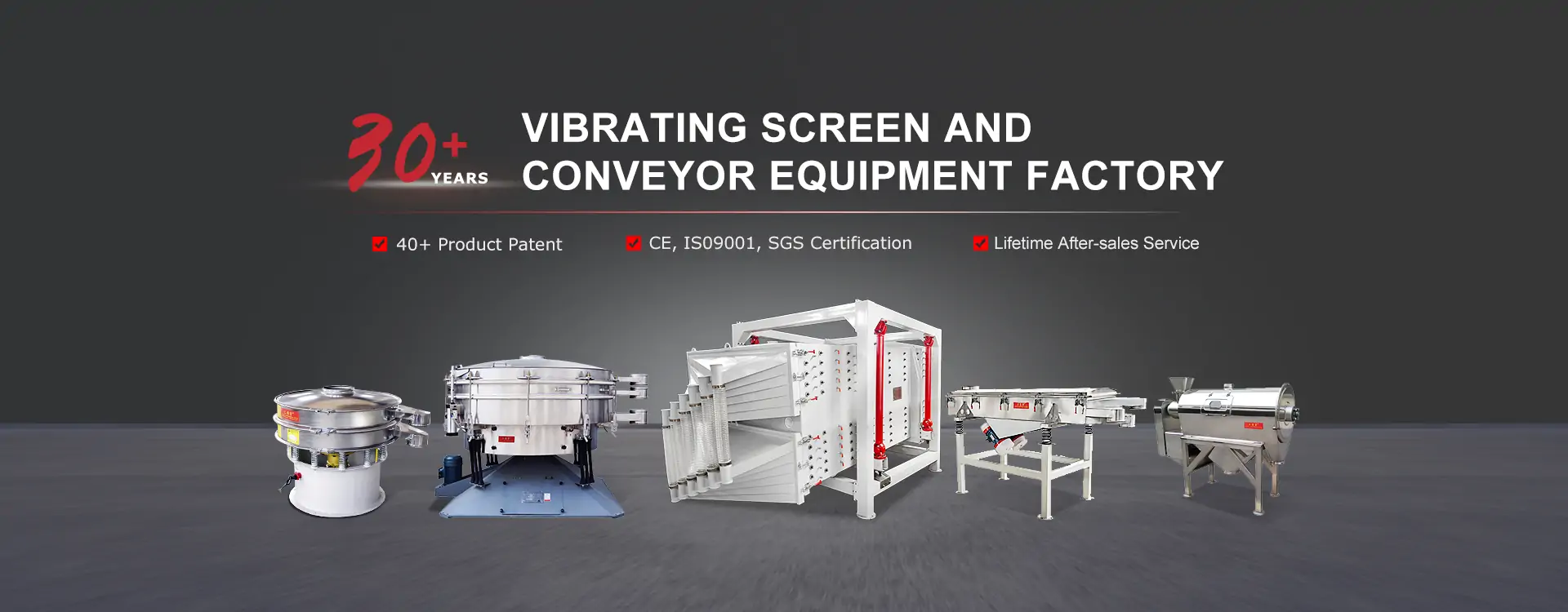
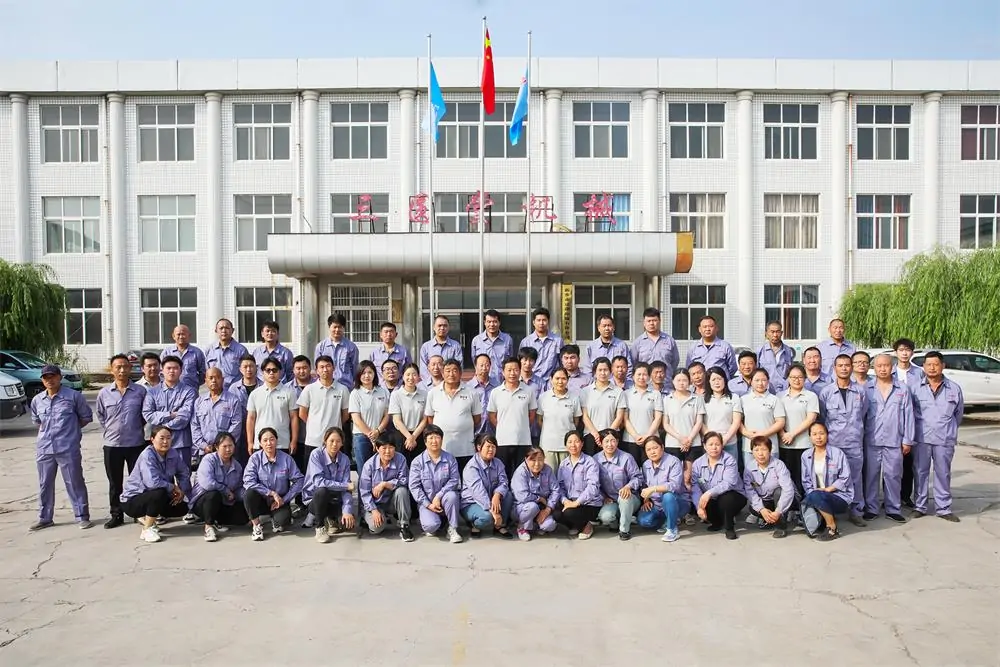
Sanyuantang has focused on screening and conveying solutions since 1994. For particle-size testing and production screening projects, our engineers review the test data together with capacity, bulk density, moisture and material behavior before recommending equipment.
Learn more about Sanyuantang or review our industrial screening machines.
Discuss Your Screening Requirement
Send us the material name, particle-size distribution, required cut size, bulk density, moisture and target capacity. Our sales and engineering team can review the data and advise whether laboratory testing or a production screening trial is appropriate.
Email: info@sanyuantang.com
Phone: +86-18639095165