
Wet wash sieves use a compatible liquid to help classify samples that do not separate reliably under dry conditions. Dry sieve analysis works well when particles are free-flowing and can move independently through the sieve openings. The trouble starts when the material does not behave that way.
Fine particles may carry static charge. They may cling to larger particles, form soft agglomerates, or repeatedly blind a fine mesh. In these conditions, extending the sieving time does not necessarily produce a better particle size result. Sometimes it simply keeps shaking the same poorly dispersed sample.
This is where wet wash sieves can be useful.
Wet sieving uses a suitable liquid to help separate particles and carry fines through the required sieve openings. It is commonly considered when dry sieving cannot disperse the sample adequately, but it should not be selected just because the material is fine.
The first question is always whether the sample, washing liquid and required test method are compatible.
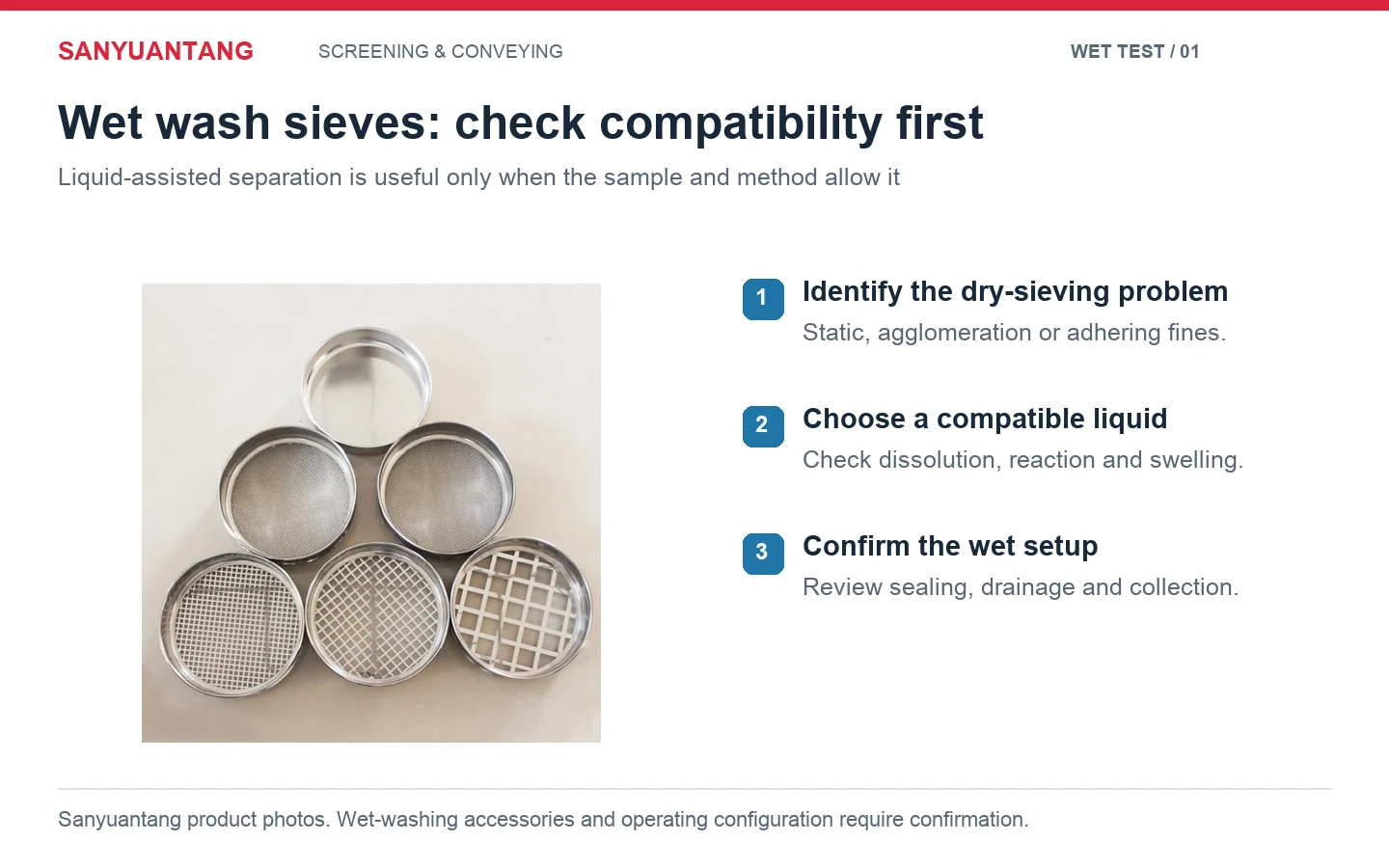
When Should You Use Wet Wash Sieves?
A wet method becomes worth considering when the problem is not the sieve opening itself, but the way the particles behave during dry testing.
Typical situations include fine particles sticking together because of static charge, agglomerated material that does not break apart during normal vibration, fine particles coating larger particles, or repeated blinding of small sieve openings. These are also the types of problems described by established wet-sieving equipment and particle-analysis sources.
Wet sieving is not automatically better, however.
If a dry sample is already passing through the sieve stack steadily and the test produces repeatable results, there may be no reason to introduce water and an additional drying step.
A useful first decision is:
| Sample Condition | Dry Sieving | Wet Sieving |
|---|---|---|
| Free-flowing granular material | Usually the first method to consider | Often unnecessary |
| Fine powder with strong static effects | May give unstable separation | May help if the liquid is suitable |
| Soft agglomerates remain during shaking | May overstate the coarse fraction | Can help disperse particles |
| Fine material sticks to coarse particles | Difficult to separate completely | Washing may improve separation |
| Mesh repeatedly blinds during testing | May become slow or unreliable | Worth evaluating |
| Water-soluble material | Often safer depending on the test method | Requires particular caution |
| Material reacts with or swells in water | May be preferable | Do not use water without method validation |
| Sample already supplied as a suspension | Drying first may alter the test condition | Wet sieving may be more appropriate |
The table is a selection guide, not a substitute for the applicable laboratory procedure.
Why Can Dry Sieving Give the Wrong Picture?
A sieve only classifies particles correctly when the particles have a reasonable opportunity to reach and pass the appropriate openings.
That sounds obvious, but it is where many fine-powder tests become difficult.
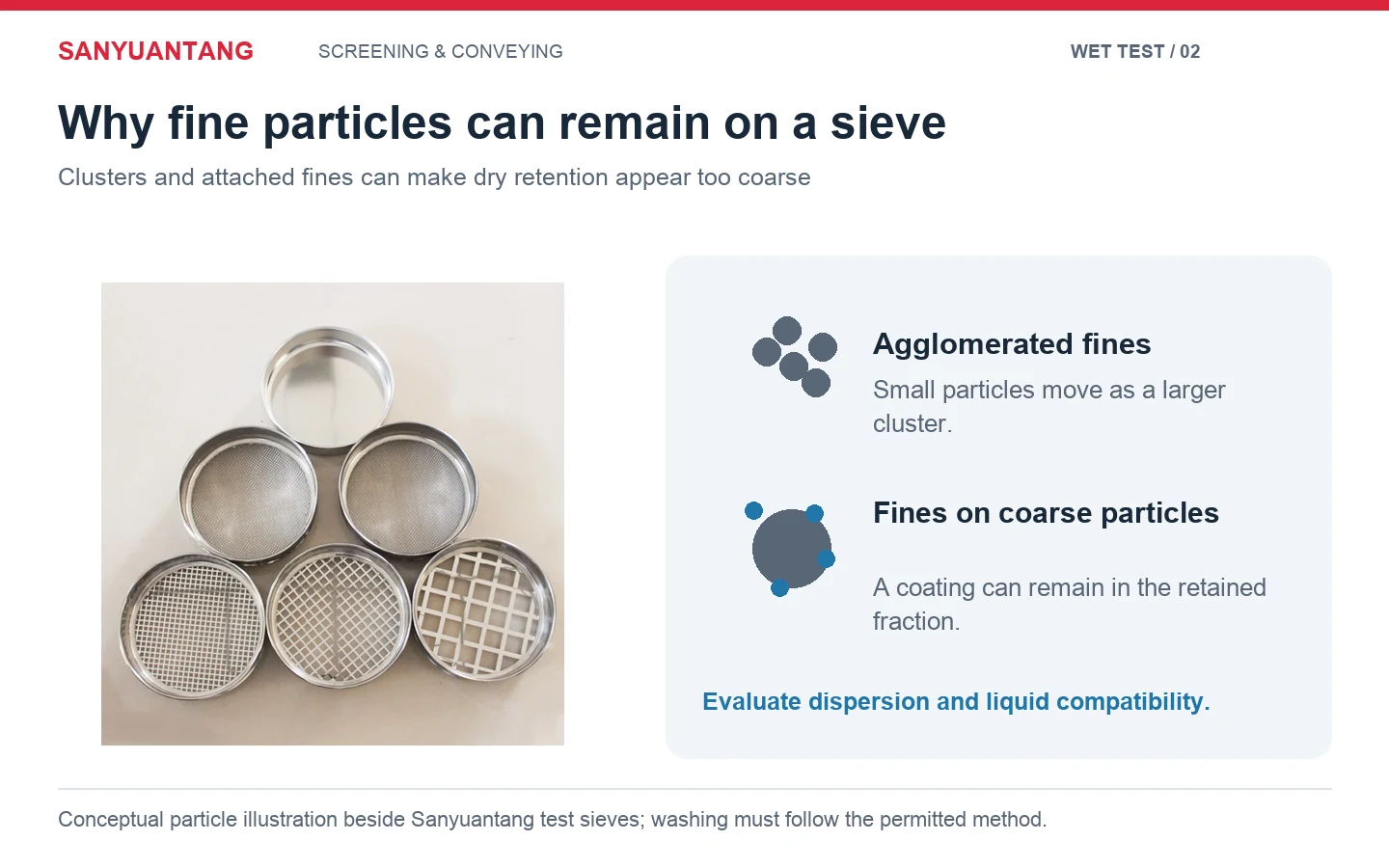
Static electricity
Very light or dry powders can develop electrostatic charge. Instead of moving freely across the sieve surface, particles may attach to each other or to the screen.
Longer shaking does not necessarily remove this effect.
Agglomeration
Several small particles may behave as one larger particle if they remain clustered together. The sieve then retains what appears to be an oversize particle even though the primary particles may actually be smaller than the aperture.
Fine particles attached to larger particles
This is slightly different from general agglomeration. Fine material may coat or adhere to a coarse particle and remain in the retained fraction.
ASTM C117-23 provides a useful material-specific example. For mineral aggregates, it notes that material finer than 75 μm can be separated more efficiently by washing, and that a wetting agent may help where fines adhere to larger aggregate particles. That does not make ASTM C117 a universal wet-sieving procedure; its scope is specifically mineral aggregates.
Mesh blinding
If near-size or cohesive particles repeatedly lodge in sieve openings, the effective open area gradually decreases.
At that point the problem is not simply “the mesh is too fine.” Sample loading, particle shape, adhesion and the physical behavior of the powder may all be involved.
This is why we normally do not recommend choosing a wet method from mesh size alone.
What Actually Happens During Wet Wash Sieving?
The exact procedure should come from the relevant material or testing standard. Still, most wet sieve analysis follows the same basic logic.
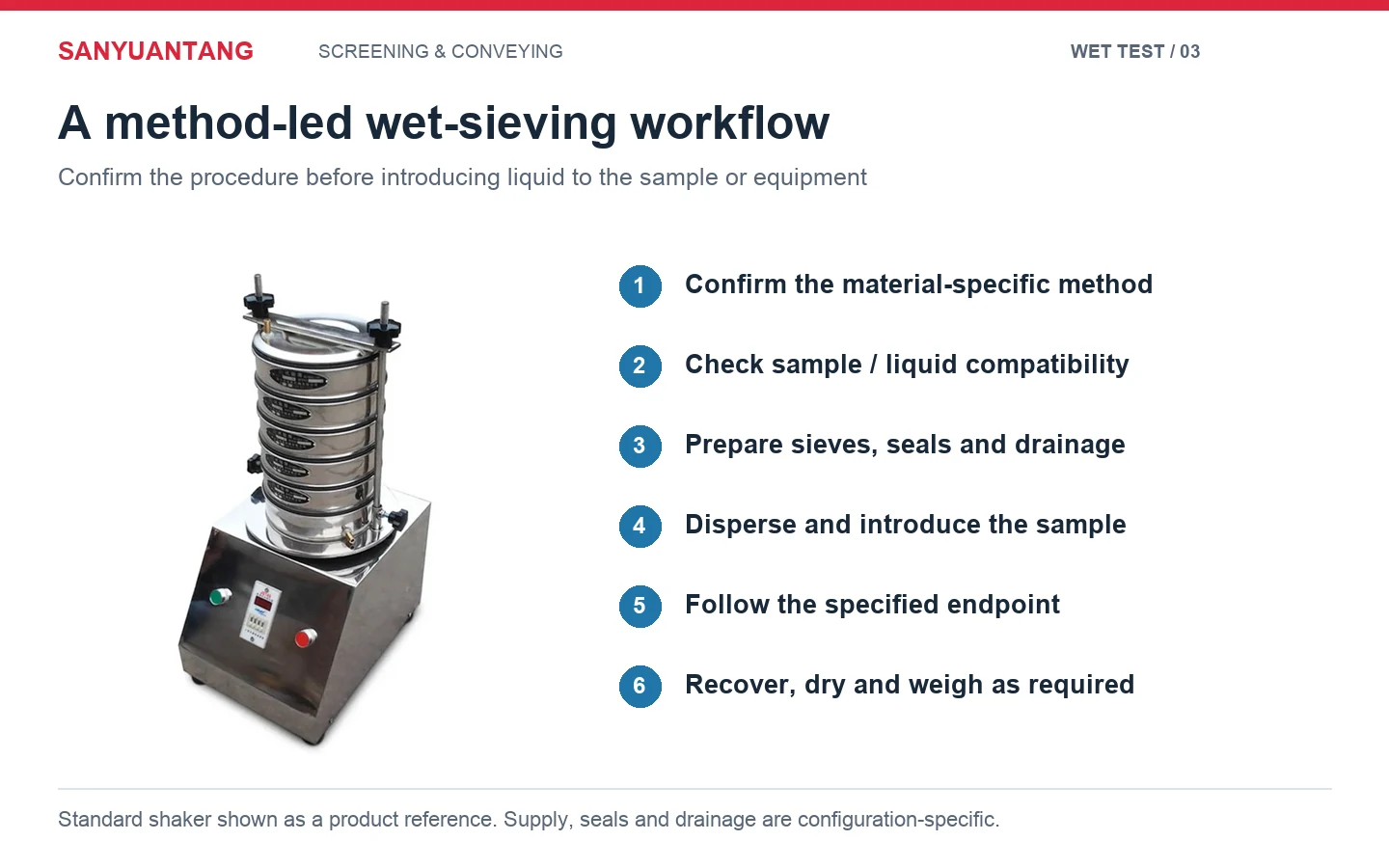
1. Confirm the test method before adding liquid
First determine what the test is supposed to measure.
Check the specified sieve openings, whether wet sieving is permitted, which liquid may be used, whether a dispersing or wetting agent is allowed, and how the retained material must be handled afterward.
This step is easy to overlook.
ASTM E11 and ISO 3310-1, for example, define technical requirements for woven-wire test sieves. They do not provide one universal wet-washing procedure for every material.
2. Check whether the sample is compatible with the liquid
Water is common, but it is not neutral for every material.
Ask whether the sample can dissolve, swell, react, soften or otherwise change when exposed to water. ASTM methods for soils and aggregates specifically warn that soluble substances can be removed during washing, which can affect what the test is actually measuring.
If the material itself changes, a technically neat wet-sieving result may still be the wrong result.
3. Prepare the sieve or sieve stack
Select the required apertures and make sure the screens are clean and undamaged.
For a multi-sieve analysis, larger openings are normally placed above smaller openings so the sample is progressively classified. In a dedicated wet-washing setup, sealing and drainage also matter because liquid must move through the stack without uncontrolled leakage.
Do not assume that every dry sieve shaker can simply be connected to a water line.
4. Disperse and introduce the sample
Depending on the procedure, the sample may first be suspended or wetted so that agglomerates can disperse before or during sieving.
The liquid is then used to help move the finer fraction through the openings while the material is gently agitated.
Excessive water pressure should be avoided where it could damage the sieve medium or mechanically degrade the material. Material-specific standards can impose their own requirements. An ISO procedure for iron ores, for example, calls for clean water at low velocity and low pressure during wet sieving.
This illustrates an important point: the liquid should assist classification, not force particles through the screen.
5. Continue to the specified endpoint
Do not invent a universal “five-minute wet sieving time.”
Different materials and test methods use different endpoints. Some laboratory procedures assess the liquid passing the sieve; others define their own washing or sieving criteria.
Follow the applicable method instead of using a fixed time borrowed from another material.
6. Recover, dry and weigh the required fractions
If the test requires retained fractions to be quantified, the material must be recovered carefully and dried according to the relevant procedure before final weighing.
For particle-size analysis, retained mass can then be used to calculate the percentage in each fraction and the cumulative particle-size distribution.
A poorly controlled transfer or drying step can undo the care taken during the actual sieving.
Wet Sieving vs. Dry Sieving: Which One Should You Choose?
The deciding factor is not simply particle size.
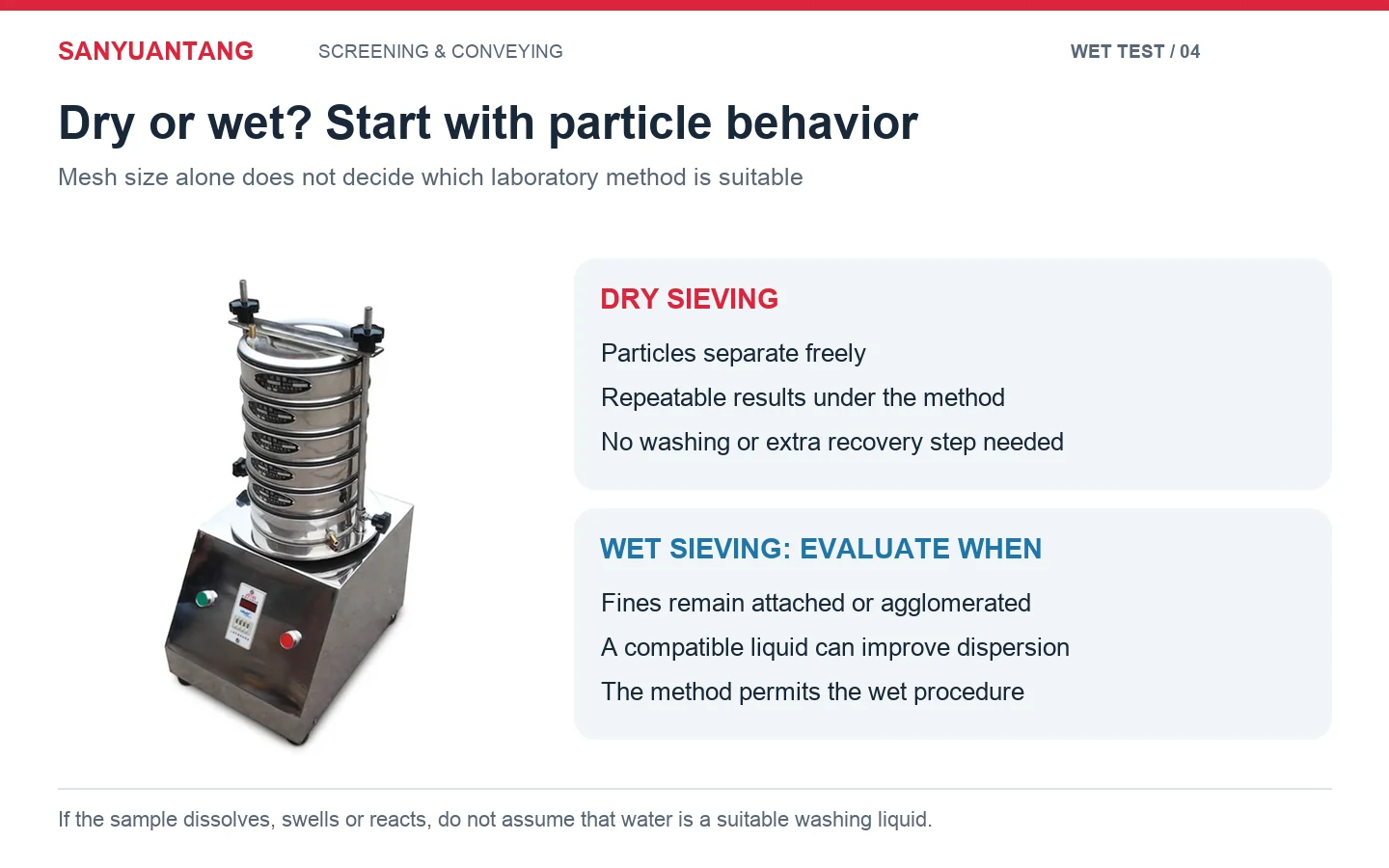
Dry sieving is usually simpler. There is no washing liquid to select, less material handling, and retained fractions can often be collected immediately. For free-flowing materials, that simplicity is a major advantage.
Wet sieving introduces additional variables, but it becomes useful when those variables help solve a real dispersion problem.
| Selection Question | Why It Matters |
|---|---|
| Does the powder flow freely when dry? | If yes, dry sieving may already be sufficient |
| Does the sample agglomerate? | Agglomerates can behave like false oversize particles |
| Is static electricity affecting movement? | Fine particles may stick instead of passing openings |
| Do fines adhere to coarse particles? | Washing can sometimes separate the coating |
| Does the liquid dissolve the sample? | Material can be lost for reasons unrelated to particle size |
| Does the sample swell or react? | Particle size may physically change during the test |
| Does the standard require a specific method? | The laboratory procedure takes priority over equipment preference |
| Must every retained fraction be recovered? | Drainage, transfer and drying become more important |
One detail that is often overlooked is repeatability.
If dry sieving already produces consistent results under a recognized procedure, changing methods just because wet sieving appears more sophisticated can create unnecessary variation.
Before Choosing Wet Wash Sieves, Check These Parameters
A buyer will often start with:
“I need a 200-mesh wet wash sieve.”
That is useful information, but it is not enough to configure a reliable test.
We normally want to know several things first:
- Material name
- Approximate feed particle size
- Required sieve opening or mesh
- Sample amount per test
- Number of size fractions required
- Whether the sample is dry, wet or already suspended
- Liquid intended for washing
- Whether the material dissolves or reacts with that liquid
- Applicable ASTM, ISO or internal test method
- Current problem during dry sieving
- Existing test sieve or sieve shaker information
- Whether retained fractions need to be recovered and weighed
Mesh tells us the cut point. It does not tell us how difficult the sample will be to separate.
Need Help Reviewing a Wet Sieving Application?
Not sure whether the problem is the sieve opening, agglomeration or the material itself?
Send us the material name, target mesh or aperture, sample amount, washing liquid and a description of your current dry-sieving problem. If you already use a sieve shaker, include its sieve diameter and current setup.
Sanyuantang can review the testing condition before deciding whether a standard dry test, wet method or a different screening approach should be considered.
Email: info@sanyuantang.com
Phone: +86-18639095165
Can a Standard Lab Sieve Shaker Be Used for Wet Sieving?
Sometimes, but this should be checked before running liquid through the equipment.
Sanyuantang's Lab Test Sieve Shaker is intended for laboratory particle-size analysis and its published application also includes testing solid content in liquid. The published technical table lists a 200 mm sieve diameter, 1–8 layers and a 0.038–3 mm granularity range, with the machine body made from SUS304 stainless steel.
Those specifications do not automatically mean that every standard configuration is a dedicated continuous wet-washing system.
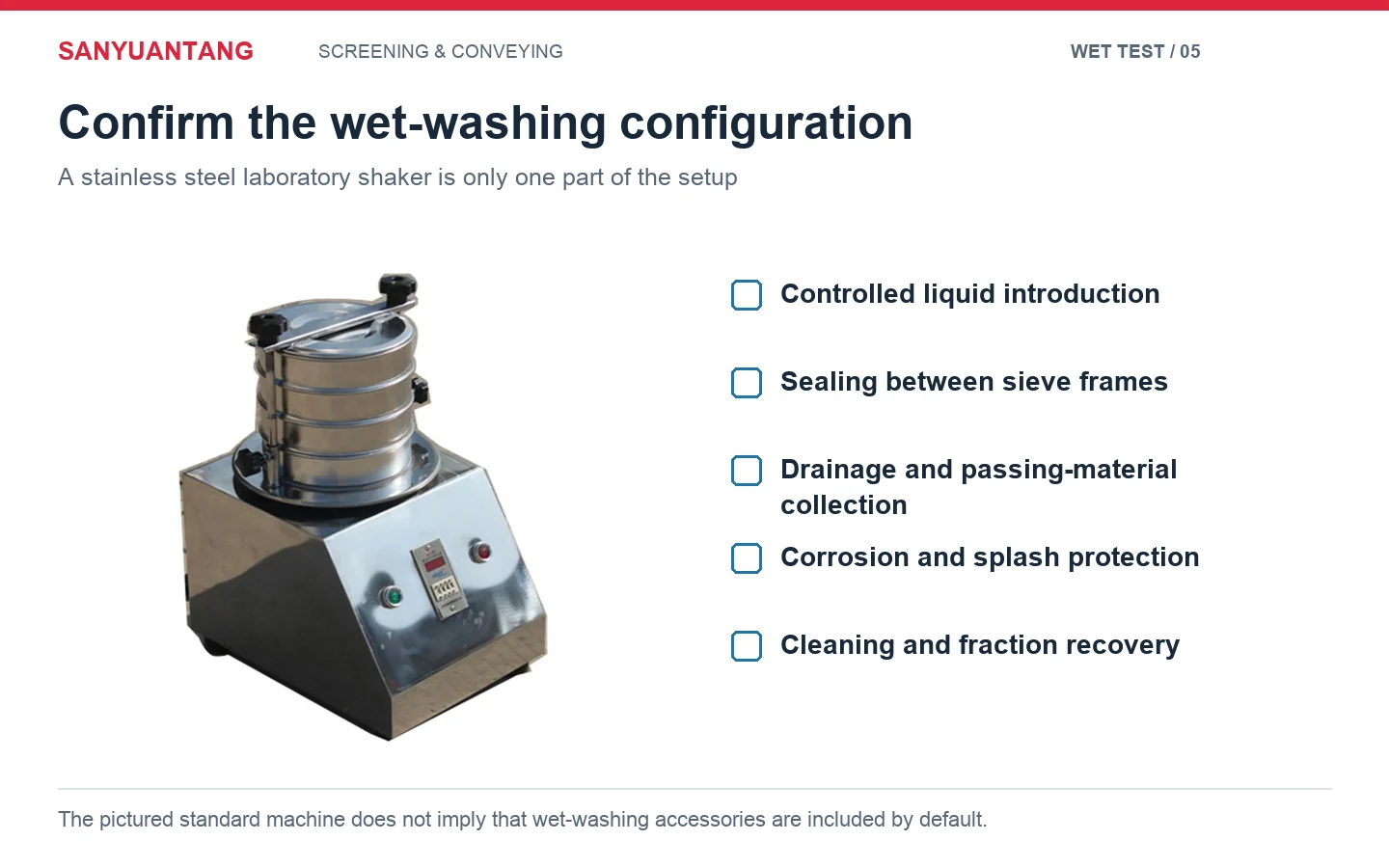
For wet washing, also confirm how the setup handles:
- liquid introduction
- sealing between sieve frames
- drainage
- collection of passing material
- corrosion exposure
- splash protection
- cleaning after testing
Dedicated wet-wash systems from some laboratory equipment suppliers use special covers, seals and drain pans specifically for this purpose. Those accessories should not be assumed to be part of another manufacturer's standard machine unless they are explicitly specified.
For sand and aggregate laboratory work, Sanyuantang also manufactures standard test sieve sets with common aggregate apertures and 200 mm or 300 mm frames. The required sieve arrangement should still follow the actual testing method rather than a generic sieve chart.
Common Wet Sieving Mistakes That Affect the Result
Most problems are not caused by the sieve itself.
| Mistake | What Can Happen |
|---|---|
| Choosing wet sieving only because the mesh is fine | Adds unnecessary steps without solving the real issue |
| Assuming water is safe for every sample | Soluble or reactive material may be altered or lost |
| Using excessive liquid pressure | Can disturb the test or damage the screen |
| Overloading the sieve | Particles have less opportunity to reach the openings |
| Ignoring agglomeration before the test | Apparent oversize fraction may be misleading |
| Losing material during transfer | Final mass balance becomes unreliable |
| Incomplete drying before weighing | Retained mass can be overstated |
| Using damaged or contaminated mesh | Aperture performance no longer represents the intended sieve |
| Mixing procedures from different standards | Results may no longer be comparable |
The last point matters more than it sounds.
A procedure developed for aggregate, soil, ceramic powder or sediment may use wet sieving for different reasons and under different conditions. USGS sediment procedures, for example, use specific liquids and pretreatment depending on how the fine fraction will subsequently be analyzed.
Borrow the principle, not blindly the procedure.
How Standards Fit Into Wet Wash Sieving
Standards are often mentioned loosely in sieve equipment pages, so it helps to separate three different questions.
ASTM E11 specifies requirements for woven-wire test sieve cloth and the construction and inspection of test sieves. The E11-24 edition covers nominal apertures from 125 mm down to 20 μm; confirm the edition required by your current testing specification.
ISO 3310-1:2016 also covers technical requirements and test methods for test sieves made from metal wire cloth, with apertures from 125 mm to 20 μm.
Neither should be described as a universal wet-sieving operating procedure.
A material-specific method such as ASTM C117-23, by contrast, defines washing for determining material finer than 75 μm in mineral aggregates. That difference is important when selecting both the sieve and the test procedure.
What Should You Confirm Before Requesting a Wet Sieving Setup?
Start with the material, not the machine.
If the powder separates cleanly under dry testing, keep the process simple. If fines remain attached, static charge affects movement, agglomerates repeatedly stay on the wrong sieve, or the applicable test standard requires washing, then wet sieving deserves a closer look.
Before requesting equipment, prepare:
- material name
- feed particle-size range
- target sieve opening
- sample quantity
- number of fractions
- washing liquid
- material/liquid compatibility
- required testing standard
- current screening problem
- existing equipment information
For difficult samples, sending a material sample or photos of the current sieve condition can be more useful than selecting equipment from a catalog alone.
Sanyuantang manufactures laboratory sieve shakers and test sieves for particle-size testing. If your application requires wet washing, provide the information above so the required sieve arrangement and operating method can be reviewed before the equipment configuration is confirmed.
Email: info@sanyuantang.com
Phone: +86-18639095165
Frequently Asked Questions About Wet Wash Sieves
What are wet wash sieves used for?
Wet wash sieves are used when a suitable liquid can help separate particles that are difficult to classify by dry sieving. Typical problems include agglomeration, static charge, fine particles adhering to larger particles and mesh blinding. The method must still be compatible with the material and the required test procedure.
Is wet sieving more accurate than dry sieving?
Not automatically. The more suitable method depends on the material and test objective. Wet sieving can improve dispersion where dry particles agglomerate or adhere, but introducing liquid may also dissolve or alter some materials. If dry sieving already gives repeatable results, changing methods may offer no advantage.
Can I use water for every wet sieve test?
No. Water must be compatible with both the sample and the test method. Water-soluble materials can be partly removed during washing, while other materials may swell, soften or react. Some material-specific procedures permit different liquids or dispersing agents, so the applicable testing method should be checked first.
What is the difference between wet sieving and wet screening?
Wet sieving usually refers to laboratory particle-size testing in which a liquid assists separation through test sieves. Industrial wet screening is a production process used for continuous slurry classification, impurity removal or solid-liquid separation. The equipment, capacity and operating objectives are therefore quite different.
Can a regular sieve shaker perform wet sieve analysis?
It depends on the machine and the type of wet test. Besides vibration, a wet-washing setup may need controlled liquid introduction, suitable sealing, drainage and collection. Do not run water through a dry-only shaker without confirming the manufacturer's intended operating configuration.
Why does my fine powder stay on the sieve even though it should pass the mesh?
The cause may be agglomeration, electrostatic attraction, particle adhesion, excessive screen loading or blinding of the openings. A smaller or larger mesh does not necessarily solve these problems. First identify whether the retained material consists of true oversize particles or smaller particles behaving as a cluster.
Do samples need to be dried after wet sieving?
If the test requires retained fractions to be weighed, they normally need to be recovered and dried according to the applicable method before final mass measurements are made. The correct drying condition is material- and procedure-specific, so a universal drying temperature or time should not be assumed.