
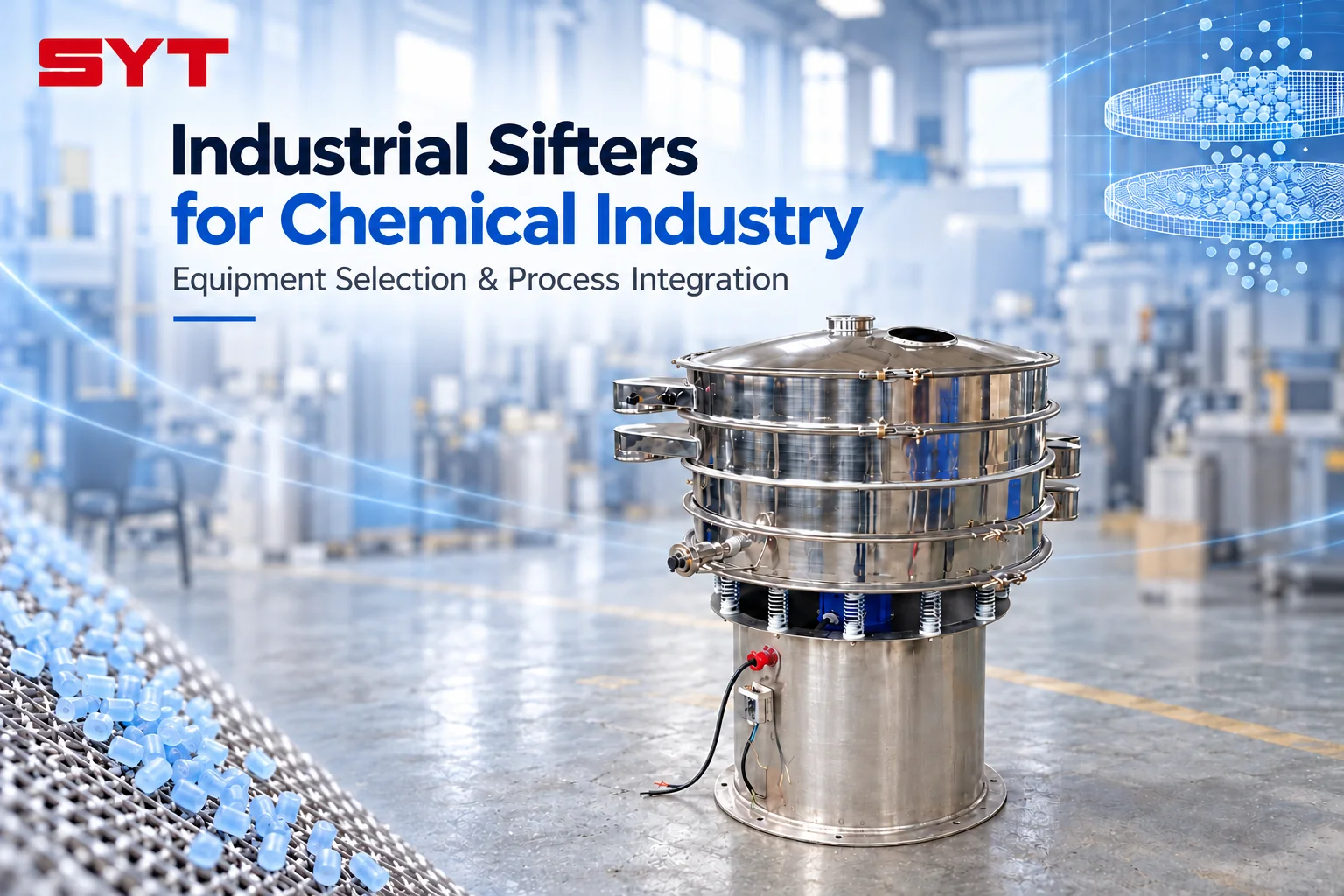
Choosing industrial sifters for chemical industry applications starts with the separation task, then the way the material behaves on the mesh. Resin powder, pigments and fertilizer can need different configurations at the same aperture because they absorb moisture, agglomerate or break differently. At Sanyuantang, we recommend rotary, ultrasonic-assisted or tumbler screening equipment according to the material and acceptance criteria, rather than using one screen type for every chemical.
What Does Chemical Powder Check Screening Remove?
In chemical powder screening, the first distinction is what needs to be separated:
- Check screening intercepts lumps, coarse particles and foreign matter larger than the screen openings.
- Grading collects separate particle-size fractions.
- Dedusting reduces the proportion of unwanted fines. Breaking soft agglomerates disperses loosely bound particles; it is a different task.
A chemical powder sifter is not a crusher. It cannot be relied on to break hard lumps or remove every contaminant with the same size as the product.
The installation position also changes the job:
- Before mixing: check incoming raw materials for oversize contamination.
- After mixing: verify that screening does not change the formulation ratio.
- Before packing: control the upper particle-size limit and check screen integrity.
If formulation components have very different particle sizes, examine the composition of the oversize stream before treating it as waste. Otherwise, a necessary ingredient may be rejected with the lumps.
Which Chemical Powder Sieving Equipment Fits the Material?
The table below is a starting point. We compare separation performance, retained material, cleaning access and production-line connections together.
| Material and task | Sanyuantang series to evaluate | What must be checked |
|---|---|---|
| Free-flowing powder or granules for check screening and grading | SY rotary vibrating screen | Aperture, bed depth and good product lost with oversize; same-size contaminants are not reliably removed |
| Fine powder with adhesion or soft agglomeration that restricts passage | SYC ultrasonic vibrating screen | Deblinding performance on the actual powder; not a replacement for drying or hard-lump crushing |
| Fragile particles or a need for longer residence on the screen | YBS tumbler screening machine | Additional breakage, fraction recovery and the cleaning method |
| Granule grading within a continuous conveying process | SYZ linear vibrating screen | Feed distribution, installation space and discharge connections |
A rotary airflow sifter is another check-screening option for suitable materials. If you share the chemical and process details, we can assess whether it belongs on the shortlist. This table is not a final machine selection: the complete material specification is needed before we recommend a configuration.
When Should Ultrasonic Deblinding for Chemical Powders Be Tested?
Compare conventional cleaning with ultrasonic assistance when fine powder progressively covers the openings, or output falls again soon after cleaning. Ultrasound acts on the screen surface to improve passage; it does not guarantee the elimination of all static electricity. If moisture has already produced hard lumps upstream, investigate storage, feeding and environmental conditions instead of simply increasing vibration.
Our published acrylic powder case uses an 800 mm, three-deck machine for 106, 90 and 75 micrometre separation requirements. The fine deck uses ultrasound, while coarser decks use bouncing-ball cleaning. Read the configuration reference: Ultrasonic Vibrating Sieve for Acrylic Powder.
The example shows why cleaning methods can differ between decks on one machine. It is not a capacity or improvement guarantee for other chemicals. With manufacturing experience dating to 1994, we can help assess your material, but the final recommendation should follow its requirements and test results. Contact us with your chemical powder details to discuss a suitable test.
Watch our powder-coating screening demonstration for a practical view of ultrasonic-assisted sieving. The material and screen setting in this video are specific to that demonstration; they are not a capacity or separation guarantee for another chemical.
How Should Vibratory Sieves for Chemicals Be Specified?
Mesh count and tonnes per hour are not enough for a quotation. The relationship between mesh count and aperture depends on wire diameter and the mesh specification. State the actual opening, wire diameter and tolerance. A higher open area may help throughput, but wire strength also matters.
- Material: name, composition, particle-size distribution, bulk density, moisture condition, temperature and tendency to absorb moisture.
- Separation: check screening or multi-fraction grading, including permissible fines and coarse particles at each outlet.
- Contact parts: chemical compatibility of the mesh, frame, seals and cleaning components.
- Site: feeding method, inlet and outlet heights, extraction connections, cleaning procedure and changeover frequency.
Neither 304 nor 316 stainless steel is universally corrosion-resistant. Selection depends on chemical composition, concentration, temperature and cleaning agents. An enclosed cover is not an explosion-protection system. For combustible, toxic or reactive powders, qualified project personnel must confirm material hazards, area requirements, earthing, containment and protective measures. The OSHA overview of combustible dust hazards explains why finely divided materials need a separate hazard assessment; applicable local requirements must also be checked.
If contact materials or protective arrangements are unclear, send us the material safety data and site requirements. We will first review the process and supply scope, then discuss the machine.
How Can a Chemical Powder Trial Verify the Selection?
Use a representative sample at the agreed aperture and feed conditions. Record the feed, every product outlet and material retained inside the machine, then sample the outputs for particle-size checks. Alongside stable throughput, record progressive blinding, acceptable powder carried into the oversize stream, cleaning time and changeover residue. Reaching the hourly feed target while rejecting good product does not establish a successful selection.
Chemical Sifting FAQs
Can One Chemical Powder Sifter Handle Multiple Materials?
Possibly, if contact materials are compatible, cleaning is effective and cross-contamination limits can be verified. Materials that react with one another or leave difficult residues may need dedicated mesh frames, contact parts or a separate machine.
Is Ultrasonic Deblinding Always Required for Fine Chemical Powders?
No. Decide from the cause of blinding and a comparative trial, not mesh count alone. Free-flowing powder may meet the requirement with conventional screen cleaning.
Can Chemical Powder Sieving Remove Every Contaminant?
No. A mesh separates mainly by size. Contamination small enough to pass through can remain in the product. Where composition, magnetism or another property is the concern, assess an appropriate additional control rather than relying on the sieve alone.
Is 316 Stainless Steel Always the Best Choice for Chemical Sifters?
No. Check the exact chemical, concentration, temperature and cleaning medium, including seals and cleaning components. The contact material should be selected for the service conditions, not from a stainless-steel grade name alone.
What Determines the Capacity of Industrial Sifters for Chemical Industry Applications?
Particle-size distribution, bulk density, moisture, feed distribution, screen area and cleaning method all affect capacity. Confirm sustained accepted output with the actual material; a catalog figure for another powder is not a reliable guarantee.
Conclusion
The right chemical sifter matches the separation target, material compatibility and site conditions, then demonstrates acceptable results. Start with a rotary screen for suitable free-flowing material; test ultrasonic assistance when fine powder blinds the mesh, or a tumbler arrangement when handling and fraction recovery warrant it. Send us your material, aperture, hourly requirement and cleaning needs so we can narrow the options. Please confirm sample shipping, test arrangements and hazardous-material acceptance before sending powder.
Sanyuantang Chemical Screening Equipment Manufacturing
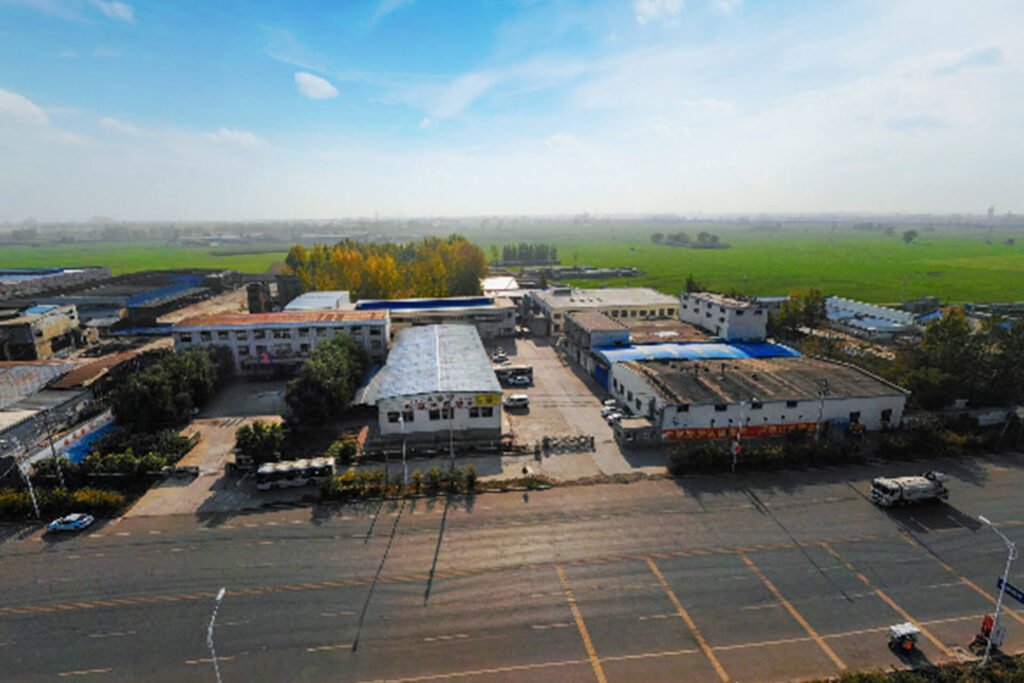
We are Sanyuantang, a screening and conveying equipment manufacturer based in Xinxiang, Henan, founded in 1994. Our factory uses laser cutting, welding, bending, drilling and CNC machining to manufacture equipment around material behaviour and production-line interfaces. For chemical screening projects, we discuss contact parts, screen cleaning, access and inlet and outlet arrangements together. Material trials and video communication help customers review the proposed separation before purchase. The final configuration, capacity and acceptance conditions are defined in the agreed technical proposal, not assumed from a general product range.
References
The Sanyuantang pages below document the equipment and application context discussed in this article. OSHA provides general combustible-dust hazard guidance; it does not certify a specific machine or replace a project-specific risk assessment.