
Efficient powder screening solutions do not always require a larger machine. Feed concentrated in one area, damaged mesh, moisture pickup and good product lost with oversize can leave a line with high feed throughput but little accepted output. At Sanyuantang, we first identify the reason for poor performance, then compare rotary, ultrasonic-assisted and tumbler screening against the same material and acceptance criteria.
What Does Powder Screening Efficiency Measure?
Feed throughput, accepted product output and target-fraction recovery are different measurements. More feed does not necessarily mean more saleable powder: an overloaded bed can carry fines into the oversize discharge. Weighing the undersize alone does not prove that its particle-size distribution is acceptable.
Record at least these three measures:
- Accepted product mass per unit time.
- The proportion of the target fraction in the feed recovered at its intended outlet.
- Total time for preparation, screening, discharge and cleaning.
For batch work, accepted product mass divided by the complete batch time is more informative than the instantaneous feed rate. Recovery calculations also need representative particle-size measurements; total undersize weight cannot replace them.
How Do You Diagnose Screen Mesh Blinding and Low Throughput?
First check feeding and discharge, then the mesh and cleaning system, and finally the machine size and arrangement. Several causes can coexist; these are investigation directions, not diagnoses from appearance alone.
| Observed problem | Possible cause | First check |
|---|---|---|
| A powder layer progressively covers the mesh | Adhesion, moisture pickup or static-related agglomeration | Compare material condition and mesh appearance before and after operation; check cleaning effectiveness |
| Individual particles lodge in openings | Near-size particles or irregular particle shape | Inspect trapped particles and verify opening shape, wire diameter and actual aperture |
| Lumps remain above a mesh the original particles should pass | Soft agglomeration or hard lumps formed upstream | Examine lump behaviour before assuming the sifter can disperse it |
| One-sided buildup or irregular discharge | Uneven distribution, restricted discharge or abnormal operation | Check feed distribution, outlets and supports; isolate before inspection |
Adhesion, pegged openings and agglomeration are different problems. Increasing vibration is not a universal remedy. Adjust mechanical settings only within the equipment limits to avoid mesh damage, spring problems or additional particle breakage. Do not use open compressed-air cleaning to investigate an unknown dust hazard. The OSHA overview of combustible dust hazards is a useful starting point for understanding the risk; it does not replace a site assessment.
If the cause is unclear, send our engineers mesh photographs, a running video and material details. These usually provide a better starting point than a throughput figure alone.
Which Fine Powder Screening Technology Should Be Tested?
We shortlist technology from the observed problem rather than treating every fine powder as an ultrasonic application.
| Candidate technology | When to evaluate it | What the comparison must establish |
|---|---|---|
| SY rotary vibrating screen with mechanical cleaning | General check screening or powder and granule grading | Passage, good product in oversize, and wear of bouncing balls or other contact components |
| SYC ultrasonic vibrating screen | Fine-powder adhesion or agglomeration that restricts passage | Deblinding, mesh condition and stable operation over time |
| YBS tumbler screening machine | Gentle handling, longer residence or multi-fraction separation | Fraction recovery, additional breakage and cleaning cost |
| rotary airflow sifter or a different classification process | A suitable check-screening, dispersion or classification task | Whether the operating principle meets the target; mesh screening is not the same as air classification |
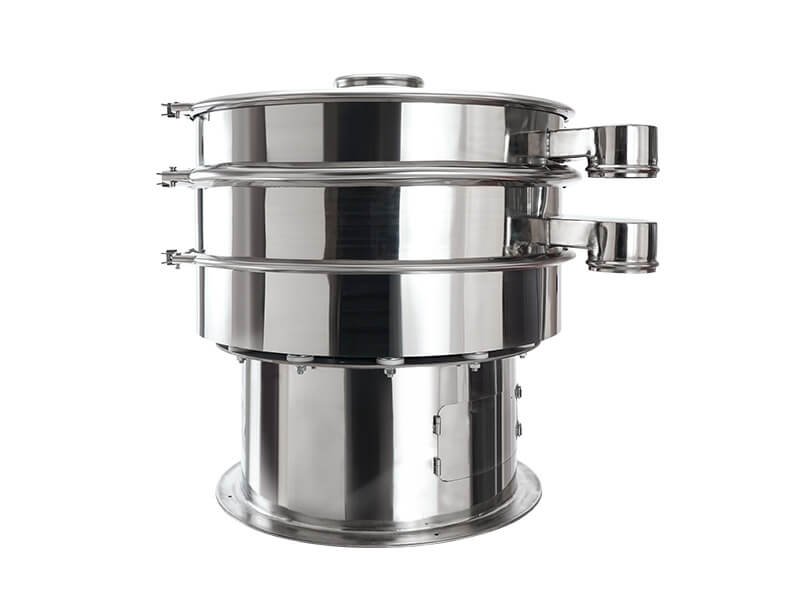

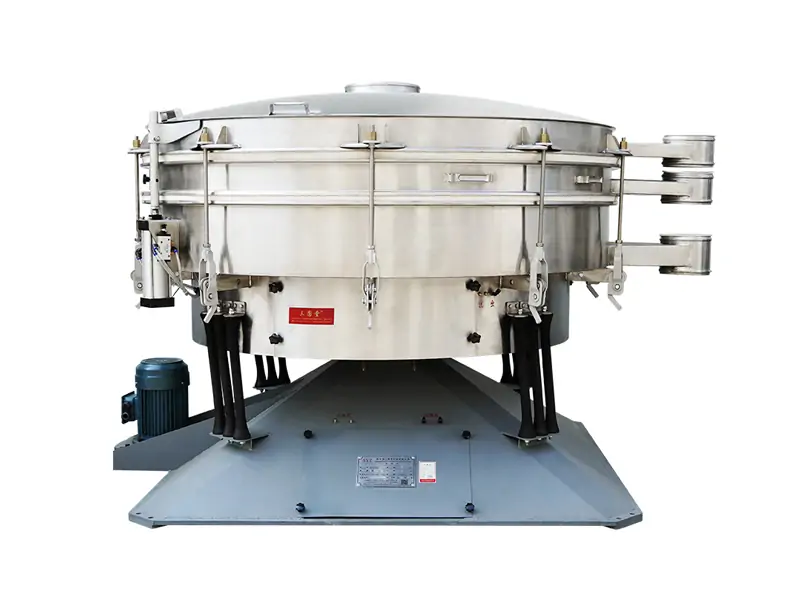
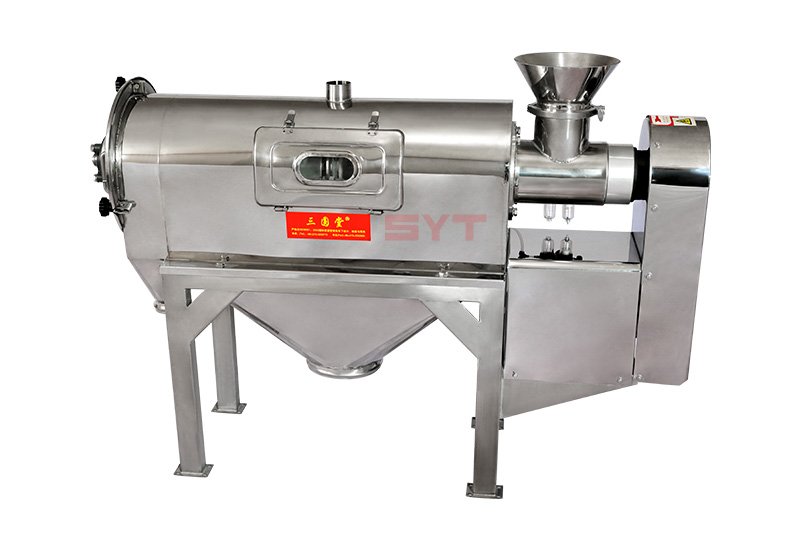
High-energy screeners are also marketed for difficult materials, but their motion and operating conditions vary. Compare results, not simply vibration intensity. Hard upstream lumps, oily adhesion or a restriction on mechanical contact may require a different pretreatment or separation process. We do not promise that a screen type is suitable before evaluating those conditions.
When Is Ultrasonic Powder Sieving Worth Using?
Ultrasonic assistance transmits high-frequency, low-amplitude mechanical vibration to the mesh to improve passage of difficult fine powder. It does not dry powder or remove the need for earthing and dust-risk assessment. For the mechanism and limitations, read How Ultrasonic Vibrating Screens Prevent Mesh Blinding in Fine Powder Screening. This article focuses on whether the method increases accepted output compared with the alternatives.
In our acrylic powder example, the 106 and 90 micrometre decks use bouncing balls, while the 75 micrometre deck uses ultrasound. Read Ultrasonic Vibrating Sieve for Acrylic Powder for the application configuration. The useful point is selecting cleaning by the problem on each deck, not applying an improvement percentage to unrelated powders.
A powder name and mesh count alone cannot establish whether ultrasonic screening is worthwhile. Treat it as one candidate and compare it under the actual material and operating conditions.
Our matcha-powder demonstration compares rotary screening with ultrasonic assistance. It illustrates a way to investigate mesh blinding, rather than a universal improvement rate. Confirm accepted output and product loss with your own powder under agreed trial conditions.
How Should Efficient Powder Screening Solutions Be Compared?
- Use the same representative material batch and record moisture condition, temperature, bulk density and initial particle-size distribution.
- Keep the product specification fixed. Verify aperture, wire diameter, effective screen area and cleaning configuration.
- At stable feed, weigh input, each discharge, retained material and sampling losses, and check the mass balance.
- Check the particle-size distribution of each output for rejected good product and unwanted coarse particles in the target stream.
- Include cleaning, changeovers, labour, mesh consumption and powder losses when comparing cost per kilogram of accepted product.
If a machine meets the target briefly but loses output later, record the development of blinding and the cleaning interval. If it never meets the target, investigate feed conditions, aperture and task compatibility first. Contact us with your current screen type, opening, material condition and target output to plan a meaningful comparison.
Powder Screening FAQs
Are High-Energy Powder Screeners Always More Efficient?
No. Compare accepted output, recovery, breakage and maintenance cost under the same conditions. Stronger motion is not an advantage if it increases product losses or downtime.
Can a Larger Mesh Aperture Solve Screen Mesh Blinding?
It may reduce blockage, but it may also let unwanted coarse particles through. Change the aperture only when the product specification permits it and checks confirm acceptable separation.
Will a Larger Powder Screening Machine Always Increase Output?
No. Additional area may help when screen loading is the limiting factor. It will not correct a blocked discharge, poor feed distribution, damaged mesh or unsuitable material condition by itself.
How Can You Tell Mesh Damage from Low Screening Efficiency?
Mesh damage can allow oversize particles into the product even when throughput appears high. Isolate the equipment, inspect the mesh and seals, and compare product particle-size results. Low output alone does not identify mesh damage.
Should Damp Powder Be Screened with Ultrasonic Assistance?
Only after evaluating the material and process. Ultrasound may assist some adhesion-related problems, but it cannot remove moisture or reliably break hard, moisture-bound lumps. Upstream moisture control may be necessary.
What Is the Best Way to Compare Powder Screening Cost?
Compare total cost per kilogram of accepted product over a representative operating period. Include labour, cleaning and changeover time, replacement mesh, retained powder and good product rejected with oversize, not only machine purchase price.
Conclusion
The best improvement is the one that produces more accepted powder, reduces identifiable losses and justifies its operating cost. Establish the cause of the restriction before choosing a larger machine or adding ultrasound. Share your current screen, aperture, material condition and output target with us; we can discuss a side-by-side material trial and measurable acceptance conditions.
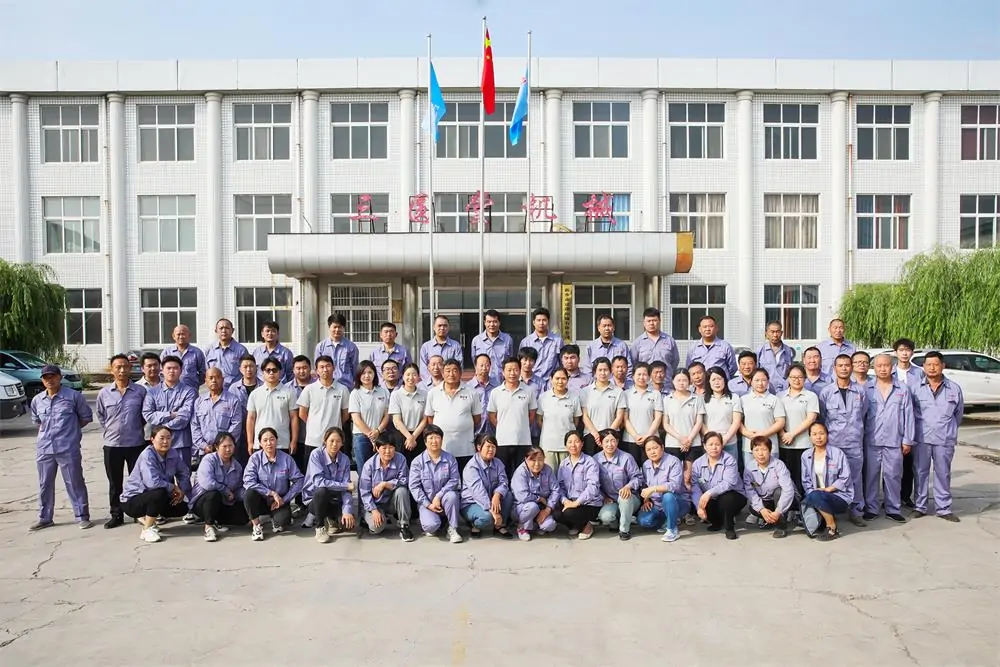
How Sanyuantang Supports Powder Screening Selection
At Sanyuantang, we manufacture screening and conveying equipment in Xinxiang, Henan, with factory operations dating to 1994. Our rotary, ultrasonic-assisted and tumbler equipment gives us several options to assess rather than one standard answer for every fine powder. Laser cutting, welding, bending, drilling and CNC machining support configuration changes for cleaning access and line connections. We offer material trials and video communication to help customers compare separation results. The purpose is to select a workable configuration for the powder and operating cycle; final capacity and acceptance requirements remain subject to the agreed technical proposal.
References
The Sanyuantang pages below document the equipment and application context discussed in this article. OSHA provides general combustible-dust hazard guidance; it does not certify a specific machine or replace a project-specific risk assessment.