Project Background
In December 2025, Sanyuantang received a rotary vibrating screen requirement from a customer in Palestine. The customer mainly produces tahini. Before entering the grinding process, peeled sesame seeds need to be screened to remove broken particles, impurities, and oversized or abnormal-sized materials. According to the production conditions provided by the customer, the required screening capacity was approximately 1 ton/hour, with a 16-mesh screening requirement.
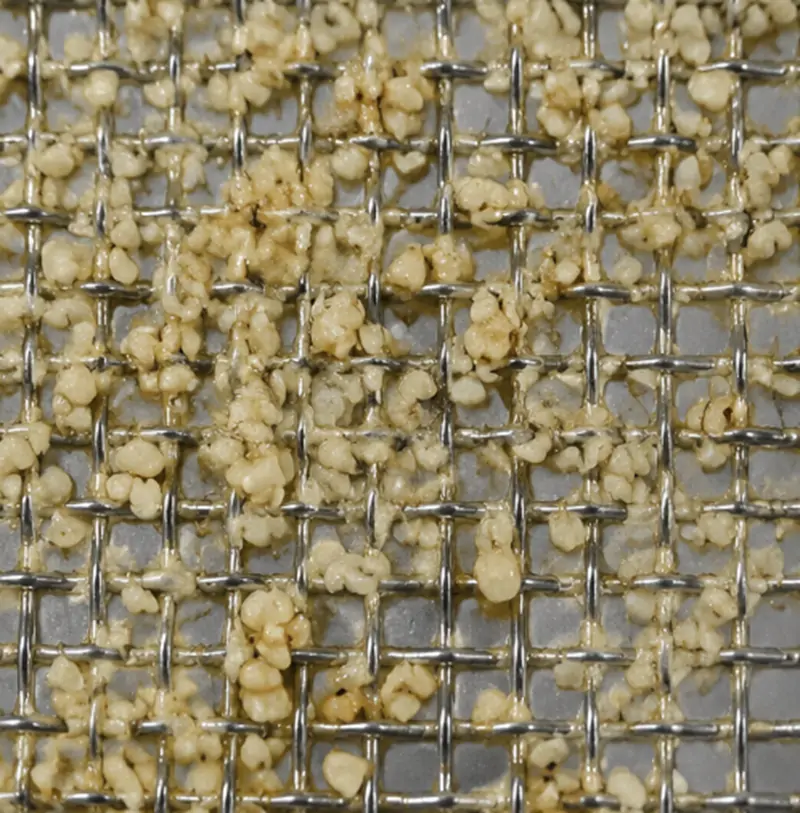
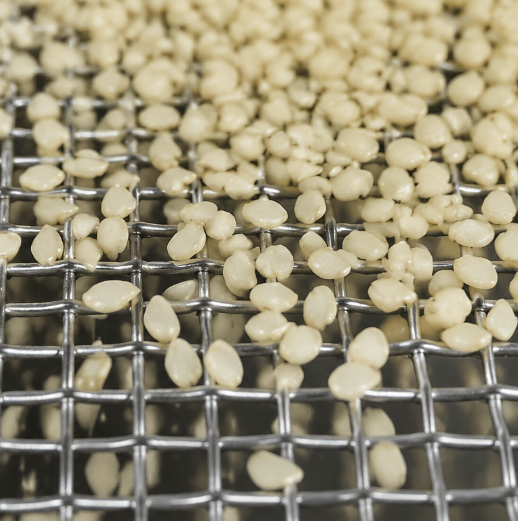
Because sesame contains a relatively high oil content, a continuous screening operation may cause material adhesion on the screen surface and fluctuations in screening performance. The customer required the equipment to maintain stable operation during long-term production.
Based on the material characteristics, screening requirements, and operating conditions provided by the customer, our engineering team developed a customized rotary vibrating screen solution with targeted structural adjustments.
Customer Challenges
Sesame is an oily granular material. During continuous screening, it can easily cause screen surface adhesion, insufficient screening, and unstable operation.
Based on the customer’s production conditions, our engineering team analyzed the material characteristics, screening requirements, and continuous operation conditions. The main challenges that needed to be addressed were as follows:
| Customer Challenge | Engineering Adjustment |
| Oil content in sesame caused fine particles to adhere to the screen mesh | Adjusted material movement conditions to reduce local accumulation on the screen surface |
| Short residence time of material on the screen surface | Added an internal return tray to extend the material running path |
| Temperature increases during continuous operation | Added an air cooling structure to reduce heat accumulation |
| Required 16 mesh screening | Applied a double-layer screen structure to achieve impurity removal and particle size control |
Problem Investigation
Before confirming the equipment configuration, the Sanyuantang engineering team analyzed the operating conditions based on the material information, screening requirements, and production conditions provided by the customer.
Based on the customer’s material characteristics, screening requirements, and production process, combined with our previous experience in sesame screening applications, we determined that the main challenge of this project was not capacity itself.
The key was maintaining stable screening performance under conditions including:
- High oil content of sesame;
- Small screening aperture requirements;
- Long-term continuous operation.
Therefore, the equipment configuration focused on:
- Reducing manual maintenance frequency.
- Extending the effective movement path of material on the screen surface;
- Reducing heat accumulation during the screening operation;
- Improving screen mesh utilization and passing performance;
Why Is This Sesame Screening Equipment Required to Be Customized
The problem with standard screening equipment is usually not insufficient processing capacity, but whether the equipment structure matches the material characteristics.
For sesame and other granular materials that are prone to adhesion, our engineering team focused on adjusting three key aspects:
- Material movement path on the screen surface;
- Temperature control during continuous screening;
- Screen mesh configuration.
The specific adjustments are as follows:
| Adjustment Item | Design Reason | Actual Effect |
| Adding an air cooling structure | Sesame is an oily material. During continuous screening, friction between the material and screen mesh may generate heat, and temperature increase can further increase material adhesion. | Improves internal air circulation, reduces heat accumulation during operation, and lowers the risk of material sticking to the screen mesh. |
| Adding an internal return tray structure | Under high-throughput operation, material may pass through the screen surface too quickly, causing some particles to have insufficient contact with the mesh. | Extends the sesame screening path, allowing insufficiently screened material to participate in screening again and reducing qualified material loss with oversized particles. |
| Double-layer screen design | The customer required particle size control through the target mesh size while also removing larger particles and impurities. | The upper screen removes larger particles, while the lower 16 mesh screen completes target size screening, achieving classification in one operation. |
Recommended Screening Equipment Type
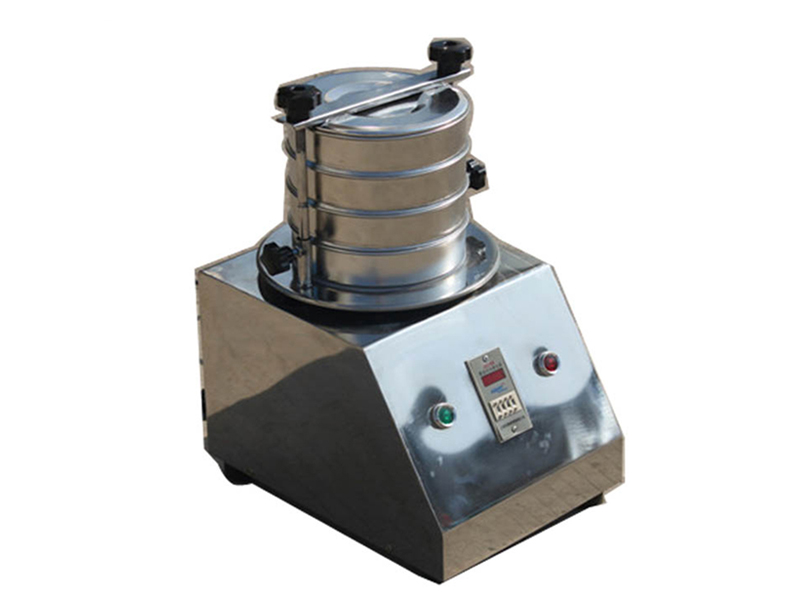
Rotary Vibrating Screen
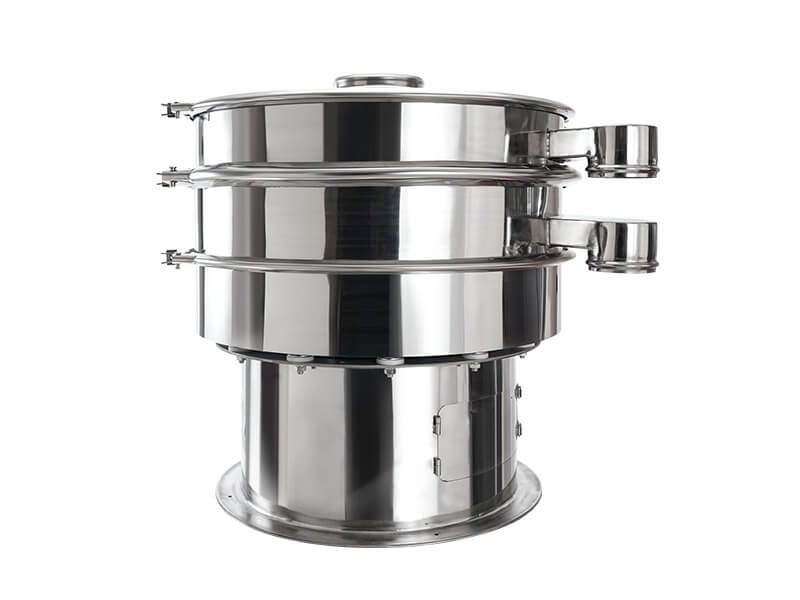
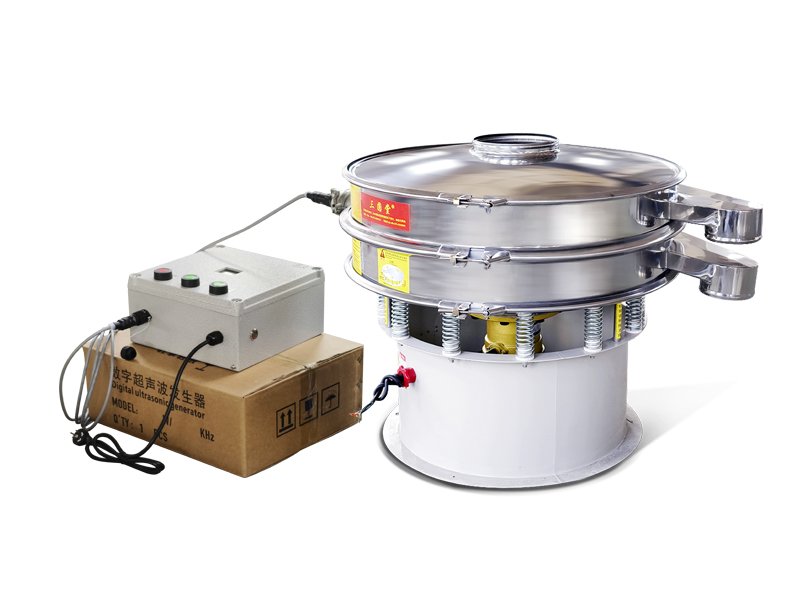
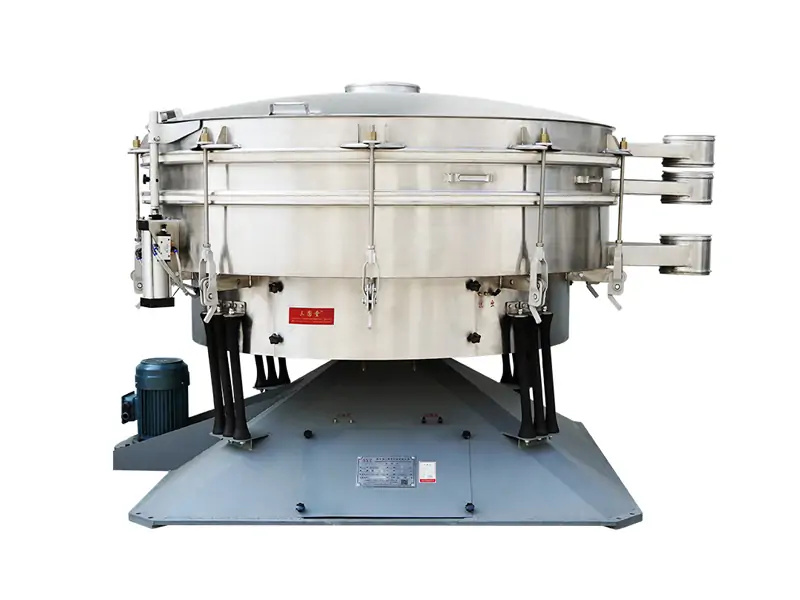
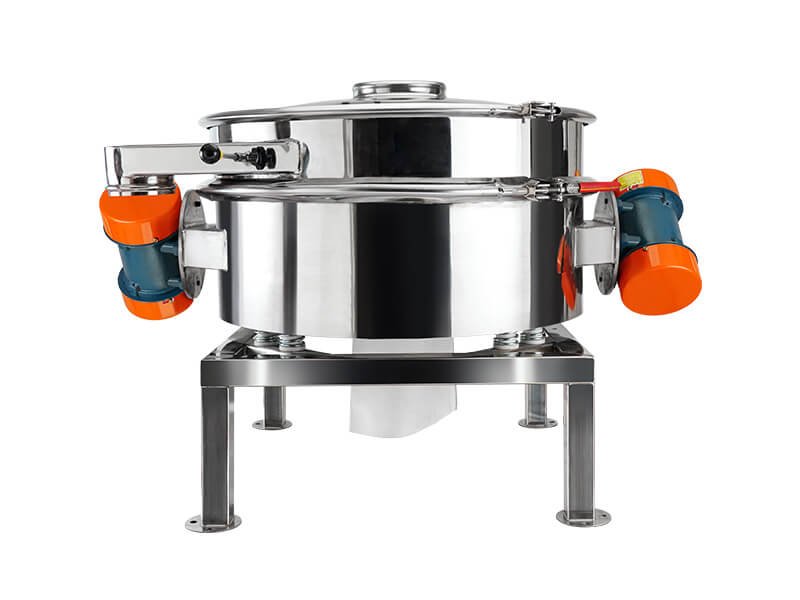
This is our standard Rotary Vibrating Screen:
For oily granular materials such as sesame, equipment selection should not only consider processing capacity but also focus on how the material moves across the screen surface.
Based on the customer’s 16 mesh screening requirement, Sanyuantang selected the SY-1200 series Rotary Vibrating Screen and customized the structure for this application. The equipment was configured with a double-layer screen, internal return tray, and air cooling structure, allowing the sesame material to achieve a longer and more stable screening process while reducing screen adhesion and screening fluctuations.
Equipment Configuration and Parameters
According to the customer’s screening requirements, the final equipment configuration was determined as follows:
| Parameter | Project Configuration |
| Equipment Model | SY-1200-2S (Customized) |
| Screen Layers | Double-layer screen |
| Screening Aperture | 16 mesh |
| Effective Screening Diameter | 桅1170 mm |
| Material | SUS316 stainless steel for material contact parts |
| Motor Power | 1.1 kW |
| Processing Capacity | Approx. 1 ton/hour (adjusted according to material conditions) |
| Customized Structure | Internal return tray and air cooling structure |
| Application Material | Peeled sesame and food particle materials |
Before and After Comparison
To address the customer’s previous problems, including screen mesh adhesion, insufficient material residence time, and unstable continuous operation, our engineering team adjusted the screening structure and improved the equipment operating conditions.
| Comparison Item | Previous Screening Method | Customized Rotary Vibrating Screen |
| Screen Surface Condition | During continuous screening, sesame fragments and fine particles easily adhered to the screen mesh, requiring manual cleaning depending on operating conditions. | By optimizing the screen structure and material movement path, local material accumulation on the screen surface was reduced and cleaning frequency was lowered. |
| Material Screening Time | Material passed through the screen surface quickly, and some particles might not have sufficient contact with the mesh. | The internal return tray extended the material movement path, allowing more sufficient screening time. |
| Continuous Operation Stability | After long-term operation, screening performance could be affected by material adhesion. | The structure was adjusted according to sesame characteristics, making the equipment more suitable for continuous screening operation. |
| Temperature Control | Long-term operation could cause local heat accumulation due to friction and material buildup. | The air cooling structure helped reduce heat accumulation during operation. |
| Classification Performance | Single-layer screening could not complete impurity removal and particle size control at the same time. | The double-layer screen achieved coarse impurity removal and 16 mesh classification in one process. |
Sanyuantang Engineer Recommendations
For food particle materials such as sesame that are prone to adhesion, equipment structure is only one factor affecting screening performance. Feeding conditions, material characteristics, and daily maintenance also have an impact on the final screening results.
- Maintain Uniform Feeding:Do not immediately run the equipment at maximum feeding capacity. The distribution of sesame on the screen surface directly affects screening performance.
- Check Screen Condition When Screening Performance Decreases:If the discharge condition changes, first check whether material accumulation or adhesion has occurred on the screen mesh before adjusting equipment parameters.
- Avoid Cleaning the Screen Mesh with Hard Tools:Fine screen meshes may deform when impacted by hard objects, which can affect future screening accuracy.
- Regularly Check the Air Cooling Structure:The air cooling system is mainly used to reduce heat accumulation during continuous operation. The ventilation area should be kept clear during use.
- Adjust Operation According to Sesame Conditions:Different batches of sesame may vary in moisture content, peeling condition, and surface characteristics. Equipment operation should be adjusted according to actual material conditions.
Conclusion
For this customer’s requirement of 16 mesh screening for peeled sesame, Sanyuantang did not directly use a standard configuration. Instead, the SY-1200 series Rotary Vibrating Screen was customized with a double-layer screen, internal return tray, and air cooling structure. After adjustment, the material achieved a more sufficient movement process on the screen surface, reducing material accumulation on the screen mesh. The equipment successfully met the customer’s requirements for sesame screening before the grinding process.
For screening food particle materials such as sesame and nuts, processing capacity is only one factor in equipment selection. Material adhesion characteristics, screen aperture size, and continuous operation requirements also determine the final screening configuration.
Common Applications of Rotary Vibrating Screen
Rotary Vibrating Screen is not only suitable for food particle materials such as sesame, but also widely used for screening, impurity removal, and classification of various powder and granular materials. Different materials have different characteristics, including particle size, flowability, moisture content, and adhesion behavior. Therefore, screening configurations may vary according to actual production conditions.
The following are common application industries for Rotary Vibrating Screen:
| Industry | Typical Materials | Common Screening Requirements |
| Food Industry | Sesame, starch, milk powder, seasoning powder, grain particles | Raw material screening, impurity removal, particle size control |
| Chemical Industry | Resin, pigments, plastic granules, catalysts | Powder classification, impurity separation |
| Pharmaceutical Industry | API materials, pharmaceutical powder, excipients | Fine particle screening, grade control |
| Metal Powder Industry | Copper powder, aluminum powder, stainless steel powder | Powder classification, particle size control |
| New Energy Materials | Cathode materials, anode materials, conductive powder | Powder screening, impurity removal |
| Mineral Materials | Quartz sand, kaolin, mineral powder | Particle size classification, material screening |
Different materials show different screening behaviors, and equipment configuration needs to be selected according to actual operating conditions.
If you are not sure which vibrating screen is suitable for your material, you can provide your material information, processing capacity, and screening requirements. Our engineering team will analyze the actual operating conditions and help select a suitable equipment configuration.
With more than 30 years of experience in vibrating screen and fine screening equipment manufacturing, Sanyuantang has accumulated screening experience across industries including food, chemical, metal powder, and new energy materials. We can provide suitable screening equipment solutions based on different material characteristics and production requirements.
Email: info@sanyuantang.com
Phone: +86-18639095165