Introduction
A reliable quartz powder screening solution is essential for manufacturers that require continuous particle size classification while minimizing production interruptions caused by screen clogging.
In high-purity quartz powder processing, irregular particle shapes and fine mesh sizes often reduce screening efficiency, increase maintenance requirements and affect product consistency.
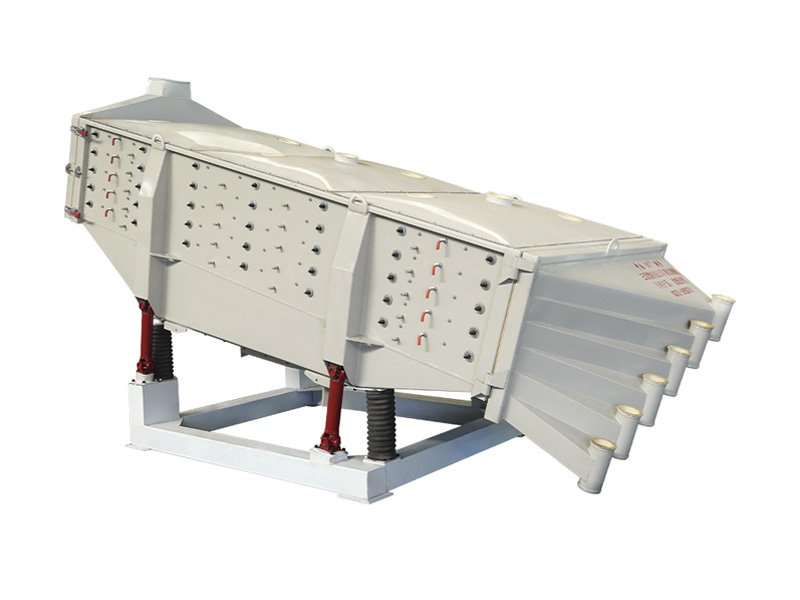
This case study explains how a Russian quartz powder producer implemented a five-deck screening solution to eliminate severe screen clogging during quartz powder screening, achieving stable 50–150 mesh classification and increasing production capacity to 1,500 kg/h.
Project Summary
| Item | Details |
|---|---|
| Project Date | May 2026 |
| Installation Period | 5 Days |
| Commissioning | 2 Days |
| Industry | Non-metallic Mineral Processing |
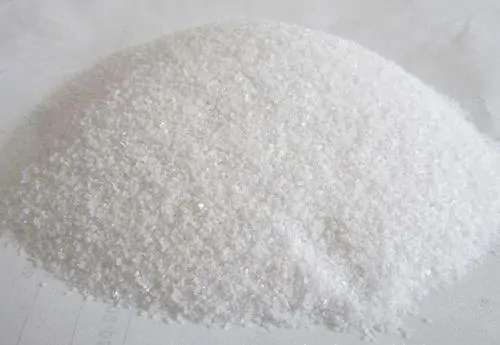
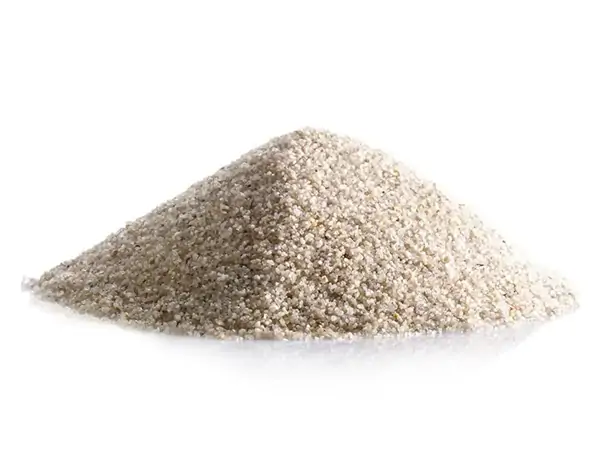
| Material | Quartz Powder |
| Equipment | SYT-1025 Square Gyratory Screen (Five Decks) |
| Screen Mesh | SUS304 Woven Mesh (50, 60, 80, 100 and 150 Mesh) |
| Screening Method | Dry Multi-Deck Classification |
| Capacity | 1,500 kg/h |
| Product Pass Rate | ≥95% |
| Installation Site | Moscow Oblast, Russia |
| Customer Objective | Continuous high-precision classification while eliminating screen clogging |
Customer Background
Russian Quartz Technology Co., Ltd. specializes in the production of high-purity quartz powder for industrial applications including glass manufacturing, ceramic materials, refractory products, electronic materials, and new energy industries. Product consistency is critical because downstream customers require stable particle size distribution across different production batches.
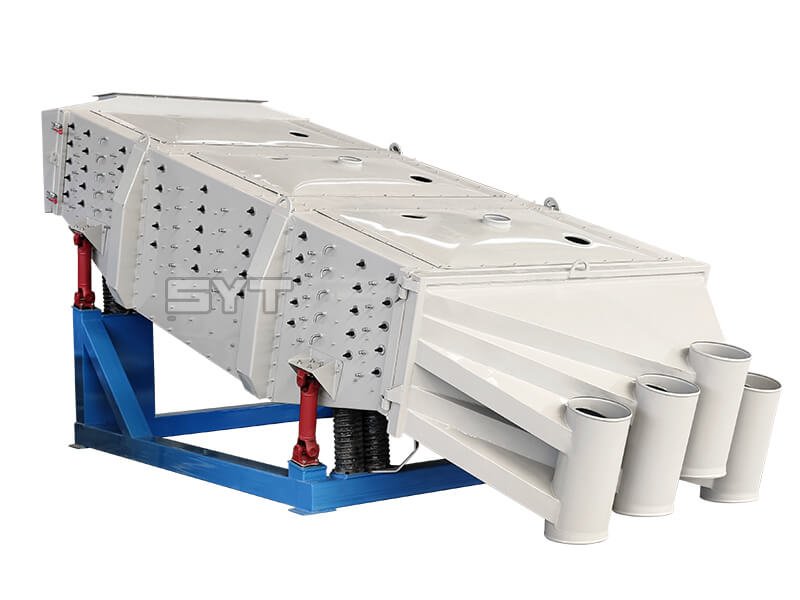
The production line was designed to classify quartz powder into multiple particle sizes ranging from 50 mesh to 150 mesh. To complete all grading steps in one process, the plant previously relied on a conventional rotary vibrating screen.
Although the original equipment could perform the required classification, it gradually became the bottleneck of the production line as finer mesh sizes were introduced.
Challenges in Quartz Powder Screening
The customer’s primary concern was not screening accuracy but production continuity.
Quartz particles produced during crushing were irregular in shape. As the material entered the finer screens, particularly 100 mesh and 150 mesh, particles frequently lodged in the mesh openings. Screen cleaning became part of normal production rather than routine maintenance.
During normal operation:
- The screening machine required cleaning approximately every two hours.
- Production had to be stopped repeatedly to remove blocked material.
- Actual throughput remained around 100 kg/h, far below production requirements.
- Frequent interruptions affected the consistency of particle size classification.
- Fine particles occasionally entered coarser fractions, reducing overall product quality.
For a manufacturer supplying high-purity quartz powder, inconsistent particle size distribution created additional quality control work and limited its ability to accept higher-value orders.
The customer therefore looked for a solution capable of maintaining continuous multi-deck screening without frequent manual intervention.
Engineering Assessment
Before recommending new equipment, Sanyuantang engineers reviewed the customer’s operating conditions instead of simply replacing the existing machine with a larger vibrating screen.
Several operating characteristics were identified:
- Dry screening process
- Five particle size classifications completed simultaneously
- Fine mesh ranging from 50 to 150 mesh
- Irregular quartz particle shape after crushing
- Continuous production requirement of 1,500 kg/h
- Stable product quality more important than maximum vibration intensity
These conditions indicated that increasing vibration frequency alone would not solve the problem. The main limitation was the movement pattern of the material across the screen surface rather than insufficient vibration force.
The engineering objective therefore became improving particle travel and reducing the probability of particles remaining stationary on the screen openings, while maintaining accurate multi-deck classification.
Quartz Powder Screening Solution
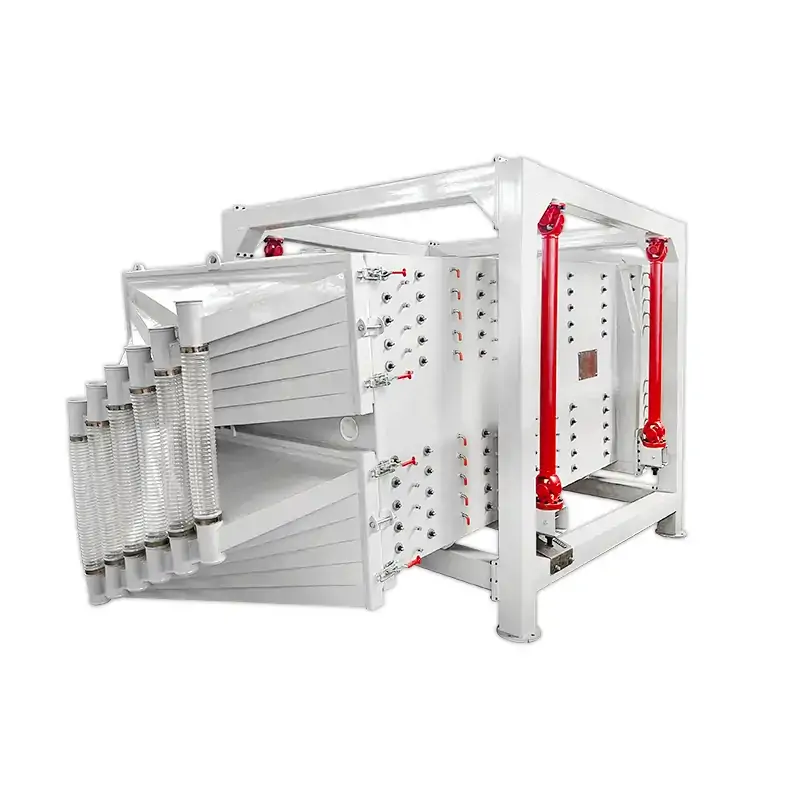
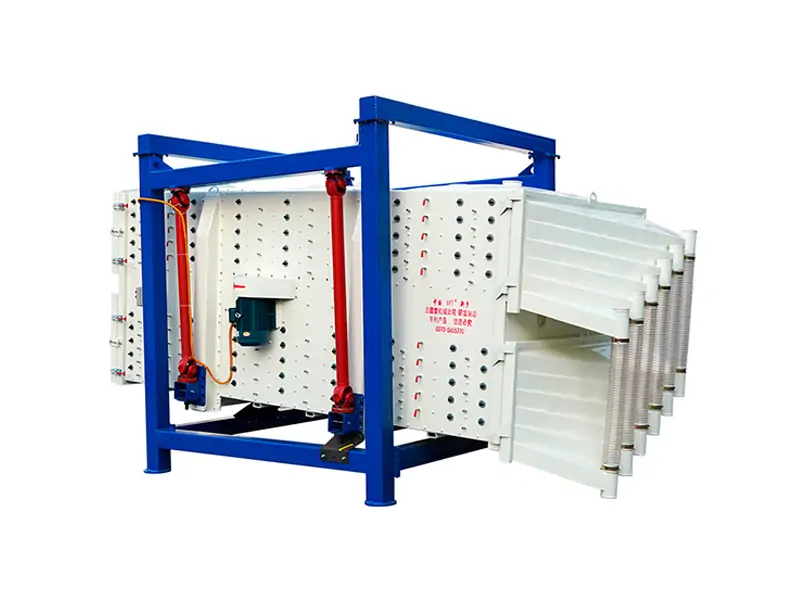
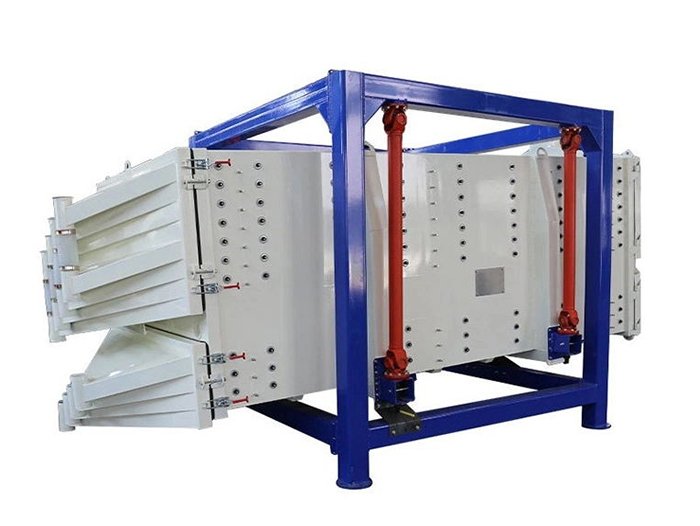
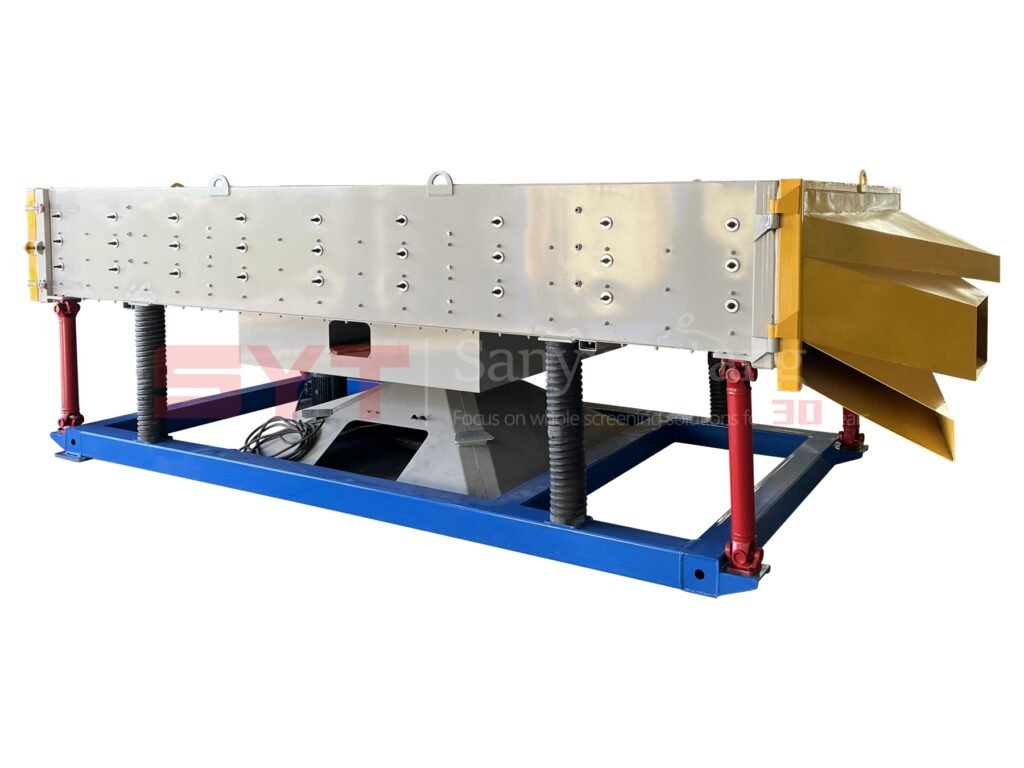
After reviewing the production process and the operating conditions, Sanyuantang recommended replacing the existing rotary vibrating screen with an SYT-1025 Square Gyratory Screen equipped with five screening decks.
The recommendation was based on the customer’s production objective rather than simply increasing screening capacity. The production line required continuous classification from 50 mesh to 150 mesh while maintaining stable product quality throughout long production cycles. Eliminating frequent screen cleaning was considered the priority, followed by screening accuracy and production capacity.
Instead of relying on higher vibration intensity, the selected screening system uses a low-speed reciprocating gyratory motion. This movement allows quartz powder to travel across the screen surface in a gradual spiral pattern, providing more opportunities for particles to approach the screen openings from different angles.
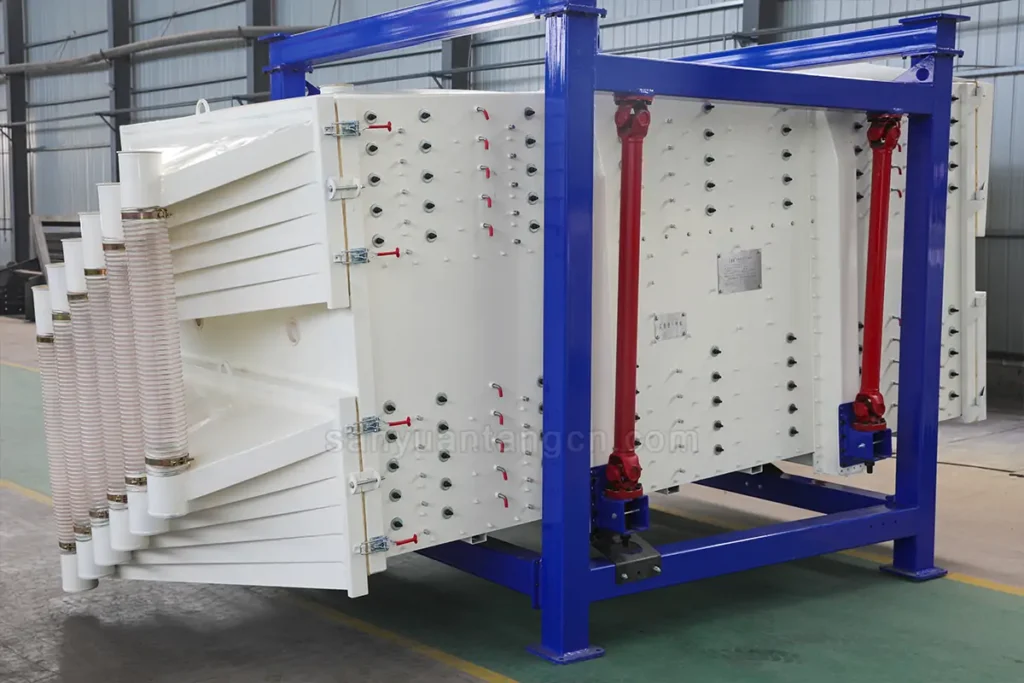

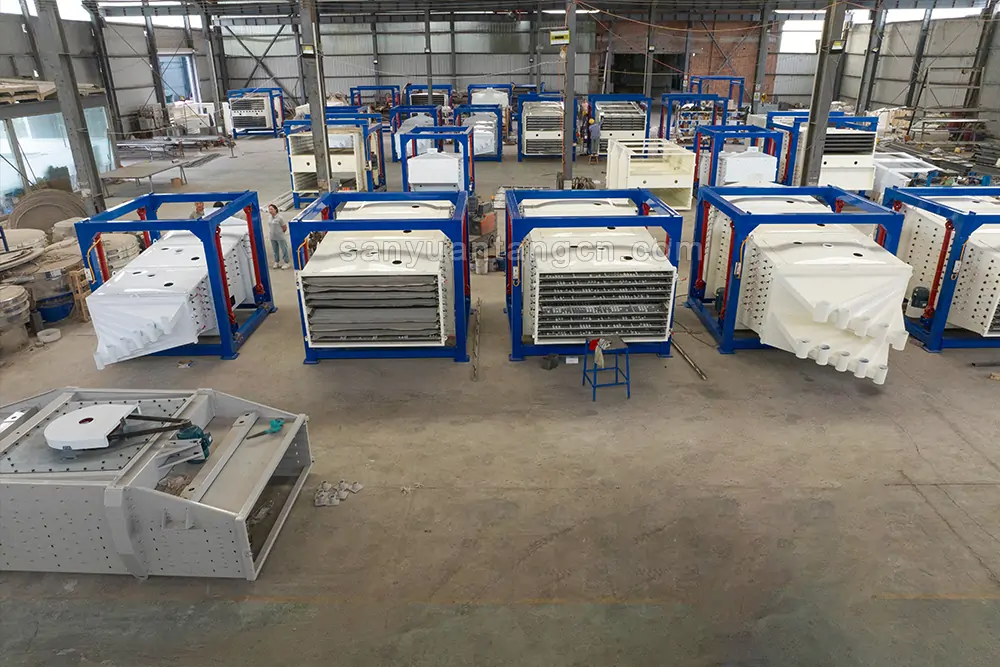
Compared with conventional rotary vibration, this screening motion reduces the chance of irregular particles becoming lodged in the mesh while maintaining a longer residence time on each deck. As a result, particle stratification becomes more complete before passing through the corresponding mesh size.
For multi-deck dry screening applications such as quartz powder classification, this operating principle provides a more stable process than high-frequency vibration alone.
Equipment Configuration
The screening system supplied for this project was configured according to the customer’s required particle size distribution and production capacity.
| Configuration Item | Specification |
|---|---|
| Equipment Model | SYT-1025 Square Gyratory Screen |
| Number of Decks | Five Decks (Six Product Fractions) |
| Screen Mesh | 50 Mesh, 60 Mesh, 80 Mesh, 100 Mesh and 150 Mesh |
| Screen Material | SUS304 Stainless Steel Woven Wire Mesh |
| Feeding Method | Top Center Feed |
| Drive System | Standard Motor with Universal Coupling |
| Screen Frame | Carbon Steel with Internal Anti-corrosion Treatment |
| Anti-Blinding Design | Bounce Ball Cleaning System with Optimized Screen Tension Structure |
| Screening Method | Continuous Dry Screening |
The five-deck arrangement enabled the customer to complete all required particle size classification in a single continuous operation without transferring material between separate screening machines.
For more information, please refer to the product details: Gyratory Screen
Why Was a Square Gyratory Screen Selected Instead of an Ultrasonic Vibrating Screen?
Ultrasonic screening technology is widely used for ultrafine powders and is effective in reducing mesh blinding under certain conditions. However, after evaluating the customer’s production process, Sanyuantang determined that it was not the most suitable solution for this application.
The decision was based on the characteristics of the production line rather than on the performance of a single machine.
Large Processing Capacity
The customer’s production target was 1,500 kg/h while performing five simultaneous particle size classifications.
A square gyratory screen provides a significantly larger effective screening area than a conventional circular vibrating screen of comparable size. The larger screening surface allows material to spread more evenly across each deck, reducing local material accumulation and supporting continuous high-capacity operation.
For this project, maintaining stable throughput over long production periods was more important than maximizing vibration frequency.
Better Performance with Irregular Quartz Particles
The customer’s screen clogging was mainly caused by irregular particle geometry rather than excessive moisture or material adhesion.
Quartz particles generated during crushing do not have a uniform shape. Some elongated or angular particles tend to approach the mesh opening in unfavorable orientations, increasing the possibility of blocking the screen.
The gyratory motion allows these particles to change orientation repeatedly while travelling across the screen surface. This improves the probability of correctly sized particles passing through the mesh without becoming trapped.
For applications involving dry quartz powder and multiple screening stages, this movement pattern provides a practical advantage over conventional high-frequency vibration.
Lower Maintenance Requirements
The production plant operates in the Moscow Oblast region, where equipment reliability and maintenance simplicity are important considerations.
Compared with ultrasonic screening systems, a mechanically driven square gyratory screen has fewer auxiliary components and a simpler transmission structure. Routine maintenance mainly involves periodic inspection of the transmission components and the screen cleaning system.
This configuration reduces maintenance complexity while providing reliable long-term operation under dusty industrial conditions.
Mature Multi-Deck Screening Design
The production process required continuous classification into 50 mesh, 60 mesh, 80 mesh, 100 mesh and 150 mesh without interrupting material flow.
A five-deck square gyratory screen is designed specifically for this type of multi-stage particle size separation. Each screening deck performs an individual classification while the material continues moving through the machine, allowing all required particle fractions to be produced during one continuous screening cycle.
This arrangement simplified the overall production process and eliminated the need for multiple independent screening machines.
Engineering Outcome Before Commissioning
Before installation, the engineering objective for the project was clearly defined:
- Eliminate frequent screen cleaning caused by mesh blinding.
- Maintain continuous dry screening from 50 mesh to 150 mesh.
- Increase production capacity from approximately 100 kg/h to the target of 1,500 kg/h.
- Improve the consistency of particle size classification.
- Reduce routine maintenance associated with screen replacement and manual cleaning.
- Provide a screening system capable of stable long-term industrial operation.
These objectives formed the basis for equipment selection and later served as the performance criteria during commissioning.
Performance Verification
The installation was completed within five days, followed by two days of commissioning. During commissioning, the screening system was tested under normal production conditions using the customer’s quartz powder and the required screening specifications from 50 mesh to 150 mesh.
The objective of the commissioning process was not only to verify screening accuracy, but also to confirm whether the production line could maintain stable operation over extended production periods without the frequent interruptions experienced with the previous screening system.
After the operating parameters were adjusted and verified, the screening system entered continuous production.
Operational Performance Comparison
The following comparison summarizes the operating performance before and after the replacement of the screening equipment.
| Performance Item | Previous Rotary Vibrating Screen | SYT-1025 Square Gyratory Screen |
|---|---|---|
| Screen Blinding | Manual cleaning required approximately every 2 hours | Continuous operation for more than 8 hours without manual screen cleaning |
| Production Capacity | Approximately 100 kg/h due to frequent downtime | Stable production at 1,500 kg/h |
| Screening Accuracy | Product consistency affected by screen blinding | More than 95% pass rate across all specified mesh sizes |
| Production Continuity | Frequent shutdowns interrupted production | Stable continuous operation throughout production shifts |
| Noise Level | High-frequency vibration with relatively high operating noise | Stable low-frequency operation with noise below 75 dB |
| Routine Maintenance | Frequent screen cleaning and screen replacement | Routine inspection of screen cleaning components only |
The improvement was achieved through changes in material movement across the screen surface rather than increasing vibration intensity. As a result, the production process became more stable while reducing manual intervention.
Production Results
After commissioning, the production line reached the customer’s planned operating capacity of 1,500 kg/h while maintaining continuous dry screening across all five screening decks.
One of the most noticeable improvements was the elimination of repeated production interruptions caused by screen blinding. Under normal operating conditions, the screening system remained in continuous operation for an entire production shift without requiring manual screen cleaning.
The stable screening process also improved particle size consistency across the finished products. Quartz powder classified at 50 mesh, 60 mesh, 80 mesh, 100 mesh and 150 mesh maintained a pass rate of more than 95%, allowing downstream production to receive more consistent raw materials.
Because screening interruptions were significantly reduced, production scheduling became more predictable and operators spent considerably less time performing routine cleaning work.
Maintenance Performance
Although production capacity was one of the customer’s primary objectives, maintenance requirements also played an important role in evaluating the project.
Under the previous screening system, screen cleaning had become a routine production task. Operators were required to stop the machine regularly, remove accumulated particles from the screen surface and resume production. These repeated interruptions increased labor requirements and reduced equipment availability.
Following the installation of the square gyratory screen, daily maintenance shifted from repetitive cleaning to routine inspection.
The optimized screen tension structure, combined with the bounce ball cleaning system, reduced the likelihood of particle accumulation on the screening surface. During normal production, maintenance personnel mainly inspected the cleaning components and transmission system during scheduled maintenance rather than responding to unexpected production stoppages.
The customer also reported that screen service life increased compared with the previous screening equipment, reducing the frequency of screen replacement during normal production.
Project Outcome
The project achieved the objectives established during the engineering evaluation stage.
The new screening system enabled continuous dry classification from 50 mesh to 150 mesh while maintaining the required production capacity of 1,500 kg/h.
By reducing screen blinding, the production line became capable of operating for extended periods without the repeated shutdowns that had previously limited throughput.
Improved particle size consistency also strengthened product quality, allowing the customer to better meet the specifications required by downstream industries such as electronic materials, glass manufacturing, ceramics and refractory products.
In addition to increasing production efficiency, the project reduced routine maintenance, improved equipment availability and created a more stable production process.
Conclusion
Screen blinding is a common challenge in quartz powder processing, particularly when irregular particles are classified across multiple fine mesh sizes in a continuous dry screening process.
For this project, replacing the conventional rotary vibrating screen with a five-deck SYT-1025 Square Gyratory Screen addressed the customer’s operational requirements by improving material movement across the screen surface rather than increasing vibration intensity.
After installation and commissioning, the production line achieved stable continuous operation at 1,500 kg/h, maintained a product pass rate above 95%, and significantly reduced production interruptions associated with screen cleaning.
For quartz powder manufacturers seeking stable multi-deck classification between 50 mesh and 150 mesh, selecting a screening solution based on material characteristics and production requirements can have a greater impact on long-term performance than simply increasing screening intensity.
Discuss Your Screening Requirements
Every quartz powder production line operates under different material characteristics, particle size distributions, and capacity requirements.
If your production process is experiencing frequent screen blinding, unstable particle size classification or limited screening capacity, Sanyuantang’s engineering team can evaluate your operating conditions and recommend a screening solution based on your actual production requirements.
Whether your application involves quartz powder, silica sand or other industrial powders, we can help identify the most suitable screening configuration for continuous and reliable operation.
Email: info@sanyuantang.com
Phone: +86-18639095165