
Project Summary
| Project | Details |
|---|---|
| Project Date | April 20, 2026 |
| Installation Period | 5 working days |
| Commissioning Time | 2 calendar days (including operator training) |
| Industry | Environmental New Materials / Fine Chemical Industry |
| Material | Activated Carbon |
| Equipment Model | FYBS-2040-8 Double Vibration Source Gyratory Screener |
| Screen Type | Stainless steel woven mesh (6/8/12/20/35/50/60/120 mesh) |
| Screening Purpose | Precise particle size classification, removal of oversized particles and fine dust, producing 8 different particle size grades |
| Processing Capacity | 1 ton/hour feeding capacity |
| Product Passing Rate | ≥95% for each particle size grade (for example, extraction rate of 120 mesh fine powder exceeds 92%) |
| Screening Method | Dry screening, closed-loop operation, dust-proof and explosion-proof design |
| Installation Location | India |
| Application Results | One FYBS-2040-8 replaced 2 Linear Vibrating Screens and 1 Rotary Vibrating Screen. Energy consumption was reduced by 40%, screen service life extended to more than 6 months, and particle size deviation was controlled within ±2%. |
Project Background
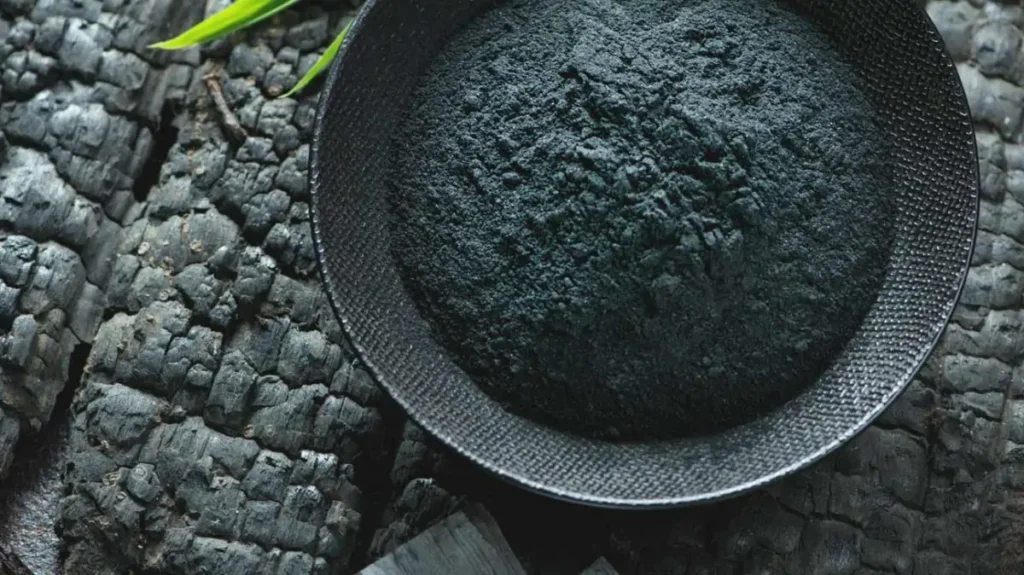
The Indian customer is a well-known activated carbon regeneration and deep-processing company, serving industries including water treatment, air purification, and gold extraction.
With increasing requirements from overseas customers for consistent particle size distribution, the customer’s existing Linear Vibrating Screen and Rotary Vibrating Screen could no longer meet production demands.
The main problems included:
- Low screening efficiency
- The existing equipment could only process 2-3 particle size grades at one time. Operators needed to frequently replace screens, resulting in high labor intensity and production delays.
- Serious screen blocking
- Activated carbon particles contain a large number of micropores. During high-frequency vibration, particles could easily become trapped in screen openings. The equipment required shutdown cleaning 2-3 times per shift.
- Dust leakage problems
- The sealing performance of the original equipment was insufficient, causing dust leakage in the workshop and failing to meet local environmental protection requirements.
The customer required a new Activated Carbon Screening Machine that could complete multi-size classification in one feeding process while ensuring continuous operation and low maintenance costs.
Sanyuantang’s Screening Solution
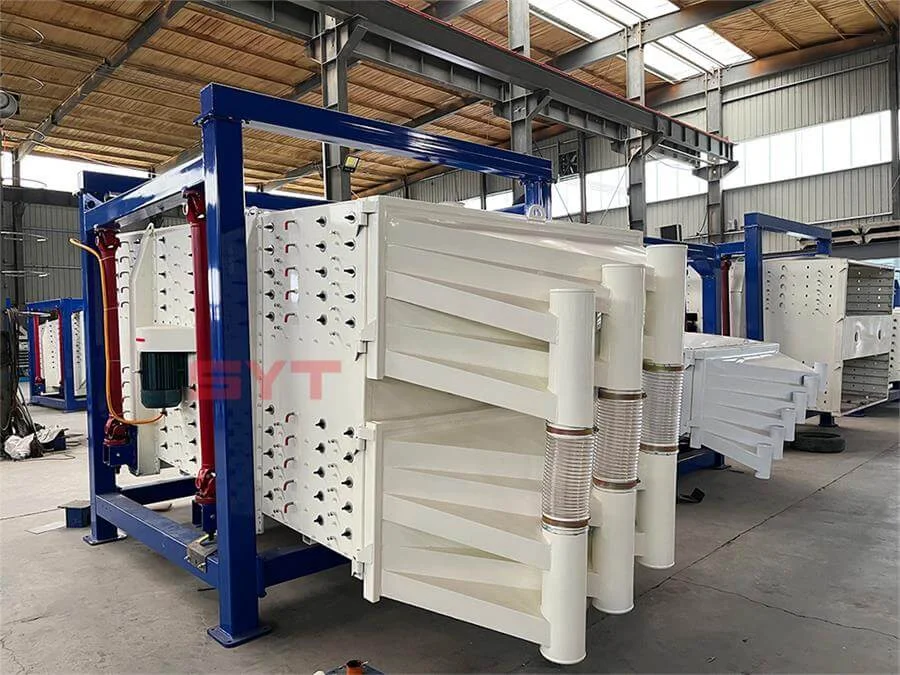
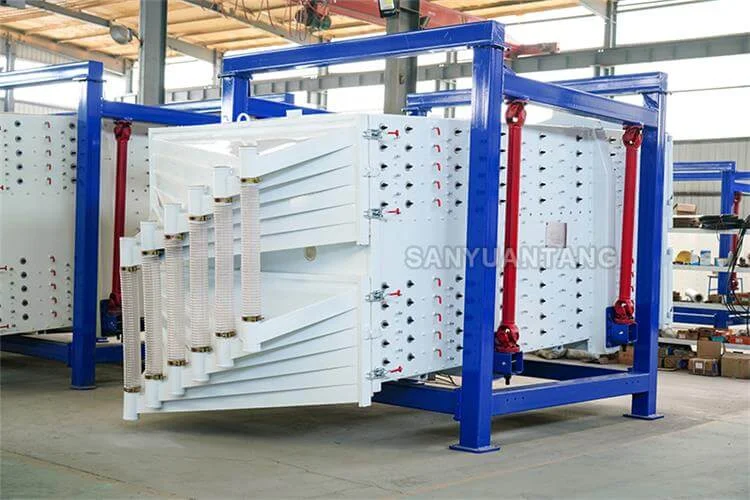
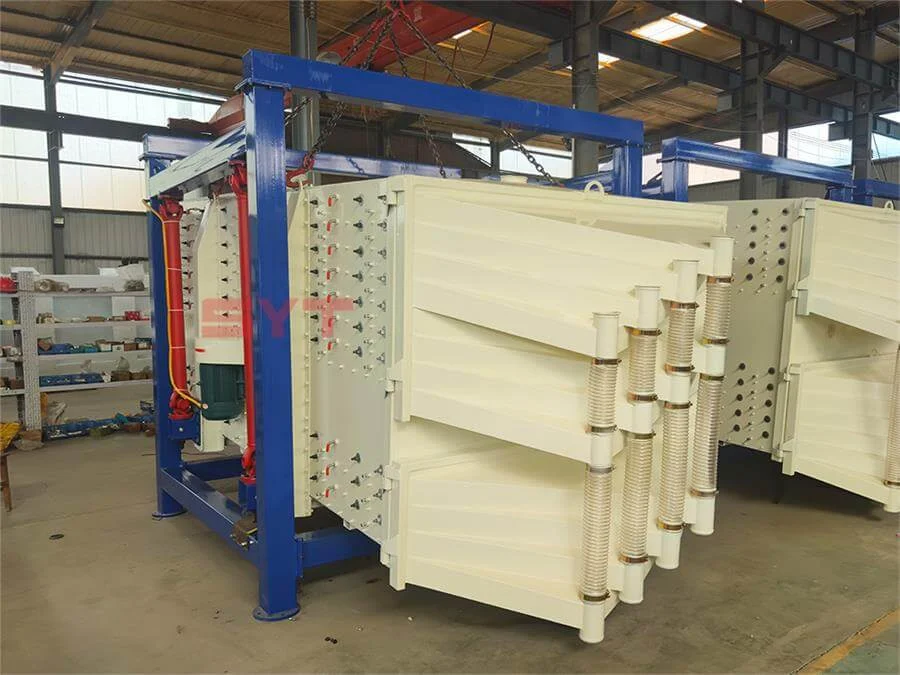
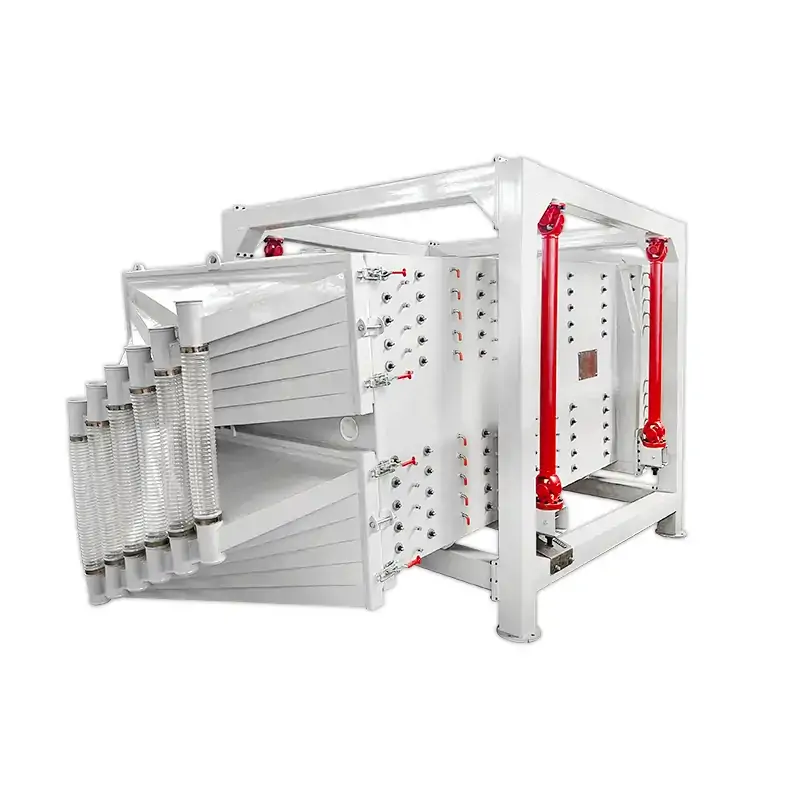
Based on the customer’s requirement of producing 8 particle size grades simultaneously, Sanyuantang recommended the FYBS-2040-8 Double Vibration Source Gyratory Screener.
Compared with conventional linear screening equipment, the gyratory screener uses a gentle circular movement combined with vertical acceleration. This screening method allows activated carbon particles to move smoothly across the screen surface, reducing particle damage while maintaining high separation efficiency.
The solution was designed specifically for activated carbon classification, including multi-layer screening, automatic screen cleaning, dust sealing, and explosion-proof protection.
Product Configuration
| Configuration | Specification / Description |
| Main Structure | Full SUS304 stainless steel construction. Material contact surfaces are mirror polished with no dead corners. |
| Screen Decks | 8-layer screen decks. Each layer uses O-ring sealing to prevent dust leakage. |
| Drive System | Double vibration motor drive with adjustable excitation force and variable frequency speed control to handle different material characteristics. |
| Anti-blocking System | Built-in elastic bouncing balls and air cleaning rings. Screen cleaning is achieved through material impact and airflow assistance. |
| Feeding Distributor | Spiral distribution device ensures uniform material feeding to the center area of the top screen surface. |
| Discharge Outlet | Each screen layer has an independent outlet. The machine provides 8 product outlets plus one fine powder outlet, with 9 total discharge ports. |
| Safety Design | Explosion-proof motor (Ex d IIB T4), grounding protection, meeting ATEX dust explosion protection requirements. |
For more product information, please refer to our product information or contact us:
Why Recommend FYBS-2040-8 Double Vibration Source Gyratory Screener?
Many customers may ask why a conventional ultrasonic vibrating screen was not selected for this application.
The reason is based on material characteristics and screening requirements.
| Comparison | Linear Vibrating Screen | Ultrasonic Vibrating Screen | FYBS-2040-8 Gyratory Screener |
|---|---|---|---|
| Screening Principle | Linear reciprocating movement | High-frequency ultrasonic vibration | Low-speed circular movement with vertical acceleration |
| Suitable Materials | Large particles and rough screening | Ultra-fine powder above 500 mesh | Granular materials, fragile particles, multi-grade classification |
| Particle Protection | Higher impact force may cause breakage | Good for fine powder, but limited for larger particles | Gentle screening with particle breakage rate below 0.5% |
| Multi-layer Screening | Usually 2-3 layers | Usually 1-2 layers | Up to 8 layers with independent discharge |
| Screen Blocking | Frequent blocking problems | Improves fine powder screening but limited for granular materials | Elastic balls and airflow cleaning reduce blockage |
| Maintenance Cost | Higher wear on bearings | Higher replacement cost for ultrasonic components | Long-life motors and quick screen replacement within 30 minutes |
Conclusion:
Because the customer needed classification from 6 mesh to 120 mesh and the material was granular activated carbon rather than pure powder, an ultrasonic vibrating screen could not fully utilize its advantages.
The FYBS-2040-8 provides a better solution through gentle gyratory screening, protecting activated carbon particle structure while achieving 8-level classification in one machine.
Before & After Comparison
| Key Performance | Before (Original Screens) | After (FYBS-2040-8) |
|---|---|---|
| Number of Particle Size Grades | Maximum 2 grades per operation, requiring screen replacement | 8 grades produced simultaneously |
| Daily Output (8 hours) | Approx. 5 tons/day due to frequent cleaning downtime | 8 tons/day with continuous operation |
| Screen Replacement Frequency | Twice per month | Once every 6 months |
| Screen Blocking Downtime | Around 2 hours per shift | Greatly reduced with automatic cleaning system |
| Workshop Dust Condition | Dust exceeded requirements, and operators needed masks | Dust leakage significantly reduced |
| Product Size Accuracy | 92% due to screen damage and mixing problems | 99.5% stable classification accuracy |
| Operators Required | 3 workers (feeding, changing screens, cleaning) | 1 operator for monitoring |
Project Results
1. Increased Production Capacity
Under the same installation area, the processing capacity increased from approximately 5 tons/day to 8 tons/day. The customer eliminated repeated screen replacement operations and achieved simultaneous production of 8 particle size grades.
2. Improved Product Quality
The extraction rate of 120 mesh fine powder remained above 92%, while activated carbon particle breakage was controlled below 0.5%. The improved screening performance helped the customer meet overseas customers’ requirements for activated carbon quality inspection.
3. Reduced Operating Cost
With screen lifetime extended from approximately 1 month to more than 6 months and lower power consumption compared with previous equipment, the customer’s overall operating cost (labor, consumables, and electricity) was reduced significantly.
4. Improved Environmental Performance
The fully enclosed structure, combined with the customer’s dust collection system, improved workshop conditions and helped the customer meet local environmental requirements for the new production facility.
Conclusion
This Indian customer project demonstrates that for high-value granular materials requiring multiple particle size classifications, the Activated Carbon Screening Machine based on gyratory screening technology provides an efficient and reliable solution.
Through customized 8-layer screening design and gentle screening movement, Sanyuantang helped the customer complete a process that previously required three separate screening machines with only one FYBS-2040-8 Double Vibration Source Gyratory Screener.
For activated carbon, molecular sieve, resin particles, and other materials requiring precise classification, Sanyuantang can provide customized screening solutions based on material characteristics, particle size distribution, and production requirements.
Email: info@sanyuantang.com
Phone: +86-18639095165
More Recommended Screening Machine

FAQs
What type of screening machine is suitable for activated carbon classification?
For activated carbon classification, a gyratory screener or multi-layer screening machine is usually more suitable than traditional linear vibrating screens. Activated carbon particles require gentle screening because excessive impact may damage particle structure and reduce product quality. The FYBS-2040-8 Double Vibration Source Gyratory Screener provides multi-level classification while maintaining particle integrity.
Can one screening machine separate activated carbon into multiple particle sizes?
Yes. A multi-layer gyratory screening machine can separate activated carbon into several particle size grades in one operation. In this case, the FYBS-2040-8 was equipped with 8 screening layers and produced 8 different activated carbon size specifications simultaneously, eliminating repeated screen replacement.
How can activated carbon screening problems such as screen blocking be reduced?
Activated carbon has porous particles that can easily block screen openings during vibration screening. Effective solutions include elastic ball cleaning systems, airflow cleaning devices, optimized vibration movement, and proper screen selection. The FYBS-2040-8 uses a combined cleaning system to reduce screen blockage and improve continuous operation.
Why is a gyratory screener better than a linear vibrating screen for activated carbon?
A gyratory screener uses a gentle circular movement combined with vertical acceleration, allowing activated carbon particles to move smoothly across the screen surface. Compared with linear vibrating screens, it provides better particle protection, higher classification accuracy, and better performance for multi-size separation.
What particle sizes can be screened by an activated carbon screening machine?
The suitable particle size range depends on the activated carbon application and production requirements. In this project, the screening range covered 6 mesh to 120 mesh, allowing the customer to produce different activated carbon grades for water treatment, air purification, and industrial applications.
How do you choose the right activated carbon screening machine?
The selection depends on several factors, including activated carbon particle size distribution, required output capacity, number of final products, moisture content, dust control requirements, and explosion protection standards. A professional screening test and equipment evaluation can help determine the most suitable solution.