
What Is a Pharmaceutical Vibratory Separator?
A pharmaceutical vibratory separator is a vibrating screening machine used to separate, grade, and remove oversized particles or impurities from pharmaceutical powders, granules, crystals, and other drug-processing materials. By applying controlled vibration to a screen surface, the equipment separates materials according to particle size while helping maintain consistent product quality.
For pharmaceutical applications, the screening equipment should be designed around material characteristics, required mesh size, cleaning requirements, contamination control, and the tendency of the material to adhere to or block the screen mesh.
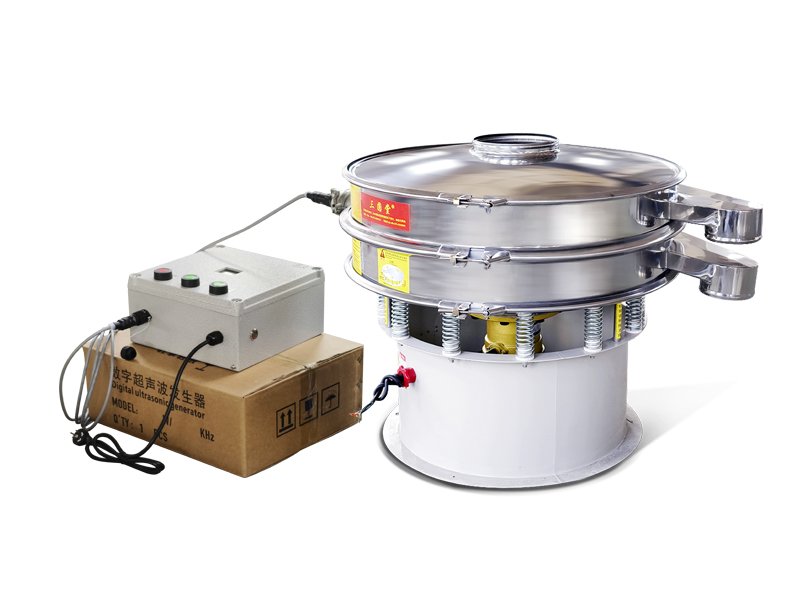
Sanyuantang provides rotary vibrating screen and ultrasonic vibrating screen solutions for pharmaceutical screening. The appropriate machine depends on whether the material is a conventional powder or granule, or a fine, sticky, electrostatic, or easily agglomerated material.



When faced with strict standards and requirements for screening drugs, the circular vibrating screen separator is essential for screening pills and powders in the pharmaceutical industry. The pharmaceutical vibratory separator provides high-efficiency and accurate screening, contributing to pharmaceutical products’ quality control and safety assurance.
Pharmaceutical Materials That Require Vibratory Screening
Pharmaceutical vibratory separators can be used for a wide range of pharmaceutical materials, depending on their particle size, moisture content, density, adhesion, and flowability. Common applications include:
- Active pharmaceutical ingredients (APIs)
- Pharmaceutical powders
- Chinese herbal medicine powders
- Pharmaceutical granules
- Drug crystals
- Excipients
- Tablets and pill-related materials
- Fine chemical and pharmaceutical intermediates
The required screening method varies by material. Free-flowing powders and granules can generally be processed with a conventional rotary vibrating screen, while ultrafine, sticky, electrostatic, or easily agglomerated powders may require ultrasonic screening to reduce screen clogging and improve screening stability.
The quality of the API determines the quality of the preparation, so its quality standards are very strict, and countries around the world have formulated strict national pharmacopeia standards and quality control methods for its widely used APIs. Usually, the screening mesh size is about 24-100 mesh, with adhesion, adsorption, and easy to block the characteristics of the net.
In the face of such strict standards, We have two pharmaceutical vibratory screener solutions: rotary vibrating screen separator and ultrasonic vibrating screen separator. They have different features, but how to choose the right vibratory separator machine for screening the drugs?
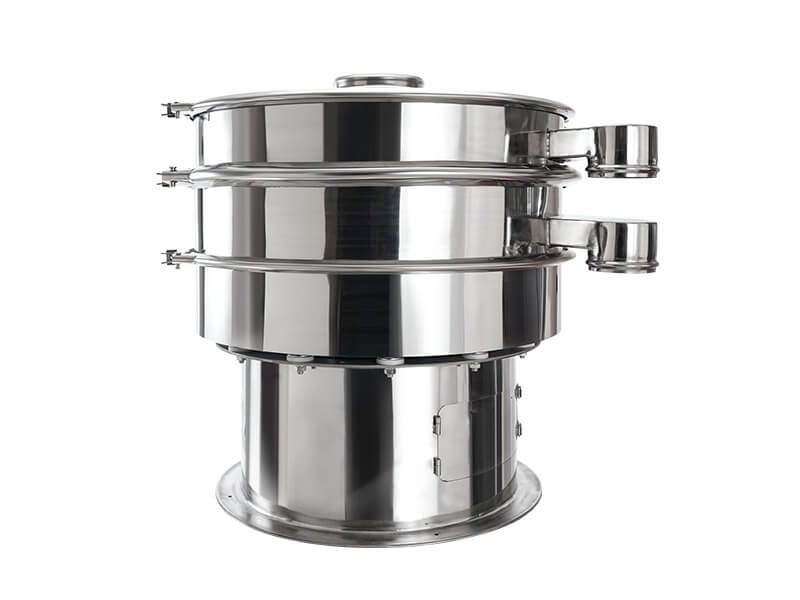
Rotary Vibrating Screen Separator
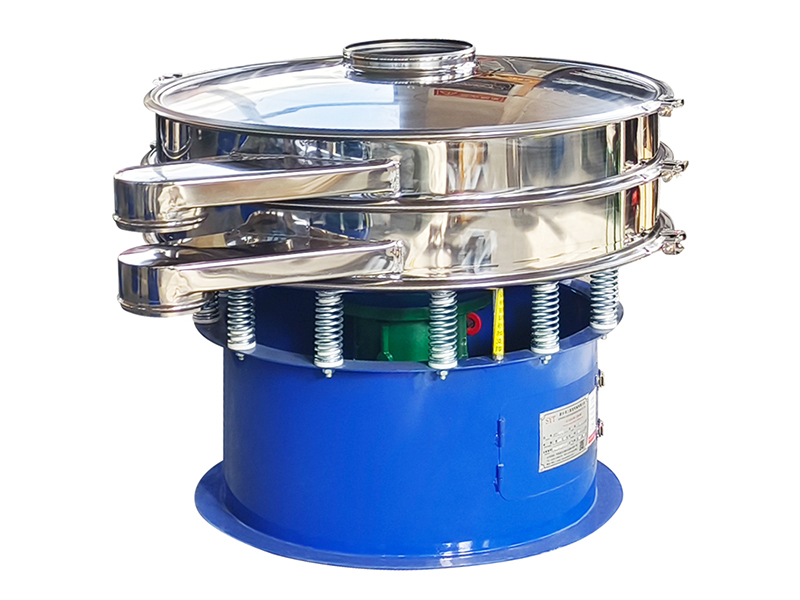
The round vibrating screen separator profile mesh frame is strictly by the ISO9001 quality management system to produce, screening efficiency is high, screen welding is smooth, uniform mesh layout, for the drug pill particle size, adhesion, API specifications are different, can effectively screen, high material pass rate. The use of stainless steel material, clean and easy to clean, can meet the production standards of the pharmaceutical industry.
Features
- High screening efficiency, compact and durable design, any powder, or mucus can be screened.
- Easy to change the net, simple operation, easy to clean.
- The stainless steel rotary vibrating screen separator fully closed structure and the powder does not fly, but also prevents the entry of pollutants.
- Can be sieved up to 500 mesh or 0.028mm. Very suitable for the screening of drugs.
Ultrasonic Vibrating Screen
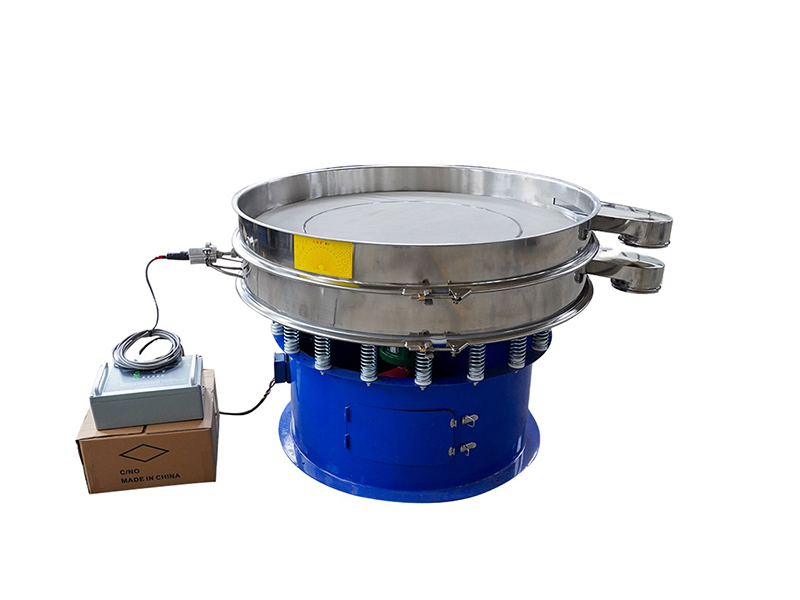
The ultrasonic vibrating screen is based on the traditional vibrating screen and then introduces a low amplitude, high-frequency ultrasonic vibration sieve (mechanical wave) on the screen superimposed on the screen a high frequency and low amplitude ultrasonic vibration meter, ultrafine powder to accept huge ultrasonic acceleration, so that the material on the screen surface always maintain a suspended state, thereby inhibiting adhesion, friction, flat fall, and other factors.
Very effectively solves strong adsorption, easy agglomeration, high static electricity, high fine, high density, light gravity, and other screening problems, so that ultrafine powder screening is no longer difficult, especially suitable for high-quality, fine powder users. It can be easily solved for the problems of easy paste, adsorption, screen blocking, and so on, and is very suitable for the screening of raw materials. It can increase the passing rate of the screen by 50%-400%.
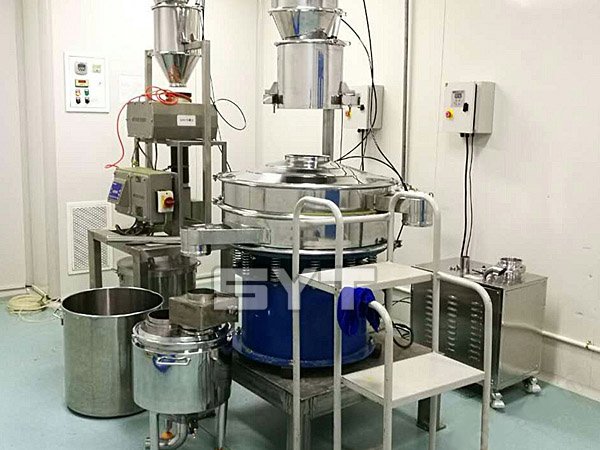
Rotary vs Ultrasonic Pharmaceutical Vibratory Separator
| Feature | Rotary Vibrating Screen | Ultrasonic Vibrating Screen |
|---|---|---|
| Pharmaceutical powders | ✓ | ✓ |
| Pharmaceutical granules | ✓ | ✓ |
| Conventional screening | ✓ | ✓ |
| Ultrafine powders | Good | Excellent |
| Sticky powders | Limited | Better |
| Electrostatic powders | Limited | Better |
| Screen clogging | Possible | Reduced |
| Fine mesh screening | ✓ | ✓ |
| High-precision fine powder screening | Good | Excellent |
| Best suited for | General pharmaceutical screening | Difficult-to-screen fine powders |
How to Choose a Pharmaceutical Vibratory Separator
The right pharmaceutical vibratory separator should be selected according to the material properties and screening requirements rather than simply by machine size.
Choose a Rotary Vibrating Screen When:
- The pharmaceutical material is relatively free-flowing
- The material is not highly adhesive
- Conventional powder or granule screening is required
- Standard particle-size separation is the main objective
- Easy cleaning and simple screen replacement are important
Choose an Ultrasonic Vibrating Screen When:
- The powder is ultrafine
- The material tends to stick to the screen mesh
- Screen clogging occurs frequently
- The material has high electrostatic properties
- Fine particles agglomerate during screening
- More stable fine-powder screening is required
For pharmaceutical screening projects, Sanyuantang can recommend the appropriate screening configuration according to the material type, particle size, mesh specification, moisture, screening capacity, and screening difficulty.
Pharmaceutical Screening Examples
| Material | Mesh | Method | Capacity |
|---|---|---|---|
| Medicinal powder | 80 mesh | Dry | 550 kg/h |
| Nucleotide | 150 mesh | Dry | 2100 kg/h |
| Panax notoginseng powder | 120 mesh | Wet | 1300 kg/h |
| Pharmaceutical granules | 40 mesh | Dry | 3500 kg/h |
| Drinking pieces | 100 mesh | Dry | 5000 kg/h |
Conclusion
Both vibrating screens offer advantages in different situations, and the choice between them will depend on the specific characteristics of the APIs being screened and the requirements of the pharmaceutical process. We should carefully evaluate the specific needs of our customers to determine the most suitable screening scheme for them, to recommend the most suitable model of machine.
Email: info@sanyuantang.com
Phone: +86-18639095165
FAQs
What is a pharmaceutical vibratory separator used for?
A pharmaceutical vibratory separator is used to screen and separate pharmaceutical powders, granules, APIs, crystals, and other materials according to particle size. It can also help remove oversized particles and impurities before subsequent pharmaceutical processing.
Which vibratory separator is best for pharmaceutical powders?
A rotary vibrating screen is suitable for many free-flowing pharmaceutical powders and granules. For ultrafine, sticky, electrostatic, or easily agglomerated powders, an ultrasonic vibrating screen is generally more suitable because ultrasonic vibration can help reduce screen clogging and particle adhesion.
Can a pharmaceutical vibratory separator screen APIs?
Yes. Pharmaceutical vibratory separators can be configured for API screening according to the API’s particle size, flowability, mesh requirement, and screening capacity. Fine or difficult-to-screen APIs may benefit from ultrasonic screening.
What mesh size is used for pharmaceutical screening?
The required mesh size depends on the pharmaceutical material and the target particle size. Pharmaceutical screening applications may use different mesh specifications for powders, granules, APIs, and other materials. The mesh should be selected according to the actual particle-size distribution and process requirements.
How can pharmaceutical powder screen clogging be reduced?
Screen clogging can be reduced by selecting the appropriate mesh, controlling material feed rate, and using suitable screen-cleaning methods. For ultrafine, sticky, or electrostatic powders, an ultrasonic vibrating screen can help reduce particle adhesion and improve material passage through the mesh.
How does Sanyuantang select a pharmaceutical vibratory separator?
Sanyuantang selects the screening machine according to the material type, particle size, moisture, flowability, mesh specification, required capacity, and screening difficulty. Material screening tests can also be used to determine a suitable machine configuration before final selection.
More Products
Related Articles
- The Role Of Sieving Machine In Pharmaceuticals
- Pharmaceutical Screening Equipment: Efficient Particle Separation for the Pharmaceutical Industry
- The Comprehensive Guide To Pharmaceutical Vibro Sifter: Working Principles, Uses, And Types
- Circular Vibrating Screen Separator In Pharmaceutical
- Different Types Of Vibrating Screens And Price