If you are checking a vibrating screen and need to know its actual amplitude, the first thing to clarify is what your measurement represents. Is it single amplitude? Double amplitude? Stroke? Acceleration? These values are related, but they are not the same thing.
For the simplest case, when you already know the double amplitude or peak-to-peak displacement:
Amplitude = Double Amplitude ÷ 2
For example: if the measured double amplitude is 8 mm, the vibration amplitude is 4 mm. But that is only one way to calculate it. If you are working with an acceleration or vibration analyzer, the calculation is different.
This guide explains how to calculate amplitude of vibrating screen, how to measure it in the field, and how to tell whether the amplitude is suitable for the screening application.
What Is Vibrating Screen Amplitude?
Vibrating screen amplitude is the maximum distance that the screen moves away from its normal equilibrium position during vibration. It is usually expressed in millimeters (mm).
A simple way to picture it is this: imagine marking the normal position of the screen box. During operation, the box moves above and below that position. The distance from the center position to the maximum displacement is the amplitude.

The total movement from one extreme position to the other is twice the amplitude.
| Term | Meaning |
|---|---|
| Amplitude | Maximum displacement from the equilibrium position |
| Double amplitude | Total peak-to-peak displacement |
| Stroke | Commonly used to describe total movement in vibrating equipment |
| Frequency | Number of vibration cycles per second |
| Acceleration | Rate of change of vibration velocity |
This distinction matters when you compare a manufacturer’s specification with a field measurement.
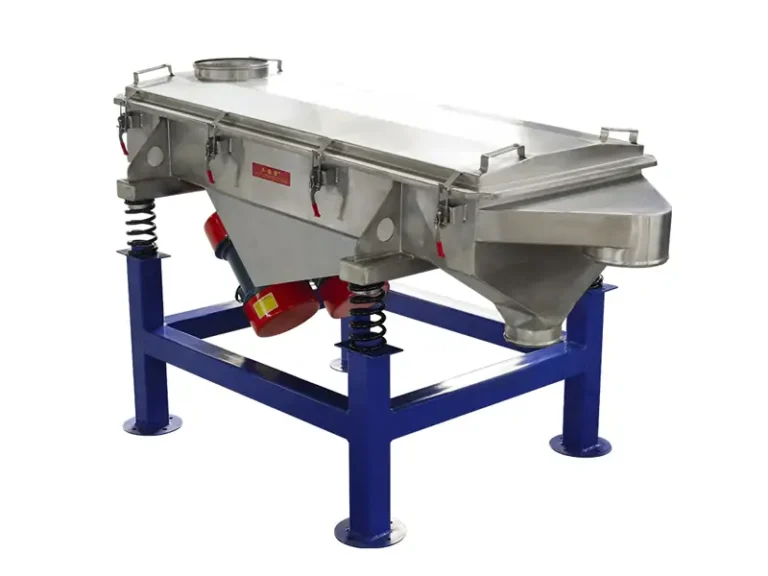
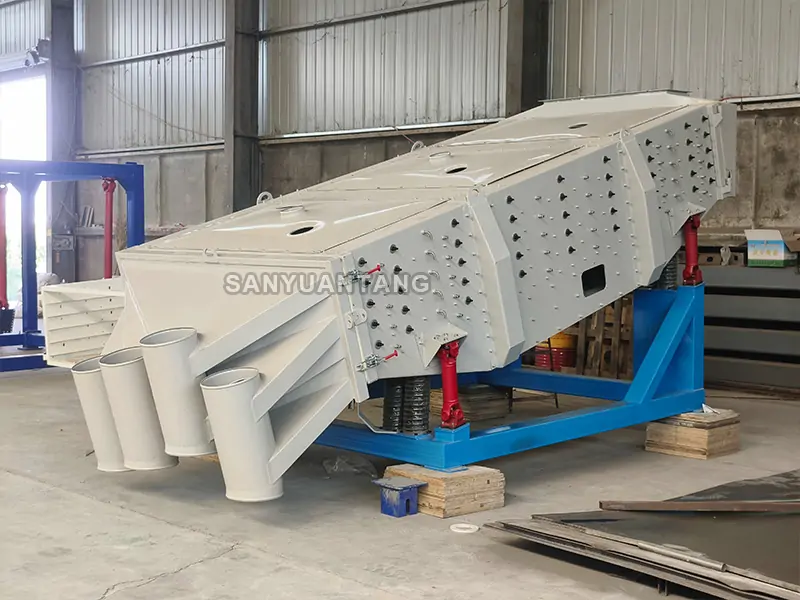
For example, Sanyuantang’s Linear Vibrating Screen specifications list an amplitude of 1–4.5 mm for the listed models, together with a shake frequency of 960 times/minute.
That 1–4.5 mm figure should not automatically be treated as a universal amplitude range for every vibrating screen. Different screen structures and applications use different vibration parameters.
How to Calculate Amplitude of Vibrating Screen
There are several calculation methods. Which one you use depends on the information available from the machine or your measuring instrument.
Method 1: Calculate Amplitude from Double Amplitude
This is the easiest method.

If you know the total peak-to-peak displacement, use: A = S ÷ 2
Where:
- A = amplitude
- S = double amplitude or peak-to-peak displacement
Example: Suppose the measured double amplitude is 10 mm.
Then: A = 10 ÷ 2, A = 5 mm,So the vibrating screen amplitude is 5 mm.
Here is another quick reference:
| Double Amplitude / Stroke | Single Amplitude |
| 4 mm | 2 mm |
| 6 mm | 3 mm |
| 8 mm | 4 mm |
| 10 mm | 5 mm |
| 12 mm | 6 mm |
| 16 mm | 8 mm |
This is usually the most straightforward calculation when you have a displacement measurement.
Method 2: Calculate Amplitude from Acceleration and Frequency
Sometimes a vibration analyzer does not give you displacement directly. Instead, you may have acceleration and frequency.
For approximately sinusoidal vibration:
A = a / (2πf)²
Where:
- A = amplitude in meters
- a = peak acceleration in m/s²
- f = vibration frequency in Hz
The relationship comes from:
ω = 2πf and: a = Aω² So: A = a / ω²
Example: Suppose a vibrating screen is operating at 16 Hz, and the measured peak acceleration is 10 m/s².
- First: ω = 2 × π × 16 ≈ 100.53 rad/s
- Then: A = 10 / 100.53²
- The result is approximately: A = 0.00099 m or: A ≈ 0.99 mm
This method is useful when the measurement system gives you acceleration instead of displacement.
One caution: this calculation assumes the vibration can be reasonably represented as sinusoidal motion. Real vibrating screens can have more complicated motion, especially when load, screen structure, eccentric weights, and supporting components are involved.
Method 3: Calculate Amplitude from Vibration Velocity
If your vibration analyzer gives maximum vibration velocity, amplitude can also be calculated.
The formula is: A = Vmax / 2πf
Where:
- A = amplitude
- Vmax = maximum vibration velocity
- f = vibration frequency
This can be useful during equipment inspection when a vibration monitoring instrument provides velocity and frequency rather than displacement.
Before doing the calculation, check whether the instrument reports peak, RMS, or peak-to-peak values. Mixing these definitions can produce a result that looks reasonable but is actually wrong.
How to Measure Vibrating Screen Amplitude in the Field
Calculation is useful, but in many cases you do not need to calculate amplitude from scratch. You can measure the machine directly.
For routine inspection, an amplitude gauge can give you a quick indication of screen movement. For more detailed diagnosis, a vibration analyzer can provide displacement, acceleration, velocity, and frequency.
A practical measurement should answer three questions:
- Where was the measurement taken?
- What parameter did the instrument report?
- Is the value peak, RMS, or peak-to-peak?
Without these details, two people can measure the same machine and report different numbers.
A simple example
Suppose an analyzer reports: Peak-to-peak displacement = 8 mm
Then: Amplitude = 8 ÷ 2 = 4 mm
If another instrument reports 4 mm amplitude, the two measurements may actually be describing the same machine.
The problem is not the machine. It is the way the data is being reported.
Vibrating Screen Amplitude vs. Stroke
This is one of the points that causes the most confusion.
In many vibrating screen discussions, stroke is used to describe the total movement of the screen, while amplitude describes the movement from the center position to one extreme.

So, for symmetrical vibration: Stroke ≈ 2 × Amplitude
Therefore: Amplitude ≈ Stroke ÷ 2
For example:
| Measured Stroke | Approx. Amplitude |
| 5 mm | 2.5 mm |
| 8 mm | 4 mm |
| 10 mm | 5 mm |
| 14 mm | 7 mm |
Always check the terminology used in the machine manual or technical drawing before comparing specifications.
Vibrating Screen Amplitude vs. Frequency
Amplitude and frequency are often mentioned together, but they describe different parts of the vibration.
- Amplitude tells you how far the screen moves.
- Frequency tells you how often it moves.
Frequency is usually expressed in Hz, RPM, or cycles per minute.
For example, Sanyuantang’s Linear Vibrating Screen specifications list a shake frequency of 960 times/minute and an amplitude of 1–4.5 mm for the listed models.
The two parameters should not be treated as interchangeable.
A screen running at a higher frequency does not automatically have a higher amplitude. Likewise, increasing amplitude does not automatically improve screening.
The useful operating point comes from the combination of the vibration system, screen design, material, and process requirements.
What Determines Vibrating Screen Amplitude?
If the amplitude changes unexpectedly, do not look at the motor alone.
Several parts of the machine can affect the actual vibration.
| Factor | Possible effect on vibration |
|---|---|
| Vibrating motor | Provides the excitation force |
| Eccentric weights | Changes the excitation characteristics |
| Screen load | Changes the dynamic response |
| Springs | Support the screen body and affect its vibration behavior |
| Frequency | Changes the relationship between displacement, velocity, and acceleration |
| Screen structure | Affects how vibration is transmitted through the machine |
| Material properties | Change how the material reacts to the vibration |
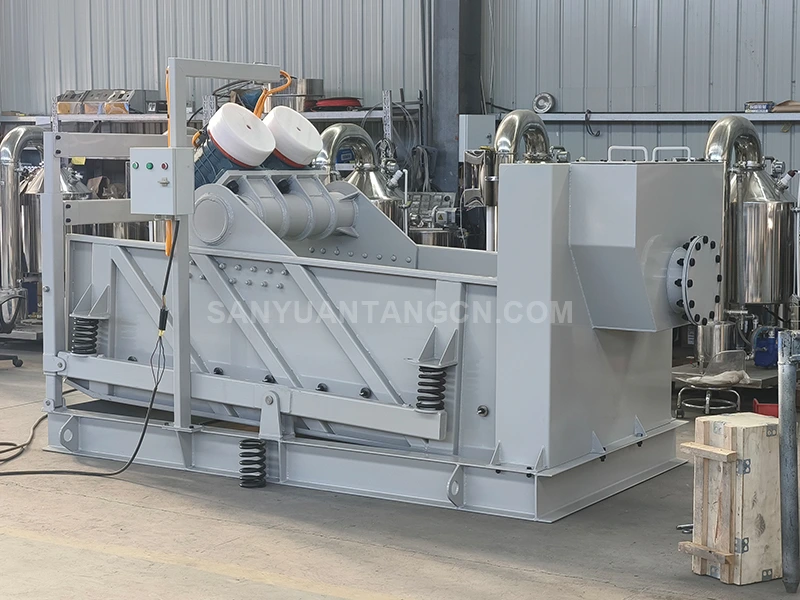
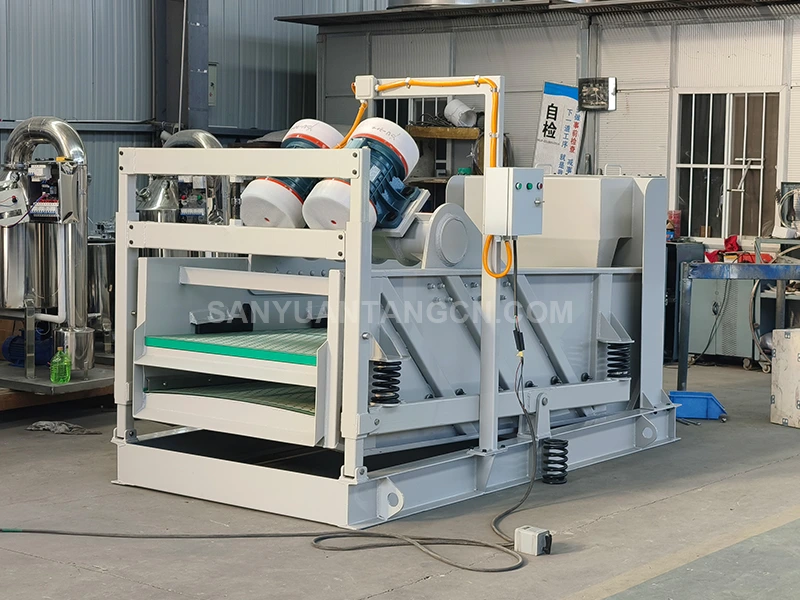
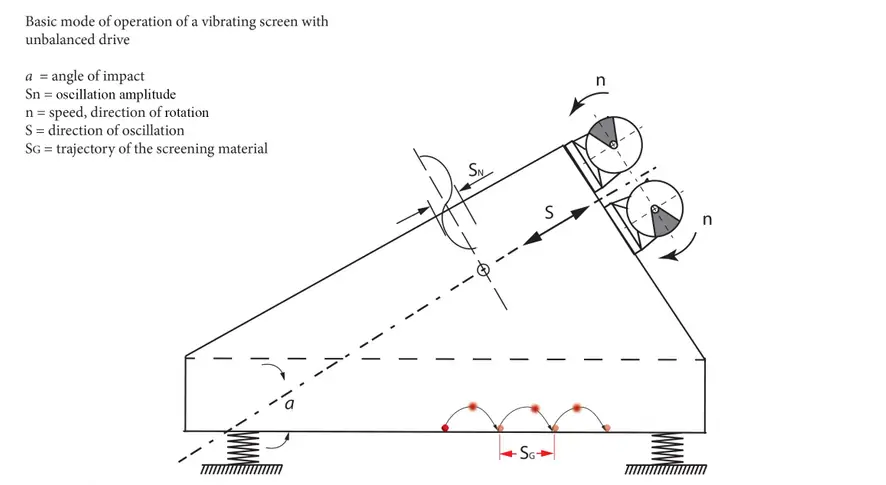
On a linear vibrating screen, for example, Sanyuantang uses two vibrating motors that rotate synchronously in opposite directions. Their eccentric forces combine to produce the linear movement of the screen box. That is why simply saying “increase the motor speed to increase amplitude” is not a good general rule.
Does Higher Amplitude Mean Better Screening?
Not necessarily.
This is worth pointing out because it is a common assumption.
A larger amplitude can give the material a stronger movement across the screen, which may be useful for certain coarse or difficult-to-move materials. But if the amplitude becomes too large for the machine or application, the movement can become unnecessarily aggressive and mechanical loading can increase.
On the other hand, if amplitude is too small, material may move too slowly or fail to stratify properly.
So the better question is not: “What is the highest amplitude I can use?”
It is:“What amplitude works with this screen, this material, and this feed rate?”
That is a much more useful engineering question.
What Happens When Vibrating Screen Amplitude Is Too Low?
If amplitude is too low for the application, you may see:
- Slow material movement
- Poor stratification
- Lower screening capacity
- Material staying on the screen for too long
- Reduced use of the available screen area
For a dewatering screen, insufficient amplitude can also affect the separation of water from the solids.
Sanyuantang notes that when the amplitude of a high-frequency dewatering screen is too small, dewatering efficiency and capacity can be affected. Its troubleshooting guidance recommends checking factors such as eccentric-wheel settings, vibration-damping springs, and excessive material accumulation on the screen surface.
So if a dewatering screen suddenly performs worse, changing the amplitude is only one possible solution. Check the rest of the machine first.
What Happens When Vibrating Screen Amplitude Is Too High?
Excessive amplitude can cause problems as well.
Possible symptoms include:
- Excessive material movement
- Unstable material distribution
- Higher mechanical loading
- Increased stress on supporting components
- Abnormal noise or vibration
- Faster wear of some components
If the screen suddenly develops unusually large movement, do not simply reduce or increase the eccentric weight until the machine “looks normal.”
Check the excitation system, springs, fasteners, bearings, screen box, and operating load.
If abnormal vibration is accompanied by unusual noise, overheating, or structural movement, stop and inspect the equipment before continuing operation.
What Is the Typical Amplitude of a Vibrating Screen?
There is no single amplitude that applies to all vibrating screens.
The appropriate value depends on the type of machine and what it is screening.
For example, Sanyuantang’s published Linear Vibrating Screen data lists 1–4.5 mm amplitude for the listed models.
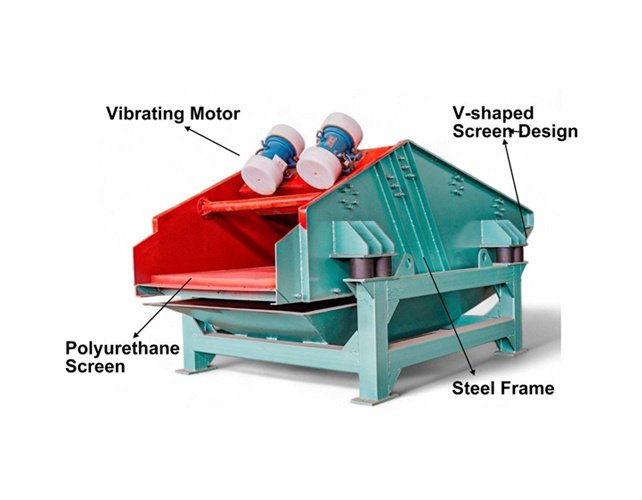
Its Dewatering Vibrating Screen specifications list 2–8 mm adjustable amplitude, with the exact operating condition depending on the equipment configuration and application.
| Sanyuantang equipment | Published amplitude information |
| Linear Vibrating Screen | 1–4.5 mm |
| Dewatering Vibrating Screen | 2–8 mm adjustable |
These numbers are useful as real equipment examples, but they should not be copied into a project specification without checking the actual machine model and material conditions.
How to Adjust Vibrating Screen Amplitude
The adjustment method depends on the type of vibrating screen.
For machines using eccentric weights, changing the eccentric configuration can change the excitation characteristics and therefore the resulting vibration.
Sanyuantang’s dewatering screen documentation specifically describes the amplitude as adjustable through the eccentric weights.
Before making an adjustment, check:
- Current amplitude
- Operating frequency
- Motor condition
- Eccentric-weight position
- Material load
- Spring condition
- Screen inclination
- Manufacturer’s recommended operating range
For a machine with two vibrating motors, both motors must be adjusted consistently. Otherwise, the screen may lose its intended vibration trajectory.
If you are unsure about the correct setting, it is better to provide the manufacturer with the material, feed rate, particle size, moisture, required separation size, and current machine parameters rather than changing the excitation force by trial and error.
Vibrating Screen Amplitude Troubleshooting
If the measured amplitude does not match the expected value, start with the basics.
| Problem | What to check first |
| Amplitude too low | Eccentric setting, motor, load, springs |
| Amplitude too high | Eccentric setting, load, supporting components |
| Uneven vibration | Motor synchronization, springs, screen box level |
| Material moves too slowly | Amplitude, frequency, inclination, feed rate |
| Material jumps too aggressively | Amplitude, frequency, feed rate |
| Dewatering performance drops | Amplitude, screen condition, material loading, inclination |
| New abnormal vibration | Bolts, bearings, springs, excitation system |
Sanyuantang’s own troubleshooting information also points to loose connecting bolts, uneven feeding, screen-box rigidity, spring conditions, and abnormal vibration as possible causes of poor material flow.
In other words, amplitude is often a symptom, not necessarily the root cause.
How Sanyuantang Selects Vibrating Screen Amplitude
For a new screening project, it is usually not enough to say:
“I need a vibrating screen with 5 mm amplitude.”
The machine needs to be matched to the material and process.
Sanyuantang asks for information such as:
- Material name
- Particle size
- Moisture
- Bulk characteristics
- Required capacity
- Separation size
- Number of fractions
- Screen mesh or opening
- Installation conditions
The company states that its engineers can customize screening and conveying equipment according to material, humidity, particle size, output, and other production requirements. Sanyuantang also offers material testing and machine trials before final equipment selection.
That approach makes sense because amplitude cannot be selected independently from the rest of the vibrating screen.
For example, the requirements for screening dry quartz sand are not necessarily the same as those for wet sand dewatering, chemical powder classification, pharmaceutical granules, or wood chips.
Sanyuantang currently provides several types of screening equipment, including Linear Vibrating Screen, Tumbler Screening Machine, Rotary Vibrating Screen, Ultrasonic Vibrating Screen, Gyratory Screen, and other customized screening equipment.
Quick Reference: Amplitude Selection Factors
| Project factor | Why it matters |
| Material size | Affects material movement and stratification |
| Moisture | Wet material can behave very differently from dry material |
| Capacity | Influences material loading on the screen |
| Separation size | Determines the required screening conditions |
| Screen type | Different machines use different motion characteristics |
| Frequency | Works together with amplitude |
| Screen inclination | Changes material residence time and conveying |
| Excitation system | Determines the machine’s vibration force |
So, when Sanyuantang engineers select a vibrating screen, amplitude is treated as part of the overall machine design rather than as an isolated specification.
FAQs
How do you calculate the amplitude of a vibrating screen?
If double amplitude or peak-to-peak displacement is known, divide it by two:
Amplitude = Double Amplitude ÷ 2
If acceleration and frequency are known, for approximately sinusoidal vibration:
A = a / (2πf)²
What is the difference between amplitude and stroke?
Amplitude is the maximum displacement from the equilibrium position. Stroke is commonly used to describe the total movement from one extreme to the other. For symmetrical vibration, stroke is approximately twice the amplitude.
How do you measure vibrating screen amplitude?
You can use an amplitude gauge, displacement measurement device, or vibration analyzer. When using an analyzer, check whether the reported value is peak, RMS, or peak-to-peak.
What is a normal vibrating screen amplitude?
There is no universal value. It depends on the screen design and application. For example, Sanyuantang lists 1–4.5 mm for its Linear Vibrating Screen models and 2–8 mm adjustable amplitude for its Dewatering Vibrating Screen.
Does increasing amplitude increase screening capacity?
It can affect material movement and capacity, but increasing amplitude is not automatically the right way to increase output. Feed rate, frequency, screen opening, material properties, screen inclination, and machine design also matter.
Can vibrating screen amplitude be adjusted?
On some machines, yes. The adjustment method depends on the excitation system. For Sanyuantang’s dewatering screen, the published specifications identify the amplitude as adjustable through eccentric weights.
Why is my vibrating screen amplitude different from the specification?
First check whether you are comparing the same measurement definition. One value may be single amplitude while another is double amplitude or peak-to-peak displacement. Then check operating frequency, material load, eccentric settings, springs, motors, and other vibration-system components.
Final Takeaway
If you only remember one formula from this article, use this one:
Amplitude = Double Amplitude ÷ 2
But don’t stop there.
When diagnosing a real vibrating screen, you also need to know how the vibration was measured, what the frequency is, what the screen is processing, and whether the machine is operating within its designed range.
For Sanyuantang vibrating screens, amplitude is one part of the equipment configuration. The actual machine should be selected according to the material, particle size, moisture, capacity, separation requirements, and operating conditions.
If you are unsure what amplitude your application needs, providing those process details to a vibrating screen manufacturer is usually more useful than choosing a number first and trying to make the machine fit it.
Sanyuantang has been focused on screening and conveying equipment since 1994 and provides customized screening solutions based on actual material and production requirements.
Email: info@sanyuantang.com
Phone: +86-18639095165